
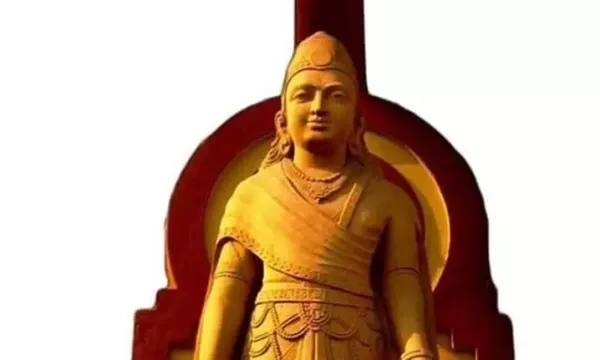

Power, when pursued only for personal elevation, rarely leaves behind moral memory. But power shaped by discipline, counsel and purpose can become an instrument of civilisational consolidation.
In the life of Chandragupta Maurya, Bharat's civilisational memory preserves not merely the story of an emperor, but the journey of a young man who rose through adversity, accepted guidance, built institutions and eventually understood that authority too must remain subordinate to duty. His life speaks not only to rulers and administrators, but to every individual who seeks to transform difficulty into direction, ambition into responsibility and success into service.
Chandragupta Maurya, founder of the Mauryan Empire, ruled for 24 years, from 321 BCE to 297 BCE (according to the testimony of the Puranas and the Buddhists). He emerged at a time when internal political decay (declining kingdoms like the Nandas) coincided with external disruption (Greek incursions and instability after Alexander). This unique convergence allowed him, guided by Chanakya, to dismantle existing powers and establish the Mauryan Empire that was one of the earliest and most powerful models of political unity and administrative order. There are many lessons to be learnt from his journey and I would like to share a few that had the greatest impact on me.
The first of these lessons is that greatness is seldom born in comfort. It is formed through endurance, correction and the willingness to be shaped by demanding circumstances. For the young professionals, leaders and institutions, this lesson carries enduring relevance. One's origin or circumstances are not the final measure of one's capacity. A life of meaning begins when the individual refuses to surrender to limitation and instead converts difficulty into inner resolve and becomes worthy of responsibility before claiming authority.
At the centre of this transformation stands Chanakya, also remembered as Kautilya, one of the most formidable minds in Indian political thought. The relationship between Chandragupta and Chanakya is not merely a tale of strategy alone. It is a deeper example of mentorship, discipline and the shaping of raw potential. Chandragupta possessed courage and ambition, but Chanakya gave these qualities direction, structure and purpose. In this relationship lies a timeless lesson that talent without guidance can become scattered, while wise counsel gives ambition a moral and strategic framework. No leader, however gifted, grows in isolation. The willingness to learn, to listen, to be corrected and to submit personal impulse to disciplined training is itself a mark of strength.
This has clear relevance for modern life. In families, institutions, public service and corporate environments, mentorship remains one of the most valued sources of transformation. A capable person may rise quickly, but without wise counsel, that ascent can lose direction. The mind that refuses correction eventually becomes captive to its own self-interest. Ethical leadership begins with the humility to recognise that knowledge and perspective before they can be exercised.
The fall of the Nanda dynasty, often perceived as oppressive due to heavy taxation and centralised power structures, and the rise of the Mauryan, assumes special relevance when understood through the lens of responsibility. Chandragupta's achievement was not simply that he defeated an existing order that was flawed, but that he helped establish a new one. This distinction is important. Destruction alone is never leadership. True leadership lies in the capacity to replace instability with order, fear with confidence and fragmentation with coherence. In this sense, Chandragupta's life teaches that power becomes ethical and meaningful only when it serves a purpose larger than personal victory. Authority must create security, justice, administration and continuity. Without these, success remains incomplete.
His leadership also demonstrates the moral value of disciplined courage. Courage is often imagined as bold action in moments of danger, but Chandragupta's life suggests a more mature understanding. Courage also lies in waiting, preparing, learning and choosing the right moment. It lies in accepting hardship without losing direction and facing well-entrenched forces without surrendering to intimidation. Anger can never be a strategy and impatience is not strength. This kind of courage is essential in every age and situation. Leaders are often judged by speed, visibility and forcefulness, but enduring leadership requires composure. The ability to act decisively must be balanced by the wisdom to act at the right time and for the right reason.
Perhaps Chandragupta's greatest leadership lesson lies in institution-building. He is remembered not merely because he rose to power in adverse circumstances, but because he helped establish one of the most significant imperial structures in Indian history. The Mauryan achievement was not limited to conquest. It involved administration, organisation, governance, economic management, security and political integration. This is where his example becomes especially relevant to modern leadership. A true leader does not build only around himself. He builds systems that outlast him. Personal charisma may create excitement, but institutions create continuity. Personal success may win admiration, but institutional strength creates legacy.
This distinction matters deeply in contemporary corporate life. Individuals may seek recognition but a legacy is created by committing oneself to building processes, teams, structures and cultures that endure beyond their presence. Chandragupta's example reminds us that leadership should not become personality-driven. It must mature into architecture. The test of leadership is not only what happens while the leader is present, but what remains functional, ethical and stable when he is absent. In this lies the difference between temporary dominance and lasting contribution.
Chandragupta's engagement with the wider world also reflects strategic maturity. The political environment during this period was complex. The north-western frontier required both reinforcing and diplomatic management. Seleucus I Nicator, a former general under Alexander, became one of the Diadochi (successors) and founded the Seleucid Empire, stretching from Syria to parts of Central Asia. Chandragupta's dealings with him are often remembered as an example of realism in statecraft. The two entered into a Treaty of remarkable pragmatism, even exchanging envoys, and avoided conflict. The lesson here is not merely strategic success, but the ability to convert conflict into settlement and uncertainty into advantage. Mature leadership does not confuse aggression with strength. It understands when to resist, when to negotiate and when to transform confrontation into a durable order.
Yet the most profound moral lesson from Chandragupta's life may come not from his rise, but from the way tradition remembers his final years. In his later years, Chandragupta Maurya is widely believed to have turned toward asceticism and spiritual renunciation, most strongly associated with the Jain tradition. Whether approached as history, tradition or civilisational memory, this final movement gives his life a rare completeness. The same figure who acquired immense power is remembered also for stepping away from it. This introduces a deep Indian understanding of greatness. Power is not the highest end of life. It must eventually be measured against inner conquest, detachment and moral accountability.
In this, Chandragupta becomes more than a conqueror. He becomes an example of the full arc of human aspiration that includes struggle, discipline, achievement, service and renunciation. His life teaches that ambition is not wrong when it is disciplined by duty. Strength is not dangerous when it is restrained by ethics. Authority is not corrupting when it remains accountable to a larger moral order. But ambition without restraint, strength without conscience and authority without humility can weaken even the most capable individual.
Chandragupta Maurya offers a complete framework of life and leadership. The lessons drawn here do not capture the full measure of his journey, but they are among the ones that leave the deepest impression. The young must learn to rise above circumstance, the ambitious must seek guidance, the powerful must build institutions, the strategic mind must remain anchored in purpose and the successful must remember that achievement is not the final measure of life. In the end, Chandragupta's enduring relevance lies not only in the empire he built, but in the values his life continues to provide. Discipline before power, duty before ambition, counsel before ego and moral purpose before personal glory.
Views expressed are personal. The writer is Chairperson Bharat Ki Soch