
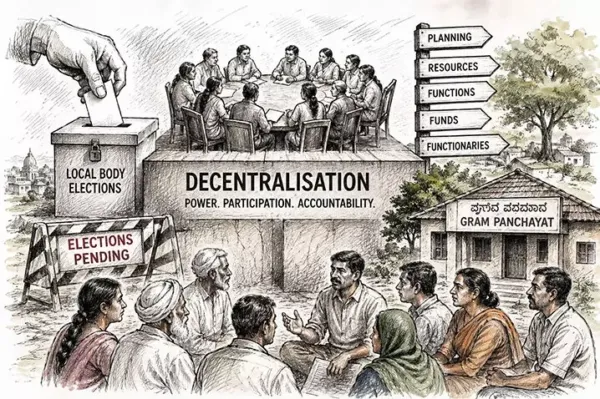

Based on the announcement made by the Chief Minister of Karnataka in the Legislative Assembly that Karnataka is going for a big push in Decentralization, as it has been done in Kerala after the enactment of the 73rd Amendment to the Constitution of India, a committee has been set up to take steps to operationalise the Decentralisation efforts by building a mass movement through the People's Plan Campaign.
This being the intention, the logical question is why Karnataka is not conducting elections to Local bodies, as it is in the manifesto of the Indian National Congress that the 73rd Amendment to the Constitution of India be implemented in letter and spirit. In the whole of India, Kerala is the only state conducting elections to local governments on time. All other states are reluctant to conduct elections for local governments. The committee has initiated a preliminary discussion with experienced persons in Decentralisation and with the officials who are going to be the torch bearers of this initiative, at Mysuru State Institute of Rural Development and Panchayati Raj from April 8-10. A person who has spent 30 years in the same domain with a deep sense of commitment and part of the people's plan campaign in Kerala narrated the whole experience of Kerala and made a plea that Karnataka can take certain aspects from Kerala and carve out a framework suitable for this state.
It is to be remembered that Karnataka is a pioneer in Decentralisation in the 80s under the leadership of Ramakrishna Hegde, which inspired Rajiv Gandhi to formalise a local government system in the whole of India on a sustainable basis. Kerala was the last state to enact conformity legislation to the 73rd Amendment to the Constitution of India. But it becomes a leading state in empowering Local Government. Hence, all over the country, experts are drawn from Kerala to empower the Local Governance system and women's Self Help Groups. In such a way, Kerala has been positioned to empower the citizens. Karnataka need not seek any experience from any other state as it has its own history of empowering people, which is more progressive than the 73rd Amendment to the Constitution of India," observed by none other than the person who drafted the Panchayati Raj Bill in Karnataka under Ramakrishna Hegde and the 73rd Amendment bill to the Constitution of India under PV Narasimha Rao, former Prime Minister and Rural Development Minister. When the whole discourse was on one major observation, everyone was making the point that if the Rural Development and Panchayati Raj Minister evinces interest in this exercise, Karnataka will show the way to other states in such a way that people's movement could be built up in Karnataka, as the state still maintains a culture of harmony, which is not prevalent in many other states. One critical issue raised by many experts is that in the absence of Local Bodies, who will take responsibility at the ground for all such initiatives to mobilise people and sustain the momentum till the preparation of the participatory people's plan.
There are issues in the process of implementing the announcement of the Chief Minister, as there is a gap between the Karnataka Panchayati Raj and Gram Swaraj Act and the present-day practices of Local Governance in Karnataka. A series of steps is needed at the state level to remove the obstacles in implementing the state Act in letter and spirit. Further, the bureaucracy has to be oriented to a new culture of working with elected representatives of the people at the grassroots.
There is yet another point which is also being discussed. Whenever a new initiative is taken at the state government level, the party in power looks at what political mileage it could get out of the new initiative. Nowhere has it been proved that by empowering people, the party would get substantial support from the people who get substantial benefits from the Local Government.
Yet there is an opportunity for the political parties to move closely with people and identify themselves with people, and thereby, the alienation of the public from the Government and the political parties can be arrested. At present, everywhere we find people's alienation and political apathy, which are being tackled by the Government and the political parties through freebies and direct transfer of cash for each and every political activity. While engaging the ordinary people in the campaign, people are engaged in developmental activities, and thereby new development narratives could be generated, from which political narratives could be evolved if the political activists have integrity and earnestness. It is huge political mileage the party could get out of this exercise. A new development consciousness could be created through the continuous engagement of the people in the campaign.
Against this background, the whole issue was deliberated. Two things are imminent for any serious political action. First, if there is a political will on the part of the state leadership, it will be carried out effectively, efficiently, and enthusiastically. In the absence of political will, creating a public will is the only way. If the leadership has a political will, certainly Karnataka will lead the Decentralisation movement in this country. But a blueprint for action has been prepared and is ready for action. It all depends on the Minister for Rural Development and Panchayati Raj to follow it up.
If he has a will, a support structure is ready to build a movement from below to develop a people's politics. One has to wait and see whether the new opportunity is being used or not. It is to be remembered that in the 2024 election Manifesto of the Indian National Congress, it has been reiterated that Congress will take steps to implement the letter and spirit of the 73rd Amendment to the Constitution of India.
Views expressed are personal. The writer is a former Professor and Rajiv Gandhi Chair for Panchayati Raj Studies, Gandhigram Rural Institute