





This Nexus of Good Awardee, iDream Education, has managed to bring about a transformation in learning outcomes in a remote part of the country.
What it has accomplished in East Jaintia Hills, Meghalaya, is truly remarkable. The model it has put in place is replicable and scalable through public-private partnership, in the true spirit of Nexus of Good.
For generations, the story of East Jaintia Hills in Meghalaya was written underground. Almost every family in this remote, hilly district either worked in a coal mine or owned one. Coal was not just an occupation - it was the organising idea of the local economy, the reason children left school early, and the reason many never saw much point in returning. When coal mining in the district was halted, the immediate, tangible income that mining offered disappeared overnight. What replaced it was not a new economy but the absence of one: families drifted into daily wage labour, a livelihood that is even more erratic and even less forgiving of a child's time in school.
The consequence showed up starkly in the district's education data. Only 25-28% of students in East Jaintia Hills were clearing their Grade X board examinations - a number low enough to represent not just an education gap, but a generational one. Two forces were compounding each other. First, with parents themselves unaware of what alternative careers existed beyond mining, school attendance became a casualty of convenience: whenever money ran short, children were pulled out and sent for daily wage work, with no one at home able to make the case for why school mattered more. Second, Meghalaya's school curriculum, textbooks, classroom teaching, and board examinations are entirely in English. But the actual language of instruction on the ground was Khasi and Pnar, the languages children speak at home and understand best. Students were, in effect, being asked to take a high-stakes examination in a language they had barely been taught to read, write, or speak with confidence.
It is against this backdrop that a young Deputy Commissioner, Abhilash Baranwal, launched Project Ka-Lawei - a name that means, fittingly, "The Future." Its premise was simple: could technology, when deployed thoughtfully, help a district rebuild the bridge between its children and their education, in a language they could not yet fully command, and in schools that could not always count on the children showing up?
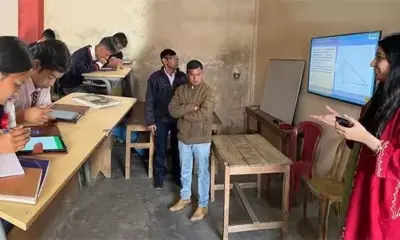
In the first phase of the project, 20 schools were selected for a pilot. Each was equipped with a Smart Classroom using affordable Smart TVs and a pen drive pre-loaded with curriculum-aligned digital content, with no internet dependency - a crucial design choice in a district where connectivity is unreliable at best. The pen drive carried an offline learning platform, iPrep, loaded with English-medium digital content for Grades 6 to 10, mapped to the Meghalaya State Board curriculum: animated concept videos, practice questions, digitised syllabus books, activities, and a digital library of stories, poems, and biographies. For children who had rarely encountered English outside a textbook, this was their first sustained exposure to the language in a form that was visual, engaging, and repeatable at their own pace.
Before assuming what the intervention should look like, the district did something it deserves credit for: it measured. A baseline assessment across the pilot schools revealed that Grade X students carried learning gaps of up to four grade levels. This is a hard number to absorb, but it explained everything - students were not simply weak in English; they were being taught concepts several years ahead of what their foundational knowledge could support. The response was a structured bridge course built into iPrep, one that told teachers precisely which junior-grade content to revisit with their students before attempting to teach grade-level material. On-field teams trained teachers in how to run this bridge course within their existing timetables, turning remediation into routine rather than an afterthought.
The early signals were encouraging. Within six months, the 20 pilot schools recorded 4,500 hours of Smart Classroom usage - evidence that the tool was being used, not merely installed. On the strength of this, the district scaled the programme to 166 classrooms, with a clear, singular focus: lifting the Grade X pass percentage.
A second layer was added as the programme matured: monthly assessments through the iPrep Assessment App, testing students on exactly what had been taught the previous month. This closed a loop that Indian classrooms often lack. It provided timely, granular feedback to teachers on which concepts had actually been understood and which had not. Teachers used this data to continuously refine the bridge course rather than repeating a generic remedial script for every class.
The results, tracked over three years, tell their own story. Smart Classroom usage climbed from 4,500 hours to over 53,000 hours every year. And the number that had defined the district's education crisis - the Grade X pass percentage - moved from 25-28% at the outset, to 62% by the end of the second year, and to over 90% by the end of the third year.
What makes Ka-Lawei worth studying is not the technology itself, but the sequencing of decisions around it: diagnose before designing (the baseline assessment), remediate before accelerating (the bridge course), and measure continuously rather than assume (the monthly assessments). Technology here was not a substitute for teaching; it was an instrument that enabled overstretched teachers in a resource-constrained district to do something they could not have done at scale on their own. It enabled teachers to meet each child closer to where they actually were, in a language and at a pace that made sense to them.
The district administration is not resting on these numbers. With a far larger cohort of students now clearing Grade X and moving on to higher education, the focus has shifted from pass percentages to the quality of what students carry with them - improving actual marks and grade-level learning outcomes, not just the ability to clear the bar.
East Jaintia Hills' coal seams may be closed, but Ka-Lawei suggests the district has found a different kind of resource to draw on - one that, unlike coal, will not run out.
Views expressed are personal. The writer is an author and a former civil servant