




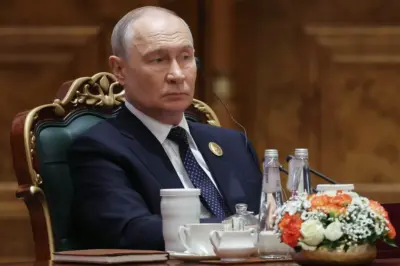

New Delhi: Russian President Vladimir Putin on Sunday proposed a new insurance mechanism and a collaborative initiative for the grain market among the BRICS nations as he called upon the grouping to adopt a holistic approach in combating pressing global challenges.
Putin proposed the new initiatives for economic growth among the BRICS member nations as well as the Global South nations amid crippling sanctions imposed by the Western powers on Moscow for its war on Ukraine.
The G-7 countries, the European Union, and the UK prohibited Western companies from insuring any ship transporting Russian crude unless the oil was purchased at or below a specified price cap. The sanctions relating to the insurance sector have adversely impacted Russian crude oil exports.
The Russian president also pitched for setting up a dedicated platform for economic growth with the BRICS.
"We have independent routes for moving capital, labour and technologies. In fact, we can operate regardless of outside pressure," Putin said at the concluding session of the BRICS summit.
"We have some promising initiatives going forward, such as creating an insurance mechanism and a grain market. These are Russian proposals, and we invite all other member states to make use of those," he said without elaborating further.
Putin also complimented the functioning of the New Development Bank (NDB), saying it is handling projects worth USD 140 billion.
The NDB is a multilateral development bank established by the BRICS nations.
"As global challenges keep surfacing, we should adopt a holistic approach to address both the symptoms and root causes," Putin said.
"Global South countries should jointly advance better (global) governance structure and tackle both traditional and nontraditional security threats," he said.
The Russian president also said that the global stature of BRICS is rising as it has been focusing on charting an independent course to combat pressing global challenges.
"The broad participation in today's meeting confirms that international interest in BRICS continues to grow. Many around the world find our core values and ideals appealing, including our commitment to charting an independent course and a desire to resolve problems collectively, guided by international law and the key provisions of the UN Charter," Putin said.
The concluding session of the BRICS summit was attended by the bloc's full member nations as well as its partner countries.
"This format opens the door to direct, candid dialogue between full-fledged BRICS members and partner countries, as well as other states and multilateral organisations keen to work with our group," Putin said.
Highlighting the importance of greater intra-BRICS economic cooperation, Putin said a common platform for better trade and investment ties will be helpful to all the member nations.
"We have great new horizons for investment and cooperation and partnership between markets. We're talking about forming a joint platform for growth within BRICS that would combine the competitive advantages of all members of the group," he said.
"This platform must be built on the principles of openness and availability to not just the partners of BRICS, but to all of our friends," he said.
BRICS, originally comprising Brazil, Russia, India, China, and South Africa, expanded in 2024 to include Egypt, Ethiopia, Iran, the United Arab Emirates and Saudi Arabia, with Indonesia joining in 2025.
Belarus, Bolivia, Kazakhstan, Cuba, Malaysia, Nigeria, Thailand, Uganda, Uzbekistan and Vietnam became BRICS partner countries last year.
BRICS has emerged as an influential grouping as it brings together 11 major emerging economies of the world, representing around 49.5 per cent of the global population, around 40 per cent of the global GDP and around 26 per cent of the global trade.