




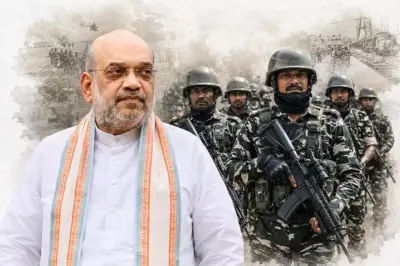

Nations are built twice: first through political freedom and then through institutions capable of protecting that freedom. Few institutions embody that responsibility more than the Central Reserve Police Force (CRPF).
Since its inception, the CRPF has stood at the forefront of India's internal security architecture, responding to the nation's most complex challenges, from maintaining public order to combating insurgencies and terrorism across diverse and difficult terrains.
As the CRPF commemorated its 88th Raising Day on July 27, it celebrated nearly nine decades of courage and sacrifice, while reflecting on a significant transformation in India's internal security strategy. This transformation rested on four pillars: personnel welfare, operational modernisation, direct political engagement, and targeted security operations alongside sustained development.
For decades, CRPF personnel operated under some of the country's most demanding conditions. Dense forests, unfamiliar terrain and unpredictable guerrilla warfare required extraordinary courage, often at enormous personal cost. PM Modi's government placed personnel welfare and modernisation at the heart of India's security architecture.
A series of welfare initiatives, including Ayushman CAPF, the CAPF e-Awas Portal, CAPF Punarvaas and the Welfare and Rehabilitation Board, strengthened healthcare, housing, rehabilitation and financial security for personnel and their families. The introduction of honorary ranks for eligible CAPF and Assam Rifles personnel and operational casualty certificates, on the lines of the armed forces, ensured that service and sacrifice received greater institutional recognition.
The government simultaneously accelerated the modernisation of the force through Modernisation Plan IV. Advanced weapons, surveillance technologies, secure communications, specialised vehicles and protective equipment transformed CRPF operations. Better intelligence, superior equipment and technological precision reduced operational risks, improved mission effectiveness and, most importantly, minimised casualties among security personnel. Capability, however, delivers results when matched by leadership.
Under the strategic guidance of Union Home and Cooperation Minister Amit Shah, the government has transformed the CRPF into the driving force behind India's campaign to replace the Red Corridor with a development corridor.
Throughout the campaign, Amit Shah consistently chose engagement over distance. He travelled repeatedly to CRPF camps in challenging operational theatres, including Bastar and the forward tactical camp at Basaguda in Chhattisgarh. Often visiting soon after major anti-Naxal operations, he interacted directly with jawans, reviewed operational preparedness and met injured personnel.
These visits reinforced confidence among personnel, strengthened coordination between policymakers and field commanders, and ensured that operational decisions reflected ground realities. The physical presence of the Union Home Minister in active conflict zones sent a clear message that the nation's political leadership stood firmly behind those serving on the frontlines.
Under Amit Shah's guidance, the force emerged as the operational backbone of India's campaign against Left-Wing Extremism. The CRPF spearheaded intelligence-led operations that systematically dismantled Maoist infrastructure across central India. Its specialised CoBRA battalions led landmark missions, including Operation Black Forest, Operation Octopus, Operation Double Bull and Operations Chakharabandha, significantly weakening the operational capability of the CPI (Maoist).
Operation Black Forest alone eliminated 27 hardcore Maoists, while sustained operations compelled the People's Liberation Army to abandon several long-held strongholds. Security forces restored the writ of the state across strategic locations, including Budha Pahad, Parasnath, Barasmiya, Chakrabandha, Karreguttalu and Abujhmad, areas that had remained Maoist bastions for decades.
Amit Shah set a national objective of making India free from Left-Wing Extremism by March 31, 2026. Intelligence-led operations neutralised several senior Maoist leaders, including Basarvaju, Patiram Manjhi, Ganesh Uike and Milind Teltumbde. Sustained pressure triggered large-scale surrenders across Chhattisgarh, Telangana and Maharashtra. Naxal violence declined by 56%, security force fatalities fell by 75%, civilian deaths declined by 70%, and the number of affected districts reduced from 126 in 2014 to a single district of concern by 2026, with none remaining in the "most affected" category.
Since 2014, the Modi government established 594 fortified police stations and 408 security camps, and built over 12,200 kilometres of roads in previously inaccessible regions. Coordinated action by state governments, the Enforcement Directorate and the National Investigation Agency disrupted the financial architecture of Maoist organisations, leading to the seizure of assets worth over Rs 102 crore. Expanded telecommunications, banking infrastructure, post offices, industrial training institutes, skill development centres and rehabilitation policies restored governance, created economic opportunities and encouraged former Maoist cadres to return to the mainstream.
Regions once synonymous with violence became connected by roads, institutions, markets and public services. Security created the space, governance consolidated the gains and development ensured they endured. The Red Corridor gradually evolved into a development corridor.
This journey from the Red Corridor to a development corridor represents the evolution of India's internal security philosophy, and the CRPF has become a critical partner in nation-building, creating a secure environment where governance can flourish, investment can reach previously isolated communities, and development can replace decades of conflict. That is the defining legacy of the CRPF at 88.
Views expressed are personal. The writer is a former DGP of Madhya Pradesh