




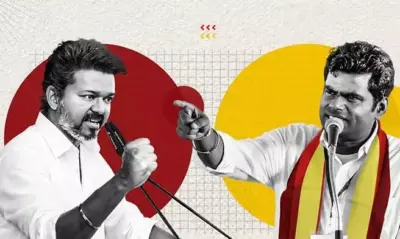

Annamalai, a former IPS officer and former State President of the BJP, has started a political movement that, as he has stated, will later become a political party.
What made him take such a decision at this juncture is a puzzle for many, not only in Tamil Nadu but also across India. Tamil Nadu politics has moved beyond the earlier binary of the DMK and the AIADMK, as they could not resist the emergence of new forces in the state's political landscape. They were unexpectedly challenged by the TVK under the leadership of Joseph Vijay, the actor-turned-politician, within a short span of time. It was widely believed that Joseph Vijay was merely using his fan base for political purposes through his cinematic influence and that he might not attract the attention of all sections of Tamil society. In reality, however, Joseph Vijay was serious about his mission of dismantling the "empire of corruption." M.G.R. had done something similar by questioning members of the ruling party about their ill-gotten wealth acquired through the misuse of power. Ending corruption is as difficult as ending caste in India. In fact, this transformative process began long ago in Tamil Nadu. It was initiated during the Jallikattu agitation led by the youth and was subsequently taken up by Annamalai when he was the BJP president in Tamil Nadu. Annamalai launched a major campaign against the corruption allegedly perpetrated by both the DMK and the AIADMK.
It was somewhat like Julian Assange's WikiLeaks. Annamalai called it the "DMK Files." These were released one after another and brought to light, in dramatic fashion, the alleged corrupt practices in the governance and administration of both Dravidian parties-the DMK and the AIADMK. Supporting this campaign, Union ministers, including the Prime Minister and the Home Minister, repeatedly attacked the alleged corruption of both parties whenever they visited Tamil Nadu. As a result, a large number of young people began following Annamalai because he had taken up the issue with seriousness and persistence. In the parliamentary election, the BJP, based on Annamalai's advice, decided that it did not need to align with the AIADMK. Ultimately, the BJP secured more than 11 per cent of the vote share, which was remarkable, though it failed to win any seats.
As a result, Annamalai was replaced by a softer leader in the BJP, one who had migrated from the AIADMK, and was appointed state president. This enabled the BJP's state unit to join hands with the AIADMK ahead of the Assembly election. While replacing him, the Home Minister stated that Annamalai's role in the party remained important and that he would be given a suitable position in Delhi. It is often argued that national political parties, including both the Indian National Congress and the Bharatiya Janata Party, do not adequately respect regional leaders or fully recognise their hard work. Barring the Left parties, many national political parties are often described as feudal in nature and character. That is why those skilled in networking, brokerage, and organisational manoeuvring often secure positions, while grassroots workers are left disappointed. Why do people prefer regional political parties? One reason is that they can reach out to their leaders more easily. Annamalai has his own vision and mission, and these may not fit comfortably within the framework of the BJP. Therefore, instead of wasting his time, he chose to move out of the party and start his own political venture.
It is a fact that Joseph Vijay is likely to remain an influential force in politics for the next two decades, and the question is: who will emerge as his principal challenger? It is unlikely to be the AIADMK, which is currently in disarray. Similarly, the DMK has weakened due to internal challenges and the absence of a towering leader like Karunanidhi. Annamalai appears to view this as a significant political vacuum. The Dravidian model, in many ways, has been appropriated by Joseph Vijay. He, too, speaks about Periyar E.V. Ramasamy and K. Kamaraj, both of whom are regarded as foundational pillars of the Dravidian model in theory.
The failure of the Dravidian parties in the 2026 election, however, would not necessarily signify the failure of the Dravidian model itself. Joseph Vijay appears to be offering that model without the baggage of corruption. People have not opposed the Dravidian model; rather, they have opposed the large-scale corruption associated with governance and administration under the Dravidian parties. Since Joseph Vijay continues many of the welfare schemes introduced by both the DMK and the AIADMK, people appear satisfied, though the traditional Dravidian parties are not. Yet, they continue to claim credit for those schemes. To an extent, that claim is valid. At this juncture, Annamalai seems to have sensed an ideological and leadership vacuum that he believes he can fill, drawing upon his extensive experience of working with people. He is young, energetic, vibrant, persuasive, and currently focused on grassroots politics and development. He has built a substantial youth following and therefore sees himself as part of the emerging political binary. Whether the future political contest in Tamil Nadu will indeed be between Vijay and Annamalai remains to be seen. For now, however, that appears to be the emerging binary in the state's political landscape.
Views expressed are personal. The writer is a former Professor and Rajiv Gandhi Chair for Panchayati Raj Studies, Gandhigram Rural Institute