




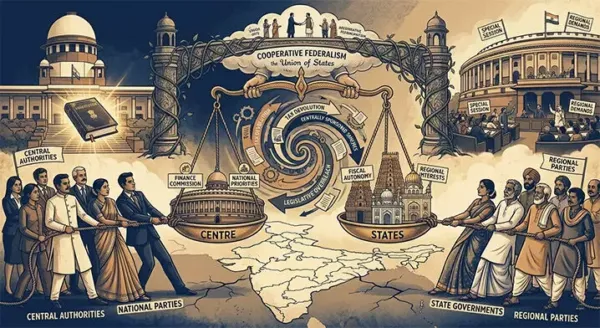

Federalism in India has often come under stress on account of the unitary nature of the Constitution, fiscal structures, and issues of governance.
The opposition-ruled states, over the last few years, have intensified their demand for more autonomy due to specific problems and structural imbalances. The three-day special session of Parliament held last week witnessed fiery speeches by lawmakers from regional parties focusing on the federal structure and state-specific interests. The situation once again highlighted the importance of Centre-State relations.
With regard to fiscal matters, southern states (Karnataka, Tamil Nadu, Kerala, Telangana) have a grievance that they contribute disproportionately high taxes (income tax, GST, corporate) but receive lower shares from the divisible pool. As argued, the Finance Commission formula rewards population and backwardness more than performance, which the southern states have shown through better governance indicators like higher literacy, lower fertility, and higher GDP contribution. The rise in Centrally Sponsored Schemes (CSS), with strict conditions reducing state flexibility in spending, has made some states insecure, as increased centralisation in the welfare narrative-for example, direct benefit transfers-dents their local political leverage. The post-GST (2017) effects have worsened the situation, as the 15th FC and the upcoming 16th FC are seen by states as unfair. The imposition of limits and higher interest on state borrowings is believed to have pushed states like Kerala, Punjab, and West Bengal into a tight fiscal position, and the same is perceived as politically motivated.
The increasing outreach of the Centre on legislative and administrative matters related to the State List or Concurrent subjects has apparently added fuel to the fire. For example, the farm laws of 2020, education policies like NEP 2020, and the NIA Act, etc., have led to friction, with the result that some states have challenged central laws in the Supreme Court. Moreover, some states have also alleged an uncooperative disposition from Governors in approvals, so much so that the Supreme Court had to intervene.
According to experts, the current system of financial devolution is based on the constitutional Finance Commission's recommendations aimed at equitability to help the poorer states. Moreover, a strong Centre is needed for national priorities, infrastructure, and reducing regional disparities. Southern states also benefit from central schemes, defence, infrastructure, and market access.
The states' demands are mainly: a higher share in tax devolution, from the present 41% to 50%; inclusion of cesses and surcharges in the divisible pool; more fiscal autonomy; and fewer conditions on funds. The scenario is not new; similar demands arose in the 1970s-80s and, as a matter of fact, ever since regional parties began calling the shots in national politics through coalitions from the 1990s to 2004, the demand for greater autonomy or the assertion of regional interests has become almost a political sentiment. Now, the intensity has only increased because of various triggers, including the recent delimitation Bill, 2026.
Dr. Ambedkar, the chief architect of the Constitution, emphasised the need for a strong Centre with a flexible federation. He preferred the expression "Union of States" over "Federation" to define India. While rejecting the rigid federal structure of the US, he favoured a dual polity that has both the character of a Union and a federation, so that national unity and security could be safeguarded at any cost. Hence, the emergency provisions, the Seventh Schedule, and residuary powers resting with the Centre, overriding states' legislative and executive powers. In the United States, for example, states enjoy absolute autonomy with dual sovereignty and separate constitutions, with rare interference from the federal government headed by the President. A similar political arrangement is unthinkable in India-a nation with diverse cultures, languages, religions, and a vast majority of marginalised classes.
The Supreme Court has exclusive jurisdiction to resolve disputes between the Centre and the states and has accordingly laid down principles of constitutional law in different cases. In State of West Bengal v. Union of India (1963), the apex court held that the Indian Constitution is not a pure federation like the USA and that it has a strong unitary bias. But equally, in another landmark judgement (S.R. Bommai v. Union of India (1994)), the court held that federalism is a part of the basic structure and that states are not mere appendices of the Centre. Though the Supreme Court, over time, has expanded its role to strengthen federalism by upholding states' taxing powers and placing limitations on the powers of Governors, it often leans towards the Centre in the interest of unity and security of the nation-a constitutional obligation the Centre is exclusively entrusted with by design.
A deeper study is necessary to appreciate the subtle realities. For example, contrary to allegations of interference by the Centre, states are effectively independent in almost all matters of governance and legislation within their jurisdiction. The central government neither supervises nor controls the states in this regard unless dictated by national interests-a rarity. Moreover, the Centre helps the states through centrally sponsored development schemes and also supports states in times of disasters. Most importantly, the All-India Services-the "steel frame" of India-state civil services, and all public servants in the state are absolutely under the control of state governments. On the other hand, the Central government depends on states to draw civil servants to work for the Government of India on deputation, since it does not have a cadre of its own. One can go on counting the benefits the states enjoy.
Problems also have a political dimension. When there is competition between national and regional parties, issues translate into questions of federal structure. For example, when it was politically feasible, even chief ministers of opposition-ruled states had cordial relations with Prime Ministers in the past, and Centre-State relations were never an issue. Then it was "cooperative federalism". Conversely, when political equations were hostile, a cold war set in, escalating issues into constitutional questions.
Politics is the art of the possible, they say. There is no good politics or bad politics any more than there is a good politician or a bad politician. However, politics cannot be detrimental to national unity; rather, it should advance the interests of the nation as a whole beyond sectarian concerns. More than between the Centre and the states, it is between national and regional parties that cordial relations need to be established. National parties have a wider appeal and a broader agenda for the entire country, while regional parties prioritise local interests; as such, both should respect each other and address discord with a spirit of accommodation.
Institutional reforms can help address the grievances of the states. Greater fiscal autonomy through higher devolution and reduced CSS conditions can ease tensions significantly. Effective functioning of the Inter-State Council (Sarkaria Commission), revisiting the role of Governors (Punchhi Commission), and prior consultation on central legislations are equally important to improve Centre-State relations. States should also engage in SWOT analysis in order to work in tandem with the Centre. To sum up, the position of the Central government as the leader of the Indian republic is non-negotiable, and the uni-federal system of the Constitution unequivocally envisages a predominant role for the Central government, no matter which party is in power.
Views expressed are personal. The writer is a former Additional Chief Secretary of Chhattisgarh