




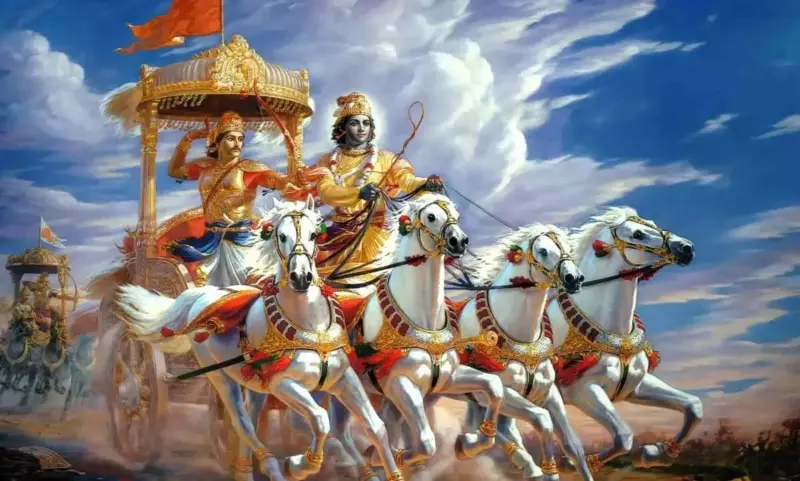

The Bhagavad Gita begins on the battlefield of Kurukshetra, described, notably, as dharma-kṣetra, a place of righteousness. This setting is significant.
It is not merely a battlefield of war, but a field where duty and consciousness are tested.
King Dhṛtaraṣṭra's opening question reflects an inner anxiety. Aware of the sanctity of Kurukshetra, he wonders whether this sacred environment might influence the course of events against his selfish, worldly interests. His concern reveals both attachment and uncertainty, even before the start of the battle. As Duryodhana surveys the opposing army, he speaks with calculated confidence. He lists the strengths of the other side, subtly revealing awareness as well as unease. This moment highlights how material consciousness is often absorbed in power, strategy, and external advantage alone.
At the same time, authoritative Vaiṣṇava commentators on the Gita have emphasized that Kurukshetra is a real field of action where dharma must be executed. Spiritual understanding does not remove one from responsibility but rather guides how responsibility is carried out.
This approach directs attention to the inner condition of the participants. Beneath external confidence, resources or strategy lies the state of the heart. Actions are shaped not merely by circumstance, but by consciousness-whether one is aligned with the Divine purpose or driven by personal desire.
A defining feature of this scene is the presence of Lord Krishna. He is not distant from the conflict; He is directly present within it. This reflects a central teaching of the Gita: that the Supreme Divine Being accompanies the living being, offering guidance within the complexities of life.
The contrast between the two sides of the battlefield reflects a deeper duality. One side represents action guided by dharma and connection to Lord Krishna, while the other reflects action driven by attachment and self-interest. This is not only a historical situation, but a condition that exists within each individual. This opening moment of the Gita invites reflection. Decisions must be made, responsibilities must be fulfilled, and uncertainty often accompanies action. Like the warriors at Kurukshetra, we frequently find ourselves standing at the intersection of choice and consequence. Are we relying only on external preparation, or are we also seeking inner clarity?
The Gita thus begins not with philosophical answers, but with a situation of dilemma that mirrors real life. It invites us to examine not just what we are facing, but how we are facing it. Are our actions guided by clarity and higher purpose, or by fear and attachment? The battlefield, then, becomes more than a place of conflict. It becomes a space of awakening. When seen through proper understanding, even challenging situations can become opportunities for inner growth. In this way, the Gita reminds us that life itself is a field of action, where duty, consciousness, and Divine guidance meet. And it is within this field that true understanding begins.
The author is the Dean Academics, Bhaktivedanta Research Centre