




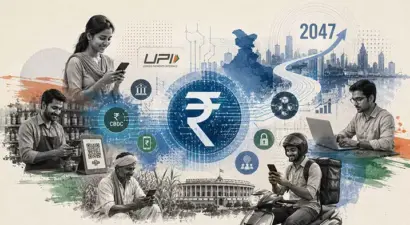

As India marches toward its centenary of independence in 2047, the vision of "Viksit Bharat" transitions from an ambitious blueprint into an actionable economic imperative.
Achieving this milestone requires sustained, high-octane growth driven by structural transformations. Among the most critical pillars of this progress is a technology-infused financial revolution. Over the last decade, India has repeatedly demonstrated how digital innovation can redefine public infrastructure, democratise economic participation, and bridge longstanding socioeconomic divides.
From the omnipresent Unified Payments Interface (UPI) to digital public infrastructure (DPI), India's financial ecosystem is undergoing a historic paradigm shift. Today, this narrative is expanding. The national conversation around the future of finance increasingly intersects with decentralised finance (DeFi), advanced fintech architecture, and sovereign digital assets. While these disruptive technologies are often viewed cautiously amid global regulatory uncertainty, they hold immense potential to build a highly transparent, efficient, and inclusive economic engine. If harnessed through robust governance, they could serve as definitive catalysts for India's journey toward global digital leadership by 2047.
The Velocity of India's Fintech Revolution
India has firmly established itself as one of the world's fastest-growing fintech ecosystems. According to market data from Invest India, the nation's fintech sector is projected to scale remarkably, targeting nearly USD 1.5 trillion in assets under management and economic revenues by 2030. Currently hosting more than 10,000 fintech startups, India ranks as the third-largest fintech hub globally, trailing only the United States and the United Kingdom.
The centrepiece of this success is the country's unparalleled digital payments infrastructure. The UPI ecosystem, orchestrated by the National Payments Corporation of India (NPCI), reached a historic milestone by processing over 17 billion transactions in a single month in early 2026. This metric underscores how deeply digital commerce has integrated into daily life. From Tier-1 metropolitan retail centers to micro-entrepreneurs and street vendors in remote villages, QR code-based payments have democratized commerce, accelerating India's transition into a cash-light economy.
This transaction velocity has fundamentally rewritten the rules of economic inclusion. Under the Pradhan Mantri Jan Dhan Yojana, more than 55 crore bank accounts have been operationalised, seamlessly integrated with biometric identity verification and mobile banking services. This architecture-the celebrated Jan Dhan-Aadhaar-Mobile (JAM) Trinity-has formed an unshakeable foundation for public service delivery, minimising leakages and establishing an international benchmark for inclusive digital growth.
Deconstructing Decentralised Finance (DeFi) and Blockchain
As the baseline digital layer matures, attention is pivoting toward the next frontier: Decentralised Finance (DeFi). Operating on blockchain protocols, DeFi eliminates traditional financial intermediaries through automated smart contracts. Globally, this ecosystem has expanded significantly, with the Total Value Locked (TVL) in DeFi protocols crossing USD 90 billion during cyclical peaks, signalling deep institutional and retail interest in alternative financial architectures.
The structural value proposition of DeFi lies in its absolute transparency, cryptographic security, and operational efficiency. For a developing economy like India, where formal credit penetration remains uneven, decentralised paradigms offer compelling alternatives. Small and Medium Enterprises (SMEs), casual labourers, freelancers, and agrarian entrepreneurs frequently encounter barriers when seeking institutional credit due to a lack of conventional collateral or formal credit scoring. Blockchain-based peer-to-peer lending platforms and decentralised identity verification can bypass these structural bottlenecks, matching underbanked segments with liquid capital directly and securely.
Furthermore, blockchain integration can optimise supply chain logistics, secure public registries, and streamline cross-border trade. This is particularly vital for international remittances. With the World Bank estimating that India received nearly USD 125 billion in remittances in 2025, deploying low-cost, near-instantaneous blockchain payment corridors could save billions in legacy banking fees, redirecting capital directly into rural and semi-urban households.
Cryptocurrency and the Sovereign Digital Frontier
Any forward-looking assessment of digital finance must address the complex dynamics of virtual digital assets (VDAs). Cryptocurrencies like Bitcoin and Ethereum have challenged traditional assumptions regarding monetary sovereignty and asset allocation. India boasts one of the largest retail digital asset user bases globally, driven largely by tech-savvy urban populations and a growing cohort of young investors.
Faced with this rapid adoption, Indian policymakers have championed a pragmatic approach that balances consumer safety with technological progression. Regulatory frameworks-including a 30% tax on digital asset gains and a 1% Tax Deducted at Source (TDS) on transactions-reflect a deliberate shift away from outright prohibition toward structured regularisation and fiscal oversight. This framework aims to mitigate risks associated with extreme market volatility, illicit capital flights, and consumer vulnerability.
Concurrently, the Reserve Bank of India (RBI) has proactively countered decentralised volatility by pioneering its own sovereign digital asset: the Central Bank Digital Currency (CBDC), or Digital Rupee. By early 2026, the RBI's wholesale and retail CBDC pilots scaled across multiple commercial banking networks, successfully processing millions of transactions. The Digital Rupee offers the cryptographic advantages of blockchain-such as programmable distribution and instant settlement finality-while maintaining the absolute stability and backing of a sovereign central bank. This duality encapsulates India's broader policy ethos: fostering native innovation while maintaining strict macroeconomic stability.
Driving Inclusion and Empowering the Gig Economy
The overarching metric of success for Viksit Bharat remains equitable human development. Traditional financial architectures historically marginalised vulnerable demographics-including rural women, migratory workforces, and low-income segments-due to rigid documentation requirements or geographical constraints. Fintech applications have systematically dismantled these barriers through micro-investments, fractional insurance products, and algorithm-driven alternative credit scoring.
This empowerment is vividly apparent within India's exploding gig economy. Estimates by NITI Aayog suggest that India's gig workforce is on track to exceed 2.35 crore workers by 2030. This decentralised labour force-comprising app-based delivery partners, freelance consultants, and content creators-relies entirely on instantaneous digital wallets, automated payroll mechanisms, and micro-credit lines to sustain their livelihoods.
Mitigating Systemic Risks and the Digital Divide
However, the trajectory toward a fully digitised economy is not without systemic vulnerabilities. Cryptographic markets are inherently volatile, exposing retail participants to steep financial risks. Concurrently, global DeFi protocols remain susceptible to smart-contract exploits, sophisticated phishing networks, and cyber-attacks that operate outside traditional institutional recovery frameworks.
Domestically, the structural challenge of the digital divide persists. True financial democratisation depends heavily on universal smartphone access, robust rural internet penetration, and widespread digital literacy. While bodies like the Telecom Regulatory Authority of India (TRAI) note surging rural connectivity, a measurable urban-rural cleavage remains. If left unaddressed, the dividends of the Web3 and fintech revolutions risk concentrating wealth within affluent urban clusters.
Finally, ecological sustainability must remain central to technological deployment. Transitioning away from energy-intensive consensus mechanisms (like Proof-of-Work) toward sustainable protocols is imperative to ensure that technological progress aligns with India's climate commitments.
Crafting the Hybrid Financial Horizon
The realisation of Viksit Bharat 2047 hinges on building a nation that is technologically advanced, structurally equitable, and globally competitive. Emerging financial technologies are not mere administrative upgrades; they are foundational instruments of economic sovereignty.
The optimal path forward does not lie in replacing legacy banking institutions, but in fostering a highly collaborative, hybrid financial ecosystem. By synthesising the agility of decentralised innovation with the stability of public oversight, India can continue to scale its digital public infrastructure safely. Ultimately, balancing bold financial innovation with proactive, consumer-centric regulation will ensure that India's digital economy becomes an engine of shared prosperity, powering the nation toward its developed future.
Views expressed are personal. John Felix Raj is the Vice Chancellor, and Sovik Mukherjee is an Assistant Professor of Economics, both at St. Xavier's University, Kolkata