





History, in its selective generosity, often crowns a few names with immortality while leaving others in the penumbra of undeserved obscurity.
Among those towering figures whose contributions to India's freedom struggle remain grievously underappreciated stands Rash Behari Bose - a man of extraordinary daring, intellectual agility, conspiratorial brilliance, and remarkable international vision, whose life reads less like a conventional biography and more like an epic of intrigue, exile, sacrifice, and revolutionary fire. Much of the biographical material on Rash Behari Bose reflects varying accounts and historical inconsistencies, but the broad arc of his revolutionary life remains indisputable.
To speak of India's freedom movement solely through the familiar vocabulary of petitions, parliamentary negotiation, and civil disobedience is to narrate only one chapter of a far larger saga. Parallel to the constitutional movement ran another stream - secretive, dangerous, uncompromising, and soaked in personal peril. Rash Behari Bose belonged unmistakably to that fierce tradition.
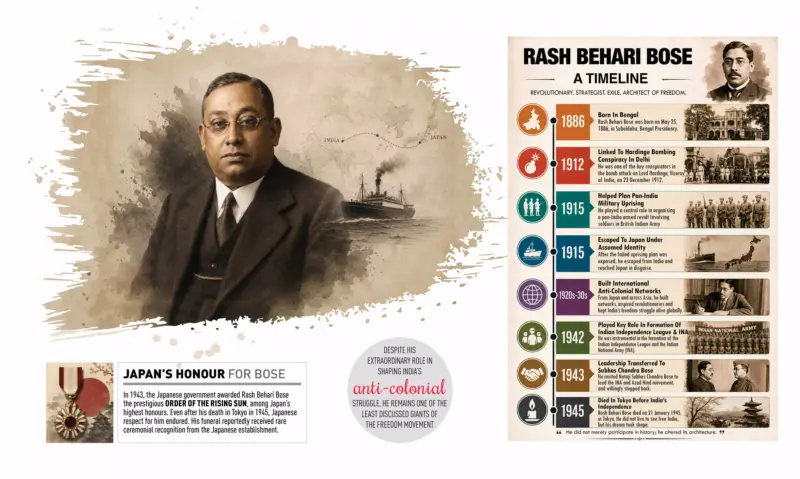
Born in Bengal on May 25, 1886, Rash Behari emerged from an era when patriotism was not a fashionable sentiment but a punishable offence. British India was not merely a political arrangement; it was a structure of humiliation. A generation of educated Indians had begun to recognise that beneath the polished rhetoric of imperial "civilisation" lay a machinery of racial arrogance and systematic subjugation.
For the young Rash Behari, nationalism was not an abstract ideological indulgence. It was visceral. Stories suggest that even in his youth, he was deeply offended by the discriminatory exclusion of Indians - particularly Bengalis - from the military service. That humiliation left an imprint. He developed an intense interest in physical fitness, discipline, and martial preparedness, unusual traits in a colonial milieu where the British had carefully cultivated stereotypes of the "effete Bengali."
His education was irregular, and by conventional academic standards, he may not have appeared destined for greatness. But history is often written not by the obedient classroom prodigy, but by the restless dissenter.
His eventual association with revolutionary circles transformed youthful defiance into organised resistance. In Chandernagore, then under French administration and therefore somewhat freer from direct British surveillance, he came into contact with nationalist revolutionaries linked to Bengal's underground movement. It was here that his latent rebellion found structure.
The first great public tremor of his revolutionary genius came in 1912.
On 23 December of that year, as Lord Hardinge, the Viceroy of India, entered Delhi in ceremonial grandeur, a bomb exploded in an audacious assassination attempt that shook the foundations of the British Raj. The symbolism was electrifying. The Empire, draped in pomp and imperial arrogance, had suddenly discovered its vulnerability.
Though operational details remain debated in historical retellings, Rash Behari Bose was widely recognised as one of the principal masterminds behind the conspiracy. What elevated the episode into legend was not merely the attack, but the breathtaking calm with which Bose allegedly resumed normal life immediately afterwards, even participating in public condemnation of the incident to deflect suspicion.
That was quintessential Rash Behari: theatrical audacity paired with cold strategic intelligence. The Hardinge episode catapulted him into the foremost ranks of revolutionary leadership. But his vision extended beyond symbolic acts of terror.
By the outbreak of the First World War, Bose recognised what many political leaders did not: empires are most vulnerable when distracted by larger conflicts. The war offered opportunity. British military resources were stretched. Indian troops were deployed overseas. Revolutionary groups abroad, particularly the Ghadar movement - composed largely of expatriate Indians from North America - were increasingly eager to trigger an armed uprising.
Rash Behari Bose emerged as the natural organiser of this grand design. The proposed insurrection of 1915 was breathtaking in ambition. It was not a local conspiracy. It was conceived as a pan-Indian military revolt involving army cantonments across multiple regions, coordinated sabotage, infiltration of regiments, and synchronised rebellion. This was not romantic amateurism. It was sophisticated revolutionary planning. Yet history is often cruel to conspiracies. Betrayal intervened.
The plot was compromised before execution. British intelligence acted swiftly. Arrests followed. Executions ensued. The revolution collapsed before ignition. For lesser men, such failure would have meant obscurity, imprisonment, or surrender.
For Rash Behari Bose, it meant reinvention. His escape from India itself has become part of nationalist lore. Under an assumed identity, he fled to Japan in 1915, under the alias of P. N. Tagore (secretary of Rabindranath Tagore), beginning one of the most extraordinary exilic chapters in the history of anti-colonial struggle.
In Japan, life was initially precarious. Britain, then allied with Japan, sought his extradition. He lived as a fugitive, changing residences repeatedly, navigating surveillance, diplomatic pressure, and uncertainty. Yet exile did not diminish him. It enlarged him. Many revolutionaries become prisoners of nostalgia when separated from their homeland. Rash Behari became something rarer - an international strategist. Gradually integrating into Japanese society, learning the language, writing extensively, and engaging in cultural life, he transformed himself from hunted conspirator into respected political interlocutor. His marriage into the sympathetic Soma family was not merely a personal turning point; it symbolised the extraordinary human alliances that sustained his journey. Even in exile, India remained his central preoccupation. He understood something profoundly modern: anti-colonial struggle required global networks.
Long before "international solidarity" became a fashionable political vocabulary, Rash Behari was practising it. He saw that India's liberation could not remain geographically provincial. It had to engage shifting geopolitical realities. This foresight became crucial during the Second World War. Once again, global war destabilised imperial certainties. Japan's rapid military expansion across Southeast Asia created unprecedented strategic possibilities. Thousands of Indian soldiers, captured as prisoners of war by Japanese forces, suddenly became a potential liberation army. Rash Behari Bose seized the moment again.
It was through his tireless efforts, alongside figures such as Captain Mohan Singh and others, that the Indian Independence League gained structure and the embryonic Indian National Army came into being. And here lies perhaps his greatest historical generosity. Many revolutionaries cling jealously to leadership. Rash Behari relinquished it. Recognising that the movement required a figure of electrifying mass charisma, he invited Subhas Chandra Bose to assume leadership. That decision was not merely tactical. It was profoundly selfless. When Netaji arrived and the Azad Hind movement acquired global prominence, Rash Behari willingly stepped aside, allowing the younger, more dynamic leader to occupy centre stage. History often remembers the climactic performer more vividly than the architect who built the stage.
That is precisely what happened. Netaji deservedly became immortal in the public imagination. Rash Behari receded into historical shadow. Yet without Rash Behari Bose, the international infrastructure that enabled the later Azad Hind experiment might never have existed. His contributions were not confined to conspiracy or militarism. He represented a fascinating ideological synthesis. He was intensely nationalist, yet not narrowly chauvinistic. He believed in international cooperation. He moved fluidly between cultures. He rejected parochialism.
At a time when political identities were often imprisoned within provincial loyalties, Rash Behari operated with astonishing geographic breadth - from Bengal to Punjab, from Dehradun to Benares, from Tokyo to Southeast Asia. He was, in many ways, one of the earliest truly transnational Indian revolutionaries. His life also complicates simplistic moral narratives. Modern readers, understandably shaped by democratic values, may feel discomfort with revolutionary violence. That discomfort is legitimate. But historical judgment requires contextual honesty. Colonial regimes were not benign administrators politely awaiting persuasion. They were coercive structures sustained by racial hierarchy, legal repression, economic extraction, and violence.
For many revolutionaries of that era, armed struggle did not appear immoral. It appeared necessary. One may debate their methods. One cannot dismiss their patriotism. Rash Behari Bose died in Tokyo on 21 January 1945, before India finally achieved independence. There is something deeply tragic in that chronology. A man who devoted his entire adult life to dismantling an empire never witnessed its collapse. A revolutionary who crossed continents for India died in foreign soil. And yet perhaps tragedy is not the correct word. Perhaps fulfilment is. For he had already seen his dream take institutional form.
He had helped create an armed liberation movement. He had inspired generations. He had internationalised India's struggle. He had transformed exile into resistance. Japan honoured him. Independent India, arguably, has remembered him far less than he deserves. This neglect reflects a larger national habit. We simplify history because nuance is inconvenient. We prefer a few monumental icons because collective memory likes manageable narratives. But nations impoverish themselves when they forget complexity.
Rash Behari Bose deserves remembrance not merely as a precursor to Netaji, nor merely as a bomb conspirator, nor merely as a fugitive patriot. He deserves recognition as one of the great strategic minds of India's liberation struggle. He was a man of astonishing resilience, a conspirator with intellectual depth, a nationalist without provincial narrowness, a revolutionary who understood geopolitics, and a patriot who sacrificed anonymity for freedom. If history is indeed a moral conversation between past and present, then our conversation with Rash Behari Bose is long overdue, for some men do not merely participate in history; they alter its architecture.