





"The essence of strategy is
Choosing what not to do."
- Michael Porter
The fuel in India's tanks may soon contain something more politically sensitive than crude oil derivatives.
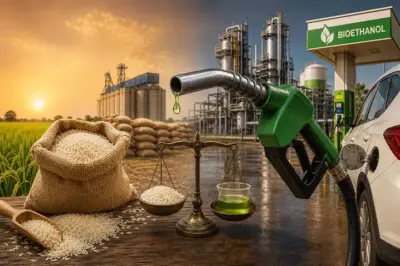
It may contain rice. As oil marketing companies introduce E85 fuel (with 85 per cent ethanol), policymakers are exploring new feedstocks to push India's ethanol ambitions. The most controversial is rice. In a country where food security is a cornerstone of public policy, converting grain into auto fuels raises itchy questions. Will we burn foodgrain in our engines, knowing feeding 140 crore people is a tough ask? Will taxpayers subsidise fuel produced from publicly-procured grain? Who bears the cost if the economics don't add up?
The instinctive answer is outrage. The thought-through answer is more complicated. Contrary to popular perception, ethanol made from rice is not markedly more expensive than ethanol produced from sugar-based feedstocks. Prices paid by oil firms for rice-based ethanol are comparable to those paid for ethanol produced from molasses. In instances, they can even be lower than ethanol derived from sugarcane juice.
That is what makes the issue more troubling. The question is not whether rice ethanol is affordable. It is whether converting procured foodgrain into fuel is the most sensible use of national resources. India holds grain stocks well above mandated buffer requirements. And maintaining these inventories costs crores in storage, transportation and handling. For policymakers, ethanol is an easy way to monetise the surplus. For taxpayers, food procured for India's strategic security is being turned into a 'suspect energy'.
Food or Fuel?
The timing of the transition is delicate too. Having only recently achieved full E20 blending, India is suddenly discussing E27, E30 and E85 adoption. A country that once debated whether ethanol should supplement petrol is now contemplating whether petrol should supplement ethanol. Ethanol usage began as an answer to a genuine challenge. India imports 90 per cent of its crude oil requirements, making it vulnerable to geopolitical shocks, supply disruptions and oscillating global prices. Every litre of ethanol cuts back that dependence, improves energy security and lowers foreign exchange burdens.
No one can dispute the logic. Indeed, the ethanol-blending programme has been one of the government's more successful policy interventions. Blending levels that once sounded ambitious have been achieved ahead of schedule. Distillery outputs have grown. Farmers have gained new markets for their produce. Ethanol blending is a rare example of a move that addresses energy security, rural incomes and environmental objectives in one single turn of the car key.
The challenge is that its success has fuelled demand. The more ethanol India blends into its fuel, the more feedstock it needs. Sugarcane and molasses can meet part of that demand, but not indefinitely. Maize has emerged as an alternate source. Rice is being discussed as the next frontier. This is why the debate becomes less about economics and more about public policy.
The Pricing Puzzle
For decades, India invested in food security systems to ensure that shortages never threatened national stability. The government procured foodgrain, maintained reserves and spent on storage and distribution. The underlying philosophy was simple: food stocks represented security. Now, some of those stocks are being used for fuel. Some feel surplus grain should not be allowed to languish in warehouses while the country continues importing expensive crude oil. Others feel that once food enters the fuel chain, the distinction between strategic reserves and industrial feedstock will blur. Both arguments have merit.
If this debate raises questions, the pricing of E85 raises some more. The E85 variant is being sold in Delhi at a discount to conventional petrol blends. That should be good news for consumers. But fuel economics are rarely straightforward. Ethanol contains less energy than petrol. Thus, vehicles running on higher ethanol content consume more fuel to cover the same distance. What matters is not the price of a litre of fuel, but the cost of travelling a kilometre.
This distinction is important because it raises unanswered questions. Is the pricing of E85 market-driven? Does it reflect the economics of production and distribution? Will such pricing remain sustainable if ethanol consumption rises? What happens if grain-based ethanol becomes a larger share of the chain? The answers matter. Because public trust matters.
Engines and Consumers
The shift to higher ethanol blends is happening through policy direction, not consumer demand. Therefore, transparency is essential. Motorists have the right to understand what they are buying, what benefits they can expect and what trade-offs may have to be accommodated.
There is another dimension that deserves attention: vehicle compatibility. E85 is intended for flex-fuel vehicles that can handle high ethanol content. But the majority of vehicles on India's roads were bought long before E85 entered the picture. As crores of owners learn to adjust to the implications of E20 blending, policymakers are suddenly throwing in the monkey wrench of higher ethanol content.
So far, there is no proposal to force E85 on all vehicles. But consumers are cautious, especially with pure petrol disappearing from the retail fuel network. Many owners worry less about E85 than about where the ethanol drive will eventually reach. The concern is real. Ethanol transitions succeed when consumers have confidence in both the technology and the policy. They become problematic when car-owners feel that decisions are being forced on them. Energy transitions are not engineering drills; they are exercises in public consent.
Brazil's Lesson
No discussion about ethanol can avoid Brazil, which is a rousing example of ethanol adoption. There is much to admire in that success story, but there is also a lesson to be learnt. Brazil's romance with ethanol was gradual, forced on it after the oil shocks of the 1970s. The government invested in production capacities, vehicle tech and infrastructure. Consumers were offered a choice. Fuel stations sold various blends. Adoption was optional, not mandatory. Flex-fuel vehicles came in only after decades of technological evolution and public acceptance.
By contrast, India seems determined to squeeze that journey into a fraction of the time. This speed may succeed too, for India's scale, tech capabilities and ambitions are very different from those of Brazil in the 1970s. But speed also introduces risks. Infrastructure must keep pace. Vehicle technologies must keep pace. Consumer awareness must keep pace. Else, the transition risks bloodying the noses of the very people it means to serve.
Measured Path
This is not an argument against ethanol. Reducing dependence on imports is a national objective. Energy security is a great national objective. India's ethanol plans have already delivered gains and deserves credit. But the next phase requires a new mindset. The goal should not be to maximise blending numbers or more ambitious targets. It should be to ensure that the shift is economically rational, technologically sound and socially acceptable.
If rice is to become fuel, policymakers must explain why that represents the most efficient use of India's grain. If E85 is to become common, people deserve clarity on pricing, efficiency and compatibility. If flex-fuel vehicles are to be the norm, the market should get the time to adapt. Any transition succeeds when citizens become willing participants, not forced passengers. The danger is not that India may embrace ethanol. It is that in the pursuit of energy security and forex savings, valid objections of the masses are dismissed.
The issue confronting India extends beyond ethanol. It touches on how it manages scarce resources, competing priorities and navigates the speed-bumps that accompany transitions. Before India decides how much ethanol belongs in fuel tanks, it first needs to answer a basic question - when food, fuel and policy begin to converge, which one are we willing to burn?
The writer can be reached on narayanrajeev2006@gmail.com. Views expressed are personal
The writer is a veteran journalist and communications specialist