




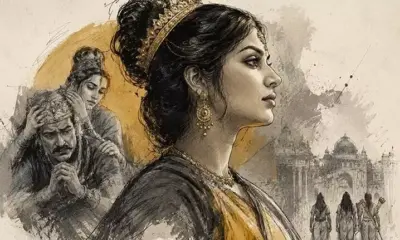

The Ramayan does not preserve only the lives of those who stood as ideals of courage, sacrifice and righteousness. It also preserves the stories of those whose choices became warnings for society.
Kaikeyi belongs to this difficult and important category. She was not without love, dignity or influence. She was the wife of King Dasharath, the mother of Bharat and one of the most powerful queens of Ayodhya. Yet her name is remembered largely through one decision that changed the destiny of the kingdom and sent Ram, the embodiment of dharma, into fourteen years of exile. Her story reminds us that affection alone is not enough. Love becomes meaningful only when it is guided by fairness, restraint and moral clarity.
Kaikeyi was not introduced as a figure of weakness. In many tellings of the Ramayan, she is remembered as a capable and courageous queen who once helped Dasharath in a moment of danger, after which he granted her two boons. This episode is important because her later error did not arise from insignificance. She had once earned trust. She had honour in the royal household. She possessed affection, access and influence. The Ramayan reminds us that individuals are rarely simply good or bad. Kaikeyi was a respected queen whose moment of weakness changed history. Past merit and high position do not protect anyone from moral failure. Character has to be renewed through right judgement at every decisive moment.
The turning point begins not with hatred, but with negative counsel. When Ayodhya was preparing for Ram's coronation, Manthara unsettled Kaikeyi's mind. She suggested that Ram's rise would reduce Bharat's future, that Kausalya would become supreme and that Kaikeyi would lose her place in the palace. Manthara did not place a weapon in Kaikeyi's hand. She placed fear in her mind. The influence of negative advisors can distort even capable minds. Leaders must seek diverse opinions, encourage honest dissent and create an environment where truth can be spoken without fear. A leader who listens only to flattery soon loses the ability to distinguish concern from manipulation.
Kaikeyi's failure was not that she loved Bharat. A mother's concern for her child is natural and powerful. Her failure was that she allowed fear to decide what love required. She wanted security for Bharat, but did not ask whether his future could be built upon injustice to Ram. Her concern became comparison. Her love became ambition. Her mind moved from protecting her son to excluding another. Decisions driven by fear rather than values may appear protective in the moment, but they often damage the very people and institutions they seek to secure. Leaders must recognise how fear and ego can distort strategic decisions.
Once her mind was clouded, Kaikeyi turned to the two boons that Dasharath had granted her long ago. By the force of his word, she had the right to ask for them. Yet the Ramayan shows that dharma is never satisfied by entitlement alone. A promise may create obligation, but conscience must still guide its use. By asking for Bharat's coronation and Ram's exile, Kaikeyi used a legitimate promise for a deeply disruptive purpose. Unrestricted boons have consequences. What is available by promise is not always justified by dharma. Ethical conduct is not measured only by whether one has the right or power to act, but by whether that action upholds fairness, protects trust and serves the larger good.
Dasharath's agony also shows the danger of power without safeguards. He was bound by his word, but broken by its outcome. A father's heart was torn between promise and affection. Ayodhya, which had been preparing for celebration, was thrown into grief. Ram, Sita and Lakshman were sent into hardship. Institutions cannot depend only on personal virtue, emotion or informal promises. They need checks and balances, governance mechanisms and the courage to challenge flawed decisions before they become irreversible. A kingdom, organisation or family weakens when one unchecked demand can disturb the larger order.
This is where Kaikeyi's story moves beyond the palace and becomes relevant to every institution. Great institutions are not destroyed by external enemies alone. They can be weakened from within when personal ambition, flattery, fear and poor governance overpower values and collective purpose. Ayodhya was not conquered from outside at that moment. It was shaken from within because affection lost balance, advice lost integrity and authority lacked restraint. This remains true in modern public life, corporate life and family life. Decline often begins when people close to power stop speaking honestly and start protecting personal interests.
The conduct of Ram gives the story its moral contrast. When informed of his exile, Ram did not rebel against Dasharath, condemn Kaikeyi or cling to the throne. He accepted the command with composure because he understood duty beyond personal entitlement. His response does not make Kaikeyi's demand right, but it shows how dharma can be preserved even when others fail in judgement. Ram's restraint teaches that ethical strength is not dependent on favourable circumstances. A person rooted in values remains steady even when treated unfairly. Where Kaikeyi allowed fear to disturb her mind, Ram allowed duty to guide his conduct.
Bharat's response is equally important. Kaikeyi acted for his supposed benefit, yet Bharat refused to accept the throne gained through injustice. His grief and anger became a moral judgement upon the very act meant to favour him. The son for whom she demanded power rejected the method by which that power was secured. Bharat's conduct reminds us that love cannot be honoured through unrighteous means. A benefit secured through unfairness becomes a burden to the person who receives it. True inheritance is not power gained at any cost, but values transmitted with integrity.
Kaikeyi's later remorse gives her story a deeply human dimension. She is not remembered only because she made a grave mistake, but because her mistake forces society to examine the fragile boundary between love and attachment, advice and manipulation, promise and justice, ambition and dharma. Her regret shows the return of conscience, but it also reveals the limits of remorse. Some consequences cannot be immediately undone, even when the heart recognises its error. Wisdom lies in preventing moral failure before it takes form. The deeper discipline is to pause before decisions harden and to question whether fear is disguising itself as care.
For modern society, Kaikeyi's story is profoundly relevant. It teaches that families, institutions and nations must not rely only on the assumed goodness of individuals. Institutions must be designed not merely around the virtue of individuals, but around systems that prevent good people from making harmful decisions. It is not enough to choose capable people around a leader. One must create a culture where truth can be spoken, motives are examined and the mission of the institution comes before personal attachment.
Kaikeyi therefore stands not as a figure to be dismissed only with anger, but as a civilisational warning to be understood with seriousness. From her, we learn that affection has value only when it is guided by dharma. We learn that influence must be governed by responsibility, ambition must be restrained by conscience, and love must be disciplined by justice. The lesson of Kaikeyi is that fear can disguise itself as care, insecurity can disguise itself as duty, and personal desire can disguise itself as protection. Her mistake changed the destiny of Ayodhya, but her story continues to guide Bharat. In the end, Kaikeyi teaches us that the mind must be guarded before action is taken, because even love can cause harm when it loses the guidance of dharma.
Views expressed are personal. The writer is Chairperson, Bharat Ki Soch