




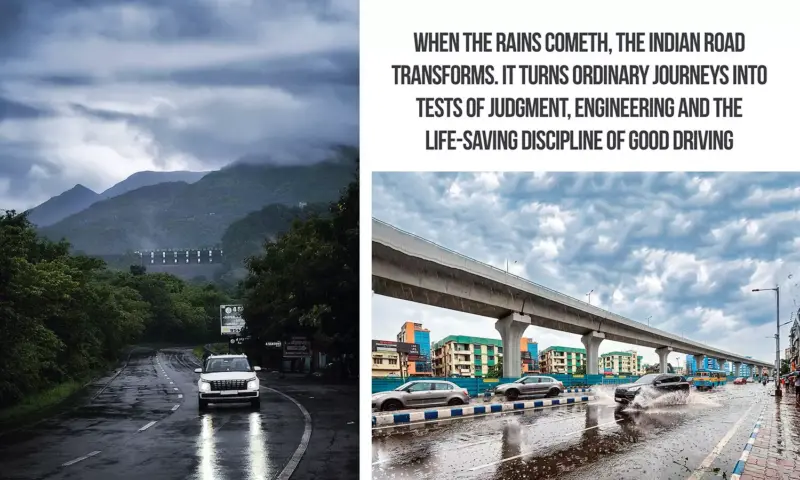

The first sign is the smell. Not of the rain itself, but the moment just before it arrives. The faint scent of wet dust lifting from the road as the sky darkens.
The wind shifts. Tentative drops hit the windshield. Within minutes, the Indian monsoon is in full command. The highway dissolves into shimmering grey, the wipers begin their relentless rhythm and the drive becomes something else entirely. In India, the monsoon does not merely change the weather. It changes the road.
For millions of drivers across the country, the season transforms routine journeys into exercises in awareness, patience and instinct. Water gathers in sudden sheets across asphalt. Visibility collapses without warning. Potholes that were minor inconveniences suddenly become axle-deep death-traps. A highway that felt fast and effortless begins to demand humility.
The monsoon, more than any other season, reveals what driving is really about.
Roads Lose Certainty
Dry roads are predictable. Wet roads are not. The science behind it is straightforward. Tyres rely on friction to grip the road surface. Rainwater reduces that friction dramatically. Hydroplaning. When the water layer becomes thick, tyres can ride on top of it rather than through it, that is hydroplaning. When that happens, steering becomes vague, braking distance lengthens and the car begins to float across (or over) the surface.
Even moderate rain can reduce tyre grip by as much as 30-40 per cent. For drivers used to summer highways, the difference can be startling. The steering wheel that once felt sharp now feels muted. The car that stopped confidently at 80 km per hour needs more road to slow down. Acceleration too must be moderated, as sudden throttle inputs can cause wheels to spin on slick surfaces.
Yet, the real challenge is not the water itself. It is unpredictability. One stretch of road may be merely damp. The next may hide a deep pool formed by clogged drainage. A patch of fresh tarmac may grip well; an older, polished surface may turn slippery almost instantly. Painted lane markings, metal expansion joints and smooth concrete surfaces often become surprisingly slick once rain begins to fall. In the monsoon, the road is never quite the same twice in a row. Or at all.
Engineering Steps Up
This is the season when automotive engineering quietly proves its worth. Features that drivers often take for granted become crucial. Anti-lock braking systems prevent wheels from locking under hard braking on wet surfaces, allowing drivers to retain control even during emergency stops. Electronic stability control intervenes when the car begins to slide, subtly adjusting braking and engine power to restore balance. Traction control reduces wheel-spin when accelerating out of slick intersections or climbing wet inclines. Many drivers rarely notice these systems during dry-weather driving. In the rain, they become silent guardians.
Even the design of tyres plays a dramatic role. Those seemingly simple grooves carved into the rubber are actually water evacuation channels. Their job is to push water away from the contact patch so the tyre can maintain grip with the road. Engineers spend enormous effort designing tread patterns that disperse water efficiently while maintaining stability at highway speeds. Worn-out tyres lose this ability, which is why tread depth matters far more in the monsoon than in any other season. A tyre that feels adequate on dry asphalt may become dangerously ineffective when confronted with standing water.
Suspension, too, reveals its character. A well-tuned suspension absorbs water-filled potholes without violently unsettling the car. It allows wheels to maintain contact with uneven road surfaces and helps keep the vehicle stable when the road suddenly deteriorates. Poor suspension, by contrast, amplifies shocks and can throw a vehicle off balance just when stability matters most. In the monsoon, the difference between an average car and a well-engineered one becomes vividly clear.
Forgotten Visibility
If grip is one challenge, vision is another. Heavy rain can reduce visibility to a fraction of normal levels. Spray from large trucks creates temporary white walls that obscure entire lanes. Headlights refract through sheets of water, turning oncoming traffic into blinding glares. Even well-lit roads can become disorienting when rain reflects and scatters light across the road surface.
Urban driving introduces additional complications. Waterlogged intersections hide broken asphalt. Two-wheelers weave unpredictably through traffic in search of drier ground. Pedestrians rush across roads to escape sudden downpours.
In such conditions, disciplined driving becomes critical. Speed must fall. Not dramatically, but surely. Following distances must increase. Sudden steering inputs must be avoided. Gentle acceleration and progressive braking become essential habits rather than optional refinements.
Experienced drivers understand this instinctively. They settle into a rhythm with the rain: wipers sweeping, tyres whispering across wet tarmac, headlights carving a narrow tunnel through the downpour. Driving becomes less a race and more a conversation with the road.
Hidden Indian Problems
Monsoon also expose a deeper reality about India's road network. Drainage systems often struggle to cope with intense rainfall. Water collects in depressions where road surfaces have settled over time. Construction joints and poorly maintained shoulders allow water to seep into the asphalt, accelerating the formation of potholes. What appears to be a smooth surface may conceal weakened layers beneath.
For drivers, this means constant vigilance. A harmless-looking puddle may conceal a deep crater capable of damaging suspension components or bending alloy wheels. Sudden braking to avoid such hazards can create chain reactions in fast-moving traffic. The monsoon, in this sense, becomes an annual stress test not only for vehicles and drivers, but for the country's road infrastructure itself.
Monsoon as a Teacher
Yet, there is something strangely beautiful about driving in the rain. The landscape changes character. Fields turn lush. Hills vanish into drifting clouds. Highways that seemed ordinary acquire a cinematic intensity. There's mist rising from the road, water streaming from culverts, distant thunder echoing across open plains. Long drives through the countryside during the monsoon carry a quiet drama. Waterfalls appear along hillside roads. Rivers swell beneath old bridges. The air grows cooler, the light softens, colours deepen.
For those who enjoy driving, the monsoon becomes a test of skill and composure. It rewards smooth inputs and punishes aggression. It demands anticipation rather than reaction. And it reminds drivers that machines obey the laws of physics, not impatience. Modern cars, with their electronic safety systems and advanced tyres, can mitigate many risks. But technology cannot replace judgment. A cautious driver in a modest car will always be safer than an impatient driver in a powerful one.
Perhaps that is why seasoned motorists often speak of monsoon drives with a mixture of caution and nostalgia. Because somewhere between the sweeping wipers and the glistening road ahead lies a rare moment of focus, when the noise of everyday life fades and the act of driving becomes deliberate. Not faster. But wiser. It has to. Or else.
Soliloquy: As all of us sweat and shrivel in the blistering Indian summer, this piece is meant to help us remember the sights and smells of the wet, good days that will surely come sometime soon.