




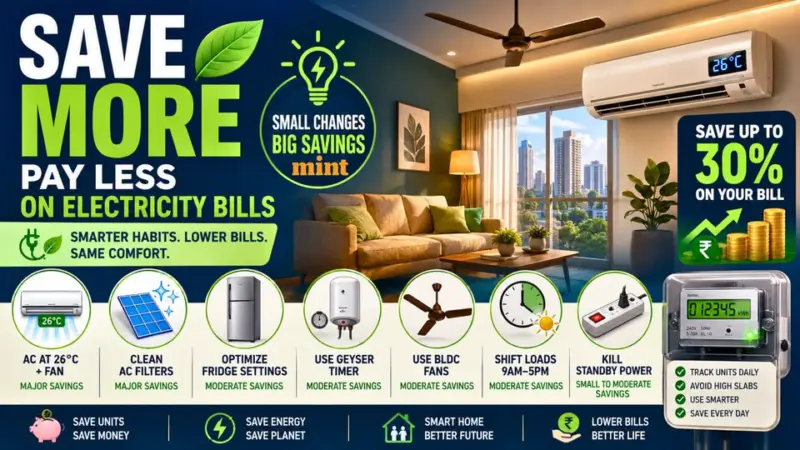

I asked ChatGPT to give 10 tricks to save electricity this summer in Mumbai. I wanted hacks that most people are not aware of. Here's what AI said.
ChatGPT tailors its advice specifically for Mumbai households. It assumes a 2BHK family using 250-600 units per month. One or two rooms have an AC. Mumbai's slab-based billing means every saved unit counts double. Crossing a higher slab raises the cost of every unit, not just the extra ones.
The Biggest Villain
ChatGPT identifies the AC as the single largest electricity consumer. A 1.5-ton AC uses roughly 1-1.8 units per hour. Mumbai's humidity keeps the compressor working harder than in drier cities.
The fix is simple: set the AC at 26°C and run a ceiling fan on low. The fan circulates air, making 26°C feel like 24°C. The compressor runs less because the temperature gap is smaller. Monthly savings can range from ₹700 to ₹2,500 per AC. The cost of this change is zero.
Cleaning AC filters every fifteen days is equally important. Mumbai's coastal air clogs filters more quickly than that in inland cities. A clogged filter forces the compressor to work longer. Regular cleaning saves ₹300- ₹1,200 per month.
ChatGPT also warns against setting the AC to 18°C. It does not cool the room faster in any meaningful way. It only keeps the compressor running longer. Dry mode is recommended for humid evenings when it is not intensely hot.
Silent Power Drains
Standby power is a quiet but consistent expense. TVs, set-top boxes, routers and old desktops consume power even when switched off. A single charger costs very little monthly. But a TV and set-top box together can cost ₹50- ₹150 per month.
ChatGPT recommends switchable power strips for these devices. The investment is ₹300- ₹800. Monthly savings range from ₹100 to ₹400.
The Refrigerator
Most households run their fridge at unnecessarily cold settings. ChatGPT recommends 3-4°C for the fridge and -18°C for the freezer. Hot food placed directly inside the compressor forces it to work harder.
The fridge also needs breathing space behind it. A condenser jammed against the wall silently wastes power. The gasket test is simple: close the door on a sheet of paper. If it slides out easily, cold air is escaping. Fixing the gasket costs ₹0- ₹1,500 and saves ₹150- ₹600 monthly.

Fans, Geysers and Washing Machines
Old fan regulators waste electricity as heat. Electronic regulators are better. BLDC fans are best, using only 28-35 watts against the standard 70-80 watts. Replacing high-use fans with BLDC models saves ₹150- ₹500 per fan monthly. The upfront cost is ₹2,000- ₹3,500.
A 2 kW geyser running 45 minutes daily consumes 45 units per month. ChatGPT recommends a timer that heats water only before bath time. This saves ₹250- ₹700 per month. Washing machines should always run on full loads with cold water. Heating water is the expensive part.
Smart Meter and Billing Tricks
Maharashtra's Time-of-Day billing rewards daytime appliance use. Running washing machines, irons and pumps between 9 am and 5 pm is cheaper. Avoiding heavy loads between 6 PM and 11 PM reduces peak-hour charges. Monthly savings are ₹100- ₹500 at zero cost.
ChatGPT also advises tracking daily unit consumption carefully. A jump from 300 to 500 units pushes the entire bill into a higher slab. Consumers should also check their sanctioned load. Excessive sanctioned load results in unnecessary fixed charges each month.
The Hidden Threat
Bad wiring is both a safety risk and a cost problem. ChatGPT recommends turning off all appliances and watching the meter.
If it still moves, there is likely a leakage or unauthorised tapping. Warm switchboards, flickering lights and frequent MCB trips are red flags. Fixing a real fault saves ₹200- ₹2,000 monthly.
With these hacks, a typical Mumbai 2BHK family can reduce consumption by 15-30% without sacrificing comfort.