




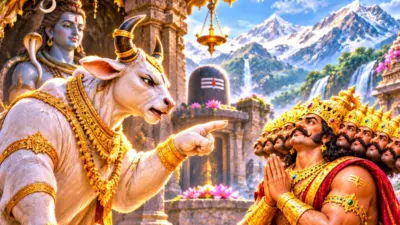

Ravana's journey in the Pushpaka Vimana comes to an unexpected halt near Lord Shiva's abode.
Ravana had defeated powerful kings, challenged celestial beings and made even the gods cautious of his strength.Ravana's Journey Was Stopped at Mount Kailash
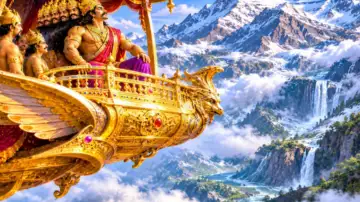 Ravana's journey in the Pushpaka Vimana comes to an unexpected halt near Lord Shiva's abode.
After defeating Kubera, Ravana was travelling in the Pushpaka Vimana when it suddenly stopped near Mount Kailash. No matter how hard he tried, the celestial aircraft would not move forward. Ravana soon discovered that this was no ordinary mountain. Lord Shiva was present there, and his divine attendant Nandi stood guard. Nandi warned Ravana not to proceed because the place was sacred. But Ravana, blinded by his victories, was in no mood to listen.
Ravana Mocked Nandi's Appearance
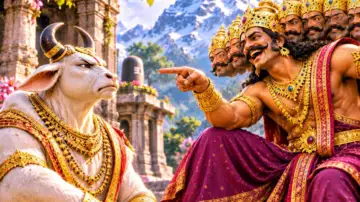 Ravana makes fun of Nandi's monkey-like face instead of respecting his warning.
Nandi had a distinctive appearance, with a face resembling that of a monkey. Instead of respecting his words, Ravana began laughing at him. He questioned how someone with such a face could dare to stop the mighty king of Lanka. Ravana believed his strength made him superior to everyone around him. He failed to understand that Nandi's power did not come from physical appearance or royal status, but from his devotion to Lord Shiva.
Nandi Pronounced a Terrible Curse
Ravana's mockery angered Nandi. He declared that the very form Ravana had laughed at would become the reason for his downfall. Nandi cursed that powerful Vanaras would one day bring destruction upon Ravana and his kingdom. Ravana dismissed the warning, believing that no group of forest-dwelling beings could ever defeat him. But the curse had pointed towards a future he could not imagine, one in which his pride would face an unexpected challenge.Ravana Tried to Lift Mount Kailash
Instead of leaving the sacred place, Ravana decided to display his strength. He placed his many arms beneath Mount Kailash and attempted to lift the entire mountain. His intention was to prove that nobody could stop him, not even the attendants of Lord Shiva. As the mountain began to shake, the gods and other beings became alarmed. Ravana believed he was showing his power, but he was about to discover how little his strength meant before Mahadev.Lord Shiva Stopped Ravana With His Toe
Lord Shiva did not need to engage in a long battle. He simply pressed Mount Kailash with his toe. The mountain became unbearably heavy, trapping Ravana's arms beneath it. Unable to free himself, Ravana cried out in intense pain. His powerful voice echoed through the worlds. The incident taught him that physical strength and conquest could not make anyone greater than the divine. His pride had brought him to a place where even his enormous power could not help him.The Cry That Gave Ravana His Name
According to the traditional account, Ravana's cries were so powerful that they were heard across the worlds. His name is associated with the Sanskrit root ru, meaning to cry or roar. In the story, this episode explains why he came to be known as Ravana. The king who had once made others fear him was now crying beneath a mountain because of his own arrogance. His encounter with Shiva became a lesson he could never forget.The Vanaras Became Part of Ravana's Downfall
Years later, Nandi's warning became closely connected with the events of the Ramayana. Lord Rama formed an alliance with Sugriva, the Vanara king, and the Vanara army helped him reach Lanka. These warriors were not ordinary fighters. They played a major role in the battle against Ravana and his forces. The very beings Ravana had once considered insignificant became an essential part of the army that challenged his power.Hanuman's Arrival Made the Warning Feel Real
Hanuman's journey to Lanka brought Nandi's warning into sharp focus. He entered the kingdom alone, found Sita in Ashoka Vatika and refused to bow to Ravana's threats. After being captured, Hanuman's tail was set on fire, but he used the flames to burn parts of Lanka. Ravana had once laughed at a monkey-like face. Now, a Vanara warrior had entered his kingdom and challenged its security.Ravana Still Refused to Understand the Warning
Even after Hanuman's attack, Ravana refused to change his decision about Sita. He continued to underestimate Rama and the Vanara army. When the war began, the Vanara warriors fought alongside Rama's forces, and Ravana eventually lost his life. Nandi's curse is remembered in devotional retellings as a prediction of this downfall. Ravana's defeat was not caused by one event alone, but by his pride, choices and refusal to correct his actions.The First Curse Was Only the Beginning
The story of Nandi's curse carries a clear message: never judge someone's strength by their appearance or position. Ravana saw Nandi's monkey-like face and laughed, but he could not see the future hidden in those words. The Vanaras later became an important part of his defeat, and Hanuman's courage shook his confidence. This was the first curse in the series of stories associated with Ravana's downfall. Another tale speaks of a woman who vowed to return in a future birth to bring about his destruction.Unlock insightful tips and inspiration on personal growth, productivity, and well-being. Stay motivated and updated with the latest at My Life XP.