

The Rise of Predictive Intelligence in the Modern Business World
In today's rapidly evolving digital economy, data has become one of the most valuable assets for businesses.
Every click, purchase, search, and interaction generates massive amounts of information that can be analyzed to uncover patterns and future trends. Modern enterprises are no longer satisfied with simply collecting data-they want to transform it into actionable insights that help them predict outcomes and make smarter decisions. This is where AI predictive analytics platforms come into play.
Artificial Intelligence combined with advanced analytics enables organizations to forecast customer behavior, identify market opportunities, reduce risks, and improve operational efficiency. Businesses across industries-from finance and healthcare to retail and logistics-are investing heavily in predictive analytics platforms to gain a competitive edge.
One emerging trend in this space is the integration of predictive intelligence with decentralized forecasting systems. Many organizations are exploring prediction marketplace platform development to combine crowd intelligence with AI-driven analytics, allowing businesses to forecast events, financial trends, and market outcomes more accurately. By leveraging machine learning models and collective user insights, companies can build powerful platforms that improve prediction accuracy and business performance.
As enterprises shift toward data-driven strategies, the demand for scalable AI predictive analytics platforms is growing rapidly. These platforms help businesses move beyond traditional reporting systems and enter a new era of intelligent decision-making powered by predictive algorithms.
Understanding AI Predictive Analytics Platforms
An AI predictive analytics platform is a technology solution designed to analyze historical and real-time data to predict future events or behaviors. It uses machine learning algorithms, statistical modeling, and data mining techniques to detect patterns and forecast potential outcomes.
Unlike traditional business intelligence tools that only show past performance, predictive analytics platforms focus on what is likely to happen in the future. These platforms process large datasets and apply advanced algorithms to generate insights that can guide strategic decisions.
At the core of predictive analytics platforms are machine learning models trained on historical data. These models continuously learn and improve over time as they process new data inputs. Businesses can use these predictions to optimize marketing campaigns, forecast demand, detect fraud, and improve operational efficiency.
Modern predictive analytics platforms are also designed to integrate with various enterprise systems such as CRM platforms, ERP solutions, financial software, and cloud data warehouses. This integration enables organizations to centralize their data and run predictive models across multiple business processes.
Why Modern Enterprises Need Predictive Analytics Platforms
The business environment today is highly competitive and dynamic. Organizations must make fast decisions based on accurate information to stay ahead. Predictive analytics platforms provide the insights needed to make these decisions effectively.
One of the biggest advantages of predictive analytics is its ability to forecast customer behavior. Businesses can analyze purchasing patterns, browsing habits, and demographic information to predict what customers are likely to buy next. This helps companies create personalized marketing strategies and improve customer engagement.
Predictive analytics is also extremely valuable in risk management. Financial institutions use predictive models to identify fraudulent transactions, assess credit risks, and detect unusual activity. By identifying potential threats early, organizations can take preventive actions and reduce financial losses.
Operational efficiency is another area where predictive analytics platforms deliver significant value. Manufacturers use predictive models to forecast equipment failures, schedule maintenance, and reduce downtime. Logistics companies use predictive analytics to optimize delivery routes and manage supply chains more efficiently.
In addition, predictive analytics helps organizations identify emerging market trends. By analyzing historical and real-time data, businesses can predict shifts in consumer demand and adjust their strategies accordingly.
Core Technologies Behind AI Predictive Analytics Platforms
AI predictive analytics platforms rely on several advanced technologies that work together to process data and generate predictions. These technologies form the foundation of intelligent analytics systems used by modern enterprises.
Machine learning algorithms play a crucial role in predictive analytics. These algorithms analyze historical datasets to identify patterns and relationships between variables. Common machine learning techniques used in predictive analytics include regression models, classification algorithms, decision trees, and neural networks.
Natural language processing is another important technology integrated into predictive analytics platforms. NLP enables systems to analyze unstructured data such as customer reviews, social media posts, and emails. By processing this data, businesses can gain insights into customer sentiment and market trends.
Big data technologies also support predictive analytics platforms by enabling them to process massive volumes of structured and unstructured data. Cloud computing infrastructure provides the scalability required to store and analyze large datasets efficiently.
Data visualization tools are integrated into predictive analytics platforms to present insights in an easy-to-understand format. Interactive dashboards and visual reports allow decision-makers to interpret predictions and make informed choices quickly.
Key Features of an AI Predictive Analytics Platform
A well-designed predictive analytics platform includes several features that enable businesses to generate reliable predictions and actionable insights.
One essential feature is real-time data processing. Modern enterprises generate data continuously, and predictive analytics platforms must analyze this data in real time to deliver timely insights. Real-time analytics allows businesses to respond to changes quickly and make proactive decisions.
Another important feature is automated model training. AI predictive analytics platforms automatically update machine learning models as new data becomes available. This ensures that predictions remain accurate and relevant over time.
Scalability is also critical for enterprise platforms. As organizations grow, their data volumes increase significantly. Predictive analytics platforms must be capable of handling large datasets and supporting thousands of users simultaneously.
Integration capabilities are equally important. Predictive analytics platforms should integrate seamlessly with existing enterprise systems, including CRM tools, financial platforms, and cloud data warehouses.
Security and data privacy are also essential features. Since predictive analytics platforms process sensitive business data, they must include robust security mechanisms such as encryption, access control, and compliance with industry regulations.
The Development Process of an AI Predictive Analytics Platform
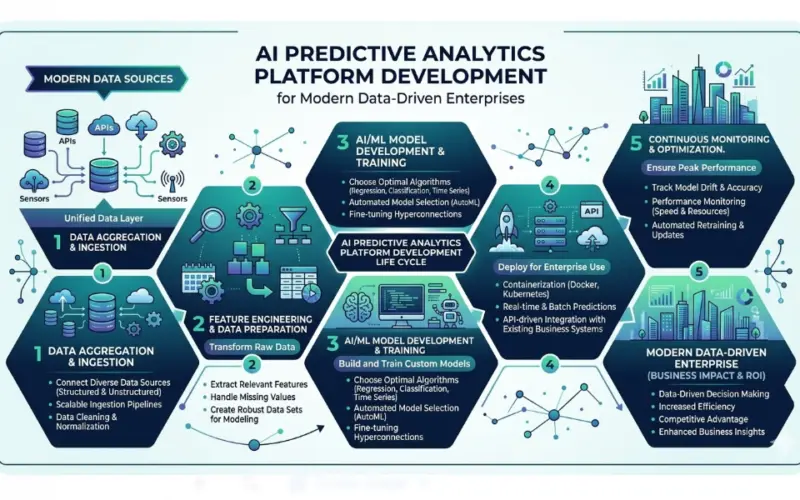
Building an AI predictive analytics platform requires a structured development approach that combines data science expertise with advanced software engineering practices.
The development process begins with identifying the business objectives and defining the use cases for predictive analytics. Organizations must determine what problems they want to solve and what outcomes they want to predict.
The next step involves collecting and preparing data. Data scientists gather historical datasets from various sources and clean the data to remove inconsistencies. Data preprocessing is essential because the quality of predictions depends heavily on the quality of the data used to train machine learning models.
After preparing the data, developers build machine learning models tailored to the business requirements. These models are trained using historical data and optimized to achieve high prediction accuracy.
Once the models are developed, they are integrated into the analytics platform. The platform includes user interfaces, dashboards, and APIs that allow businesses to interact with predictive models and analyze insights easily.
Testing and optimization are critical stages of the development process. Developers evaluate predictive model performance and refine them to improve accuracy and efficiency. Continuous monitoring ensures that the models remain effective as business conditions change.
Cost Considerations for Predictive Analytics Platforms
Developing an AI predictive analytics platform involves several cost factors, including infrastructure, development resources, data integration, and ongoing maintenance.
The platform's complexity plays a major role in determining the required investment. Basic predictive analytics systems with limited functionality may require a smaller budget, while enterprise-grade platforms with advanced AI capabilities can require significantly larger investments.
Businesses also need to consider expenses related to cloud infrastructure, data storage, and processing power. Predictive analytics platforms often rely on large-scale computing resources to process massive datasets.
Another important factor businesses must evaluate is the development cost of prediction market platforms when integrating forecasting features into analytics platforms. Platforms that combine predictive analytics with prediction markets require additional functionality, such as user-participation mechanisms, forecasting algorithms, and financial models. These features can increase development complexity and overall project costs.
However, despite the initial investment, predictive analytics platforms often deliver a strong return on investment by improving decision-making and increasing operational efficiency.
Industry Applications of AI Predictive Analytics
AI predictive analytics platforms are being adopted across multiple industries to improve decision-making and operational efficiency.
In the financial sector, predictive analytics helps institutions detect fraud, forecast market trends, and assess credit risks. Banks and fintech companies use predictive models to analyze transaction data and identify suspicious activities.
Healthcare organizations use predictive analytics to improve patient outcomes and optimize resource allocation. Hospitals analyze patient data to predict disease risks and identify potential complications before they occur.
Retail businesses rely on predictive analytics to forecast customer demand and optimize inventory management. By analyzing sales data and consumer behavior, retailers can predict which products will be popular and ensure adequate stock levels.
Logistics companies also benefit from predictive analytics by optimizing delivery routes and forecasting shipping demand. Predictive models help logistics providers reduce fuel costs and improve delivery efficiency.
Manufacturing companies use predictive analytics for predictive maintenance. By analyzing sensor data from machinery, companies can predict equipment failures and schedule maintenance before breakdowns occur.
The Role of Data Governance and Security
As predictive analytics platforms process vast amounts of sensitive data, data governance and security are critical components of these systems.
Organizations must establish clear policies for data collection, storage, and usage. Proper data governance ensures that predictive analytics platforms operate within legal and regulatory frameworks.
Data security measures such as encryption, secure APIs, and role-based access control help protect sensitive business information. Businesses must also implement compliance measures to meet regulatory standards such as data privacy laws.
Transparent data governance practices also build trust among stakeholders. Customers and partners are more likely to support predictive analytics initiatives when they know their data is handled responsibly.
Future Trends in Predictive Analytics Platforms
The future of predictive analytics platforms is closely tied to advancements in artificial intelligence, big data technologies, and decentralized systems.
One major trend is the use of automated machine learning. AutoML tools enable businesses to build predictive models without requiring extensive data science expertise. This democratizes access to predictive analytics and allows more organizations to leverage AI-driven insights.
Another trend is the integration of predictive analytics with real-time data streams from IoT devices. This enables businesses to analyze data from connected devices and predict events as they occur.
Edge computing is also gaining traction in predictive analytics. Instead of processing data solely in centralized cloud systems, edge computing allows predictions to be generated closer to the data source, reducing latency and improving efficiency.
Crowdsourced forecasting is another emerging trend. By combining AI algorithms with user insights, organizations can improve prediction accuracy and create collaborative forecasting systems.
The Growing Demand for White Label Prediction Platforms
As predictive analytics technologies evolve, many businesses are looking for faster ways to launch prediction-based platforms without building everything from scratch.
This demand has led to the rise of White Label prediction market software, which allows companies to deploy customizable prediction platforms under their own brand. These solutions provide pre-built infrastructure for market forecasting, enabling organizations to focus on user engagement and business growth rather than on complex development processes.
White label solutions significantly reduce development time and cost while still offering advanced features such as AI-powered analytics, market forecasting tools, and customizable user interfaces. Businesses can adapt these platforms to various industries including finance, sports forecasting, and event prediction markets.
Conclusion
AI predictive analytics platforms are transforming how modern enterprises use data to make strategic decisions. By analyzing historical and real-time data, these platforms enable organizations to forecast trends, reduce risks, and optimize operations.
As the digital economy continues to evolve, businesses that invest in predictive analytics will gain a significant competitive advantage. These platforms empower companies to move from reactive decision-making to proactive strategies based on accurate predictions.
With the growing integration of AI, machine learning, and decentralized forecasting systems, predictive analytics platforms are becoming more powerful and accessible. Organizations exploring predictive technologies from enterprise analytics systems to prediction marketplaces have an opportunity to unlock new levels of innovation and growth.
In the era of data-driven business, predictive analytics is no longer a luxury it is becoming a necessity for enterprises that want to thrive in a rapidly changing world.
AI Predictive Analytics Platform prediction marketplace platform development
Disclaimer
This content is a community contribution. The views and data expressed are solely those of the author and do not reflect the official position or endorsement of nasscom.
That the contents of third-party articles/blogs published here on the website, and the interpretation of all information in the article/blogs such as data, maps, numbers, opinions etc. displayed in the article/blogs and views or the opinions expressed within the content are solely of the author's; and do not reflect the opinions and beliefs of NASSCOM or its affiliates in any manner. NASSCOM does not take any liability w.r.t. content in any manner and will not be liable in any manner whatsoever for any kind of liability arising out of any act, error or omission. The contents of third-party article/blogs published, are provided solely as convenience; and the presence of these articles/blogs should not, under any circumstances, be considered as an endorsement of the contents by NASSCOM in any manner; and if you chose to access these articles/blogs , you do so at your own risk.