
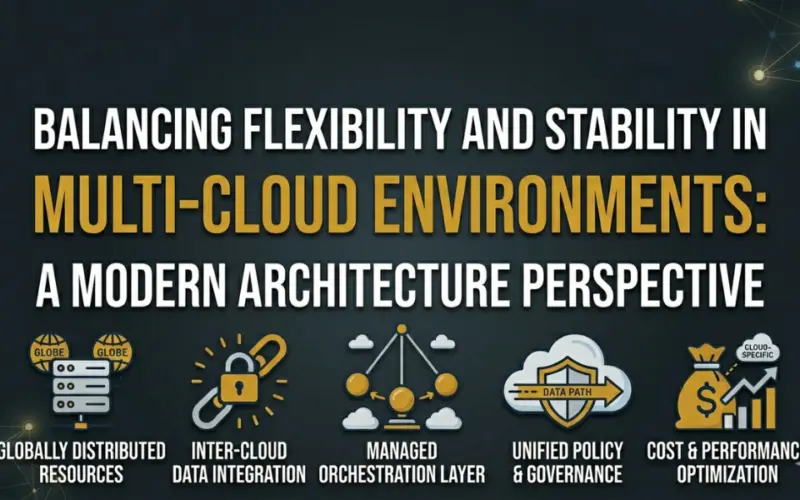

India's digital transformation journey has accelerated the adoption of cloud technologies across startups and enterprises. As organizations scale, many are moving beyond single-provider strategies toward multi-cloud environments to gain flexibility, avoid vendor lock-in, and improve resilience.
However, this shift introduces a critical balancing act-how to maintain operational stability while leveraging the flexibility that multi-cloud offers. For decision-makers evaluating infrastructure options, including models like affordable cloud hosting India, the focus is increasingly on building systems that are both agile and dependable.
Industry Landscape: Multi-Cloud Adoption on the Rise
The adoption of multi-cloud strategies in India reflects a broader global trend. Organizations are distributing workloads across multiple cloud providers to optimize performance, cost, and compliance.
Key developments shaping this landscape include:
- Over 80% of enterprises globally are expected to adopt multi-cloud strategies in some form
- Indian enterprises are prioritizing data localization and redundancy, driving multi-cloud adoption
- The rise of AI, analytics, and digital platforms is increasing demand for highly available infrastructure
While multi-cloud enables flexibility, it also adds layers of complexity in management, integration, and governance.
Core Challenges: Where Flexibility Meets Complexity
Balancing flexibility and stability in multi-cloud environments is not without its challenges. Organizations often encounter the following issues:
1. Operational Fragmentation
Managing multiple cloud platforms can lead to siloed operations.
- Different interfaces, tools, and processes increase complexity
- Lack of standardization can slow down decision-making
2. Inconsistent Performance and Reliability
Workloads distributed across clouds may experience varying performance levels.
- Latency differences between providers
- Dependency on network reliability for cross-cloud communication
3. Cost Visibility and Control
While multi-cloud aims to optimize costs, it can sometimes lead to unexpected expenses.
- Difficulty in tracking usage across providers
- Inefficient resource allocation
4. Security and Compliance Challenges
Maintaining consistent security policies across platforms is complex.
- Variations in security models and configurations
- Increased risk of misconfigurations
Strategic Approaches to Achieve Balance
Organizations are adopting structured practices to ensure that flexibility does not compromise stability in multi-cloud environments.
1. Unified Cloud Management Platforms
Centralized tools help manage multiple cloud environments from a single interface.
- Improve visibility and control
- Enable consistent policy enforcement
2. Standardization of Workloads
Using common frameworks and architectures across clouds reduces variability.
- Containerization and orchestration tools ensure portability
- Simplifies deployment and scaling processes
3. Intelligent Workload Placement
Not all workloads require the same environment. Strategic placement improves efficiency.
- Latency-sensitive applications can be deployed closer to users
- Critical workloads can be distributed for redundancy
4. Automation and Monitoring
Automation ensures consistency, while monitoring provides real-time insights.
- Automated scaling maintains performance stability
- Continuous monitoring helps detect anomalies early
5. Cost Optimization Practices
Structured cost management ensures that flexibility remains financially viable.
- Regular audits of cloud usage
- Rightsizing resources based on actual demand
Driving Innovation Through Balanced Cloud Strategies
A well-managed multi-cloud strategy enables organizations to innovate without compromising reliability.
Key benefits include:
- Enhanced Agility: Faster deployment and experimentation across platforms
- Improved Resilience: Reduced risk of downtime through redundancy
- Better User Experience: Optimized performance across regions
- Scalable Growth: Infrastructure that adapts to evolving business needs
For India's fast-growing digital ecosystem, this balance is essential to support innovation at scale while maintaining operational confidence.
Future Outlook: Toward Intelligent Multi-Cloud Ecosystems
As cloud technologies continue to evolve, multi-cloud environments are expected to become more intelligent and automated. Emerging trends such as AI-driven infrastructure management, edge computing, and policy-based automation will further simplify complexity.
Indian organizations are likely to focus on building cloud strategies that are not only flexible but also resilient and compliant. The emphasis will shift from merely adopting multiple clouds to managing them efficiently as a unified ecosystem.
Conclusion: Achieving Stability Without Sacrificing Flexibility
Multi-cloud environments offer significant advantages, but their success depends on thoughtful implementation. Balancing flexibility with stability requires a combination of standardization, automation, and strategic planning.
By adopting best practices and focusing on long-term resilience, Indian startups and enterprises can unlock the full potential of multi-cloud while minimizing associated risks. In an increasingly digital economy, this balance will be a key differentiator for sustainable growth.
Multi-Cloud Strategy Cloud Computing India IT infrastructure digital transformation Affordable Cloud Hosting India enterprise technology
Disclaimer
This content is a community contribution. The views and data expressed are solely those of the author and do not reflect the official position or endorsement of nasscom.
That the contents of third-party articles/blogs published here on the website, and the interpretation of all information in the article/blogs such as data, maps, numbers, opinions etc. displayed in the article/blogs and views or the opinions expressed within the content are solely of the author's; and do not reflect the opinions and beliefs of NASSCOM or its affiliates in any manner. NASSCOM does not take any liability w.r.t. content in any manner and will not be liable in any manner whatsoever for any kind of liability arising out of any act, error or omission. The contents of third-party article/blogs published, are provided solely as convenience; and the presence of these articles/blogs should not, under any circumstances, be considered as an endorsement of the contents by NASSCOM in any manner; and if you chose to access these articles/blogs , you do so at your own risk.
Co-Founder and CMO
Technology thrives at the intersection of innovation and infrastructure. My dual role is my commitment to both: fueling innovation at my company and strengthening the industry's infrastructure through NASSCOM's council. Together, we're not just navigating change; we're laying down the tracks for progress.