




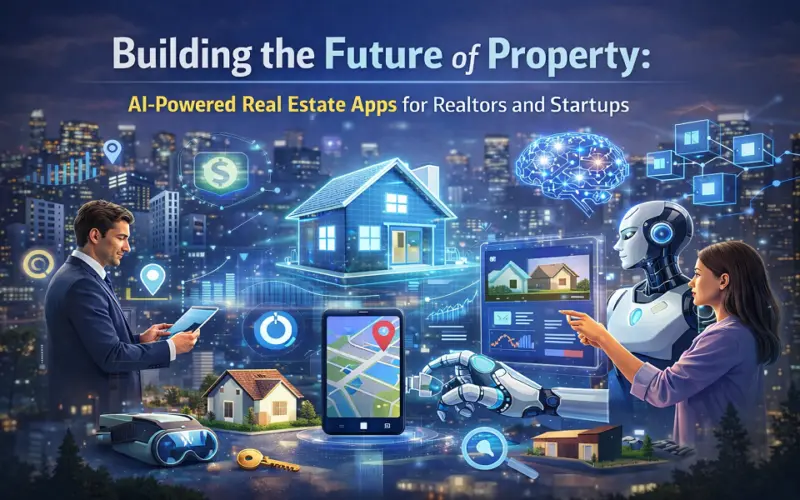

Imagine a real estate app that goes beyond listings, one that understands users, predicts preferences, and helps close deals faster. This is already a reality, with AI transforming how realtors, agencies, and proptech startups operate.
Today's property market is highly competitive. Buyers expect speed, personalization, and useful insights instead of static listings. This shift has driven the rise of AI-powered apps that use machine learning, predictive analytics, and automation to improve search, lead management, pricing, and engagement.
For realtors, AI reduces manual work and improves lead quality. For startups, it enables scalable solutions and new business models. Understanding AI in real estate app development is now essential to stay competitive.
This guide explains how these apps work, why they matter, the types you can build, and how to develop one from planning to growth.
Traditional Real Estate Apps vs AI Real Estate Apps
Traditional real estate apps made property search easier by digitizing listings and allowing filters like price, size, and location. While helpful, these platforms depend on static data and manual inputs. They do not adapt to user behavior or offer forward-looking insights.
AI-powered real estate apps mark the next stage of evolution. They analyze user activity, market patterns, and historical data to deliver personalized and intelligent experiences. Instead of just showing listings, they guide users with insights that support better decisions.
Key differences include:
- Traditional apps depend on manual search, while AI apps recommend properties based on user behavior
- Lead management is manual in traditional systems but automated and scored in AI platforms
- Pricing in older apps can be outdated, while AI enables real-time property valuation
- AI apps personalize user journeys and offer round-the-clock assistance through virtual agents
- Decision-making becomes predictive with AI-driven insights instead of reactive
The result is improved efficiency, stronger engagement, and faster deal closures.
Why Invest in AI Real Estate App Development?
AI adoption in real estate is no longer optional. It has become a key growth strategy.
The AI real estate market is expanding quickly, with strong investment in intelligent property platforms. This reflects the industry's need for smarter, more efficient solutions.
Key reasons to invest include:
- Smarter decision-making: AI enables personalized recommendations, accurate valuations, and predictive insights
- Higher efficiency: Automation reduces manual tasks and lowers operational costs
- Scalability: AI platforms can grow without a proportional increase in team size
- Market differentiation: Intelligent features help your product stand out in a competitive space
- Long-term ROI: AI systems improve over time, increasing their value continuously
Early adoption helps businesses position themselves as innovators and build a lasting competitive edge.
Types of AI Real Estate Apps You Can Build
AI can be applied across the entire real estate ecosystem. Based on your goals and target users, you can build a range of intelligent solutions.
Popular AI real estate app types include:
1. AI Property Search and Recommendation Apps
Analyze user behavior and preferences to suggest relevant properties, improving match accuracy and saving time
2. AI-Powered Valuation Apps
Deliver real-time and predictive pricing using market trends, location insights, and historical data
3. AI Lead Management Apps
Score and prioritize leads based on intent, helping agents focus on high-conversion opportunities
4. AI Chatbots and Virtual Assistants
Provide round-the-clock support for inquiries, scheduling, and guidance without human involvement
5. AI Investment Analysis Apps
Assess ROI, risk, rental yield, and appreciation potential for informed investment decisions
6. AI Mortgage and Loan Matching Apps
Match buyers with suitable financing options based on their financial profiles
7. AI Virtual Tour Apps
Enable immersive property experiences using AR, VR, and personalized walkthroughs
8. AI Document Automation Apps
Streamline contract creation, verification, and compliance processes
9. AI Fraud Detection Apps
Detect fake listings, suspicious activity, and risky transactions to enhance security
10. AI Smart Home Integration Apps
Combine AI with IoT to highlight automation, energy efficiency, and smart features
11. AI Market Analytics Apps
Predict trends, demand areas, and investment opportunities using data insights
12. AI Property Management Apps
Automate rent collection, tenant screening, and maintenance with predictive capabilities
Each type addresses specific challenges and opens new opportunities for innovation in real estate.
Benefits of AI Real Estate App Development
AI real estate apps turn traditional platforms into intelligent, data-driven systems. They help users find relevant properties faster, enable accurate pricing with real-time insights, and support better decision-making for buyers and sellers.
By automating lead management, customer support, and routine tasks, AI improves efficiency while enhancing the overall user experience. The result is higher conversions, reduced costs, and a stronger competitive position.
Key benefits include:
Faster and smarter property search
AI studies user behavior to deliver highly relevant recommendations, saving time and improving satisfaction
Accurate pricing and valuations
Real-time and predictive analytics help users make confident buying and selling decisions
Higher lead conversion rates
AI-based lead scoring highlights high-intent prospects for quicker deal closures
Reduced operational workload
Automation handles repetitive tasks like inquiries, scheduling, and documentation
Enhanced customer experience
Personalized suggestions and instant responses create a smooth user journey
Actionable market insights
AI analyzes large datasets to predict trends and uncover investment opportunities
These benefits make AI a powerful driver of efficiency and growth in modern real estate platforms.
Step-by-Step AI Real Estate App Development Process
Building an AI-powered real estate app is a structured journey that transforms an idea into a scalable, intelligent product. Each step ensures the app delivers real value while staying reliable and future-ready.
Planning and requirement analysis
Define business goals, target users, and the core problems to solve. Market research and competitor analysis help align the product with real needs, along with a clear monetization approach.
Data preparation and system architecture
Collect, clean, and structure property, market, and user data for AI models. Design a scalable cloud-based architecture to handle large datasets and future growth.
UI and UX design with prototyping
Create intuitive user journeys for smooth property search experiences. Wireframes and prototypes help validate usability early and reduce design changes later.
AI model development and validation
Build and test key AI features such as recommendations or pricing models through a proof of concept to ensure accuracy and feasibility.
MVP development
Launch a basic version with essential features and limited AI capabilities. Gather user feedback to refine the product while keeping costs controlled.
Scaling and advanced AI integration
Add features like predictive analytics, chatbots, and lead scoring. Continuously improve models as more data becomes available.
Testing, security, and compliance
Ensure performance, reliability, and AI accuracy through testing. Implement strong security and data privacy measures to build user trust.
Launch and continuous improvement
Release the app with monitoring systems in place. Use feedback and analytics to introduce updates and keep the platform competitive.
Business and Monetization Models for AI Real Estate App Development
To sustain long-term growth, AI real estate apps need clear and effective revenue strategies that align with user value.
Subscription plans for realtors and agencies
Charge monthly or yearly fees for access to advanced features like lead scoring, analytics, and enhanced listings. This creates predictable recurring revenue and improves customer retention.
Premium listing placements
Allow agents or property owners to pay for featured listings that appear at the top of search results. AI helps target the right audience, increasing visibility and conversion chances.
Transaction-based commissions
Earn a percentage from successful property sales, rentals, or loan transactions completed through the platform. This ties revenue directly to user success.
Advertising and strategic partnerships
Generate income by partnering with mortgage providers, insurers, legal services, and home service companies. AI enables precise targeting, showing relevant offers to users at the right time.
A well-balanced monetization approach helps ensure steady revenue while enhancing the overall platform experience.
Major Challenges in Building AI Real Estate Apps and Their Solutions
AI real estate app development comes with challenges such as data privacy concerns, limited access to quality data, high costs, and over-automation. These can be addressed with the right strategies and a balanced approach.
Data privacy and compliance
Real estate apps handle sensitive personal and financial data, making security and regulatory compliance critical.
Solution: Follow a privacy-first approach with strong encryption, secure authentication, consent management, and compliance with regulations like GDPR and CCPA.
Access to quality data
AI models require large volumes of accurate and up-to-date property and market data, which is often fragmented.
Solution: Partner with reliable data providers, and invest in data cleaning, validation, and real-time integrations.
High development and maintenance costs
Building AI models and managing infrastructure can be expensive, especially in early stages.
Solution: Start with an MVP to validate key features, use cloud-based AI services, and scale gradually as adoption increases.
Balancing automation with human interaction
Too much automation can reduce user trust in important property decisions.
Solution: Use AI to handle repetitive tasks while keeping human experts involved in critical interactions.
Addressing these challenges effectively helps create a secure, scalable, and user-centric AI real estate platform.
Future Trends in AI Real Estate App Development
The future of AI in real estate is centered on smarter, more secure, and highly personalized platforms. These advancements will reshape how buyers, sellers, and realtors interact with digital property solutions.
Generative AI for contracts and documentation
AI will automate the creation of contracts and legal documents based on deal terms and regulations.
Impact: Less paperwork, fewer errors, and faster transactions with reduced manual effort.
Blockchain with AI for secure transactions
Combining AI-driven fraud detection with blockchain will ensure transparent and tamper-proof property records.
Impact: Increased trust, lower fraud risk, and more reliable transactions.
Hyper-personalized property recommendations
AI will analyze lifestyle choices, financial goals, and behavior patterns to deliver precise suggestions.
Impact: More relevant listings, higher satisfaction, and better conversion rates.
Smart home and IoT integration
Apps will highlight smart features like automation, energy efficiency, and advanced security systems.
Impact: Greater appeal to modern buyers and new revenue opportunities.
Predictive market intelligence
AI will forecast trends, pricing shifts, and investment hotspots with improved accuracy.
Impact: Enables proactive, data-driven decisions for realtors and investors.
These trends will turn real estate apps into intelligent decision-making platforms, giving early adopters a strong competitive edge.
Conclusion
AI real estate app development is transforming how buyers, sellers, and realtors interact in the digital landscape. Businesses adopting AI are building smarter, more efficient, and scalable solutions that meet evolving market expectations.
With the right strategy and technology approach, AI-powered real estate apps can unlock new opportunities for growth, innovation, and long-term success.
The future of real estate lies in intelligent, data-driven platforms that deliver faster decisions, better experiences, and stronger outcomes.
AI Real Estate AI in Real Estate AIApplications articial intelligence
Disclaimer
This content is a community contribution. The views and data expressed are solely those of the author and do not reflect the official position or endorsement of nasscom.
That the contents of third-party articles/blogs published here on the website, and the interpretation of all information in the article/blogs such as data, maps, numbers, opinions etc. displayed in the article/blogs and views or the opinions expressed within the content are solely of the author's; and do not reflect the opinions and beliefs of NASSCOM or its affiliates in any manner. NASSCOM does not take any liability w.r.t. content in any manner and will not be liable in any manner whatsoever for any kind of liability arising out of any act, error or omission. The contents of third-party article/blogs published, are provided solely as convenience; and the presence of these articles/blogs should not, under any circumstances, be considered as an endorsement of the contents by NASSCOM in any manner; and if you chose to access these articles/blogs , you do so at your own risk.
Co-Founder & Digital Strategist at PixelBrainy
Sagar Sahay Bhatnagar is the Co-founder and CTO at PixelBrainy, bringing over a decade of experience in the IT industry. A visionary tech leader, Sagar excels in innovative software development and strategic technology management. His expertise drives PixelBrainy's mission to deliver cutting-edge digital solutions. Passionate about leveraging technology for transformative impact, Sagar's leadership and technical acumen continue to propel the company's growth and success.