




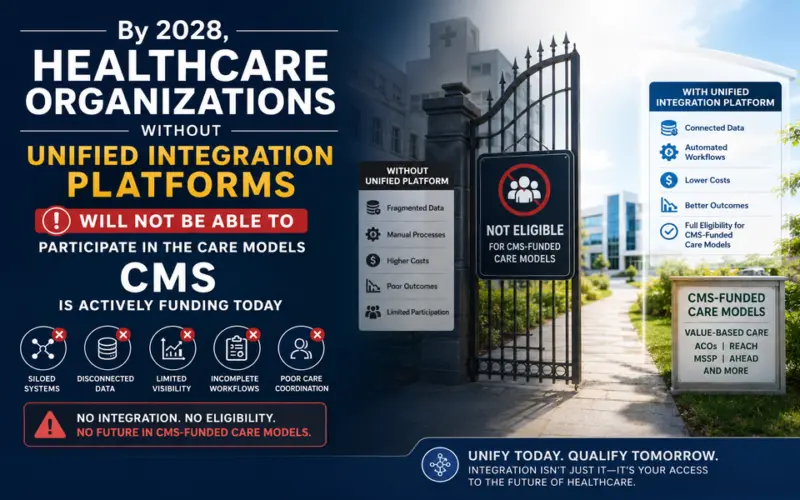

There is a version of this conversation that sounds abstract until the numbers arrive.
CMS is in the middle of the most aggressive value-based care model expansion in the agency's history.
The LEAD Model - the Long-term Enhanced ACO Design - launches January 1, 2027, and runs for ten years. The ACCESS Model began accepting applications in April 2026 and launched in July 2026. CMS-0057-F requires all five FHIR-based payer APIs in production by January 1, 2027. The CMS Interoperability Proposed Rule CMS-0062-P, still in rulemaking, will extend those requirements further.
Every one of these models carries a common technical prerequisite that is stated explicitly in the program documentation: FHIR-based API exchange, bidirectional data sharing, and integrated care coordination infrastructure. Not as a future aspiration. As an application requirement.
The organizations that are spending 2026 managing healthcare integration issues on aging point-to-point infrastructure are not just running inefficient data pipelines. They are systematically disqualifying themselves from the reimbursement models that will define the financial structure of U.S. healthcare through 2036.
What CMS Is Actually Building - and What It Requires
Understanding the stakes requires understanding the architecture CMS is constructing, model by model, year by year.
ACO REACH concludes at end of 2026. Its successor, the LEAD Model, launches January 1, 2027. LEAD is a voluntary ACO model with a planned performance period from January 1, 2027, through December 31, 2036 - the longest-running ACO model launched by the Innovation Center to date. It introduces CMS-Administered Risk Arrangements (CARA), a new digital data sharing and payment platform designed to facilitate downstream, episode-based risk arrangements between ACOs and specialists. Every component of CARA depends on data flowing cleanly between participating organizations through standardized interfaces. Organizations with fragmented, undocumented interface portfolios cannot generate the data quality CARA requires.
The ACCESS Model, which launched July 2026, is designed for organizations with mature clinical operations and data infrastructure. ACCESS presumes API-driven data exchange, including consent capture, eligibility checks, claims and clinical data integration, and bidirectional information sharing with the patient's broader care team. Applicants must ensure they have a FHIR API server and meet the requirements described in the CMS Health Tech Ecosystem pledge. This is not soft guidance. It is a stated application prerequisite. Organizations that cannot demonstrate FHIR API readiness did not qualify for the July 2026 cohort and face the same barrier for the January 2027 cohort.
CMS-0057-F, the 2024 Interoperability and Prior Authorization Final Rule, requires all five FHIR-based APIs - Patient Access, Provider Access, Provider Directory, Payer-to-Payer, and Prior Authorization - in production by January 1, 2027. Organizations that don't prepare now will face data gaps, missed deadlines, and the risk of penalties, regulatory scrutiny, or reputational damage. For payer-adjacent organizations, this is not a voluntary modernization initiative. It is a compliance deadline with enforcement consequences.
Taken together, these three parallel tracks - LEAD, ACCESS, and CMS-0057-F - represent a federal architecture for healthcare reimbursement that assumes FHIR-native integration as the baseline. Not as a future capability. As the current table stakes.
Why "Healthcare Integration Issues" Are Now a Strategic Disqualifier
The term healthcare integration issues usually refers to the operational friction caused by fragmented data systems - duplicate documentation, delayed alerts, batch feeds that arrive too late to inform clinical decisions. That framing, while accurate, undersells the risk considerably in 2026.
The emerging risk is not operational. It is strategic. Healthcare organizations with healthcare integration issues at the architectural level - no unified integration platform, no FHIR API infrastructure, no bidirectional connectivity between clinical and financial systems - are not just running inefficiently. They are building a structural inability to participate in the programs CMS is using to direct Medicare and Medicaid payment.
Consider what LEAD requires operationally. It is a total cost of care model with capitated, population-based payments. Participating ACOs must track every clinical event, every care transition, every specialist referral, and every quality measure across an attributed population - and report that data to CMS in a format and at a cadence that aging HL7 v2 point-to-point infrastructure was never designed to support.
Many organizations discover that their "FHIR-ready" systems need significant upgrades to meet real-world interoperability demands. The gap between having a FHIR endpoint and having a unified integration platform that can ingest, normalize, route, and report clinical data at population scale is the gap between checkbox compliance and genuine participation capability. CMS's model documentation distinguishes between the two. Organizations that built point-to-point interfaces and declared themselves interoperable are discovering that distinction in real time.
The Timeline That Leaves No Comfortable Buffer
Organizations accustomed to treating integration modernization as a multi-year, low-urgency initiative need to recalibrate against actual deployment timelines.
Most organizations require 6 to 9 months for comprehensive FHIR implementation, with multi-site consolidation extending to 12 to 18 months depending on complexity. That timeline means an organization that begins integration platform assessment today is looking at production readiness in late 2026 at the earliest - and 2027 for anything involving multi-site complexity or significant legacy remediation.
The LEAD Model application window opened in March 2026. The ACCESS Model second cohort starts January 2027. CMS-0057-F full API compliance is required January 1, 2027.
An organization that has not begun its integration modernization assessment is already behind the procurement and implementation schedule required to participate in the next wave of these models. The buffer that felt comfortable 18 months ago has closed.
What Unified Integration Actually Requires
Resolving healthcare integration issues at the scale these models demand is not a point-solution problem. It requires four capabilities working as a coherent platform.
A single integration engine that consolidates HL7 v2 feeds, FHIR R4 APIs, payer data connections, and post-acute network feeds into one governed, monitored architecture. Hub-and-spoke integration eliminates the compounding maintenance burden of point-to-point portfolios and reduces per-interface build cost by 40 to 60 percent once the platform infrastructure is established.
FHIR R4 bidirectional capability with documented API scope - not just read access to patient records, but write-back of clinical events, real-time prior authorization status, and population-level bulk data access for quality measure reporting. The distinction between FHIR read and FHIR read-write is the distinction between CMS compliance optics and genuine model participation capability.
Governance and monitoring infrastructure that treats integration data as a managed asset - with real-time alerting on interface failures, audit trails that satisfy HIPAA Security Rule requirements, and documented recertification processes for every EHR upgrade cycle. CMS model audits increasingly examine data completeness and source documentation, not just submission accuracy.
Population health data flows that connect the clinical record to risk stratification, care gap identification, and quality measure generation without manual extraction, reformatting, or analyst intervention. LEAD's CARA platform and the ACCESS Model's outcomes reporting both require this level of automated, structured data production at scale.
The Organizations Pulling Ahead Are Already Building
The health systems, ACOs, and digital health companies that are winning participation slots in LEAD, ACCESS, and the payer FHIR mandates are not the largest organizations in the market. They are the organizations that made the integration platform investment 12 to 24 months ahead of the deadlines - and are now collecting the reimbursement and quality bonus income that their fragmented competitors cannot access.
This is the structural consequence of healthcare integration issues left unresolved through multiple budget cycles. The cost was always there. It was just denominated in missed opportunity rather than direct expense - until the missed opportunities became missed program applications, missed compliance deadlines, and missed payment model participation.
The window to change that outcome for the 2027 cohort is open. It will not stay open indefinitely.
Build the Integration Infrastructure That CMS Requires
Our team helps healthcare organizations assess their current integration architecture against CMS model participation requirements, identify the gaps between their current infrastructure and FHIR API readiness, and build the unified integration platform that turns compliance requirements into reimbursement opportunities.
healthcare integration services Healthcare integration issues Integrated health solutions
Disclaimer
This content is a community contribution. The views and data expressed are solely those of the author and do not reflect the official position or endorsement of nasscom.
That the contents of third-party articles/blogs published here on the website, and the interpretation of all information in the article/blogs such as data, maps, numbers, opinions etc. displayed in the article/blogs and views or the opinions expressed within the content are solely of the author's; and do not reflect the opinions and beliefs of NASSCOM or its affiliates in any manner. NASSCOM does not take any liability w.r.t. content in any manner and will not be liable in any manner whatsoever for any kind of liability arising out of any act, error or omission. The contents of third-party article/blogs published, are provided solely as convenience; and the presence of these articles/blogs should not, under any circumstances, be considered as an endorsement of the contents by NASSCOM in any manner; and if you chose to access these articles/blogs , you do so at your own risk.