





Building healthcare software is not like building a regular app. The stakes are higher, the regulations stricter, and the consequences of failure can directly impact patient lives.
A structured approach to custom healthcare software development is not optional - it is essential.
Whether you are developing an EHR system, a telemedicine platform, a patient portal, or a clinical decision-support tool, having a clear implementation checklist dramatically increases your chances of launching on time, within budget, and in full compliance. Below is a comprehensive guide to help healthcare organizations and development teams navigate every critical phase.
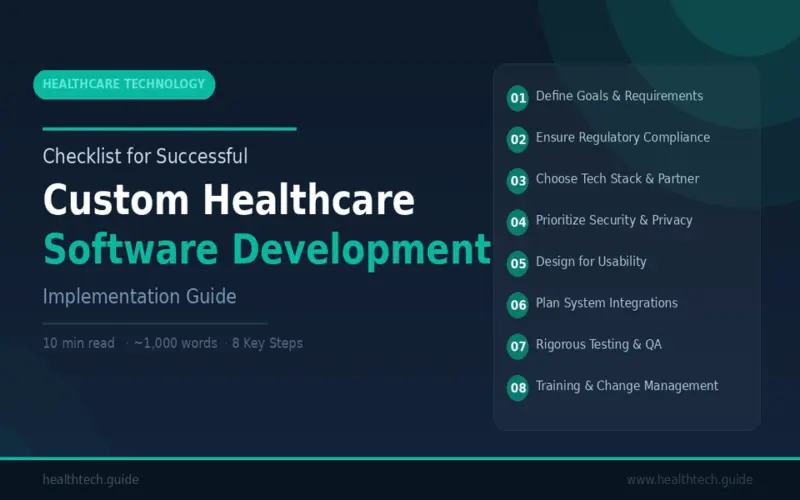
1. Define Clear Project Goals and Stakeholder Requirements
Every successful custom healthcare software development project begins with clarity on what the software must achieve. Vague requirements lead to scope creep, budget overruns, and misaligned products. Before writing a single line of code, every stakeholder must be aligned on the purpose and expected outcomes of the system.
- Identify all stakeholders - physicians, nurses, administrators, billing teams, and IT staff - and document their workflows and pain points.
- Define measurable success metrics such as reduced patient wait times, faster documentation, or improved billing accuracy.
- Create detailed use-case scenarios that reflect real clinical environments, not idealized ones.
2. Ensure Regulatory Compliance from Day One
Compliance is not a checkbox you tick at the end - it must be embedded into every design and development decision. Depending on your region and software type, you must address frameworks such as HIPAA (USA), GDPR (Europe), HL7, and FHIR standards. A HIPAA violation can cost between $100 and $50,000 per violation and can permanently damage patient trust.
- Engage a healthcare compliance consultant early to identify all applicable regulations for your specific software type.
- Design data flows and access controls that meet HIPAA's minimum-necessary standard and audit trail requirements.
- Plan for FHIR/HL7 interoperability if the software needs to communicate with other healthcare systems or EHRs.
3. Choose the Right Technology Stack and Development Partner
The technology choices you make early in custom healthcare software development will shape scalability, security, and long-term maintenance. Not every development team has deep healthcare domain expertise - this distinction matters enormously. Always vet your development partner on prior healthcare projects, not just general software portfolios.
- Select a stack that supports security standards - encryption at rest and in transit, OAuth 2.0 authentication, and role-based access control.
- Vet your development partner specifically on HIPAA-compliant architectures they have built previously.
- Evaluate cloud infrastructure options like AWS GovCloud, Microsoft Azure Health APIs, or Google Cloud Healthcare API for compliant hosting environments.
4. Prioritize Security Architecture and Data Privacy
Healthcare data is among the most targeted in the world. A security-first mindset during custom healthcare software development is not a luxury - it is a baseline requirement. The average cost of a healthcare data breach in 2023 was $9.7 million, making proactive investment in security far more cost-effective than reactive recovery.
- Conduct threat modeling sessions before development begins to identify potential attack surfaces in your architecture.
- Implement multi-factor authentication and session timeout policies across all user roles.
- Schedule regular penetration testing throughout development - not only before go-live.
- Create a comprehensive data backup and disaster recovery plan with defined RPO and RTO targets.
5. Design for Clinical Usability and Accessibility
A technically sound system that clinicians find frustrating to use will fail in practice. Healthcare UX requires understanding the cognitive load of medical professionals working under pressure. Software that slows down a physician or adds unnecessary steps to a nurse's workflow will face resistance and poor adoption regardless of how well it is built.
- Involve end-users in design sprints - especially physicians and nurses - to validate workflows before full development begins.
- Follow WCAG 2.1 accessibility guidelines to ensure the software is usable by staff with disabilities and by patients of varying abilities.
- Minimize click depth for critical actions like emergency alerts, prescription entry, or lab result review.
6. Plan Integration with Existing Healthcare Systems
Modern healthcare organizations operate multiple systems simultaneously - EHRs, laboratory information systems, billing platforms, and pharmacy systems. Your custom healthcare software development must account for seamless interoperability from the start. Integration challenges are one of the most common causes of project delays and cost overruns.
- Map all existing systems the new software must connect with and document their APIs and data formats early.
- Use industry-standard protocols such as HL7 and FHIR R4 rather than proprietary integrations that create future vendor lock-in.
- Build and test integration layers in staging environments that mirror production as closely as possible.
7. Execute Rigorous Testing Before Go-Live
Testing in healthcare software carries a moral weight that typical software does not. Bugs here can delay diagnoses or cause medication errors. Your QA process must be thorough, documented, and repeatable. Cutting corners on testing to hit a launch deadline is never acceptable in a clinical environment.
- Perform unit, integration, and end-to-end testing across all clinical workflows, edge cases, and failure scenarios.
- Conduct User Acceptance Testing with actual clinical staff in a controlled environment before launching.
- Test performance under peak load conditions simulating high patient volumes, concurrent users, and large data transactions.
8. Invest in Training and Change Management
Adoption failure is one of the leading causes of healthcare IT project collapse. Even the most brilliantly built custom healthcare software development will deliver zero value if clinical staff do not use it effectively. Studies show that software adoption is three times faster when organizations invest in structured training programs and dedicated change management.
- Develop role-specific training programs tailored separately to physicians, nurses, front-desk staff, and administrators.
- Designate internal super-users who receive advanced training and can support colleagues during the transition period.
- Create a post-launch feedback loop to capture user issues and resolve them rapidly after go-live.
Conclusion
Successful custom healthcare software development is the product of methodical planning, unwavering compliance discipline, clinical empathy in design, and post-launch commitment to continuous improvement. Each point in this checklist represents a potential failure if overlooked - and a genuine competitive advantage when executed well.
Healthcare organizations that treat software implementation as a strategic initiative - not just an IT project - consistently deliver systems that improve patient outcomes, streamline operations, and stand the test of time. The checklist above is not a one-time document. It should be revisited at every phase of your project to ensure that nothing critical is left behind.
healthcare software development Custom Healthcare Software Development Healthcare app development
Disclaimer
This content is a community contribution. The views and data expressed are solely those of the author and do not reflect the official position or endorsement of nasscom.
That the contents of third-party articles/blogs published here on the website, and the interpretation of all information in the article/blogs such as data, maps, numbers, opinions etc. displayed in the article/blogs and views or the opinions expressed within the content are solely of the author's; and do not reflect the opinions and beliefs of NASSCOM or its affiliates in any manner. NASSCOM does not take any liability w.r.t. content in any manner and will not be liable in any manner whatsoever for any kind of liability arising out of any act, error or omission. The contents of third-party article/blogs published, are provided solely as convenience; and the presence of these articles/blogs should not, under any circumstances, be considered as an endorsement of the contents by NASSCOM in any manner; and if you chose to access these articles/blogs , you do so at your own risk.