
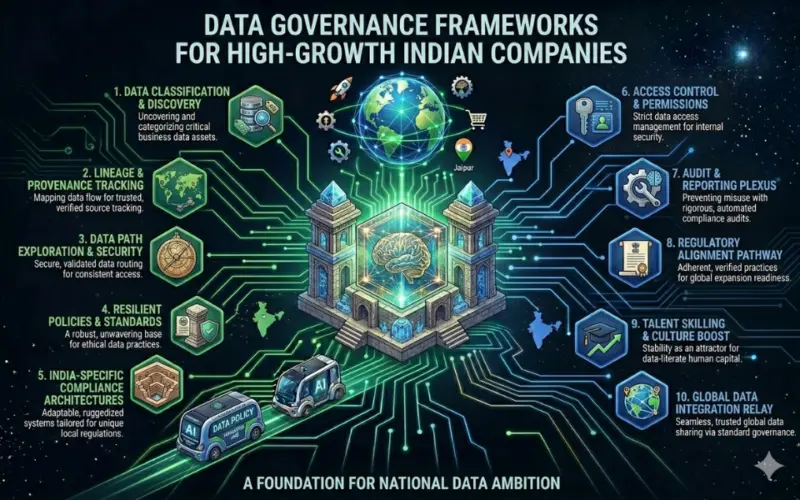

Introduction: Why Data Governance Is a Strategic Imperative
Data has become one of the most valuable assets for high-growth Indian companies.
From fintech platforms analyzing transaction patterns to healthtech startups processing patient insights and SaaS firms optimizing user journeys, data-driven decision-making now shapes competitive advantage.
India's digital economy is expanding rapidly, with increasing regulatory attention on privacy, cybersecurity, and cross-border data flows. In this environment, data governance is no longer limited to compliance functions. It is a strategic framework that ensures accuracy, accountability, security, and responsible innovation.
For founders, CIOs, and technology leaders, building a strong data governance model early can prevent operational risks while supporting sustainable scale.
The Evolving Data Landscape in India
Several trends are redefining how organizations manage information:
- Rapid adoption of AI and advanced analytics
- Growing reliance on cloud hosting in india for scalable infrastructure
- Implementation of stronger data protection regulations
- Expansion into global markets with varying compliance standards
High-growth companies often operate in multi-cloud or hybrid environments. Cloud hosting in india provides flexibility and scalability, but it also introduces new governance complexities, particularly around data residency, encryption, and access controls.
According to industry research, poor data quality can cost organizations up to 15-20% of annual revenue due to inefficiencies and decision errors. As data volumes increase, governance maturity becomes essential.
Common Governance Gaps in Scaling Organizations
Startups and fast-growing enterprises frequently prioritize speed and product expansion. As a result, governance frameworks may evolve reactively rather than strategically.
1. Lack of Clear Data Ownership
Without defined accountability:
- Teams duplicate datasets
- Data definitions vary across departments
- Decision-making becomes inconsistent
Clear data stewardship roles are often missing during early growth stages.
2. Inconsistent Data Quality Controls
Rapid scaling can lead to:
- Incomplete or inaccurate records
- Poor validation mechanisms
- Fragmented reporting structures
These issues weaken analytics accuracy and customer trust.
3. Security and Access Vulnerabilities
As organizations expand across locations and adopt cloud hosting in india, managing access rights becomes more complex. Risks include:
- Excessive user permissions
- Weak authentication mechanisms
- Insufficient audit logging
Security gaps not only expose data but also damage brand credibility.
4. Regulatory Non-Alignment
With evolving Indian and global data protection frameworks, companies must ensure:
- Lawful data collection practices
- Transparent consent management
- Proper data retention and deletion policies
Delayed compliance adjustments can result in penalties and operational disruption.
Building a Robust Data Governance Framework
A structured governance model balances agility with accountability.
Define Clear Governance Structures
Organizations should establish:
- Data owners responsible for domain-specific datasets
- Data stewards managing quality and lifecycle
- Governance committees overseeing policy enforcement
Clear roles reduce ambiguity and improve coordination.
Standardize Data Policies and Documentation
Comprehensive documentation should include:
- Data classification guidelines
- Access control protocols
- Retention schedules
- Incident response frameworks
Consistency strengthens internal alignment and simplifies audits.
Integrate Governance with Cloud Strategy
As enterprises increasingly rely on cloud hosting in india, governance frameworks must extend into cloud environments. Key considerations include:
- Encryption at rest and in transit
- Role-based access control across cloud platforms
- Automated compliance monitoring tools
Embedding governance into infrastructure design prevents misalignment during rapid scale.
Implement Continuous Monitoring and Auditing
Governance is not a one-time initiative. Effective systems include:
- Automated data quality checks
- Regular vulnerability assessments
- Real-time access monitoring
- Periodic policy reviews
This proactive approach ensures frameworks remain aligned with business growth.
Enabling Sustainable Innovation and Trust
Strong data governance directly contributes to long-term ecosystem growth:
- Enhances customer confidence in digital platforms
- Supports AI and analytics accuracy
- Strengthens investor trust
- Facilitates cross-border expansion
India's ambition to become a global digital powerhouse depends on responsible data management practices. High-growth companies that embed governance early are better prepared for regulatory evolution, technological complexity, and global competition.
Moreover, mature governance frameworks reduce operational inefficiencies, enabling teams to focus on innovation rather than remediation.
Conclusion: Governance as a Growth Enabler
In fast-scaling organizations, data often grows faster than internal controls. Without a structured governance framework, even innovative companies may encounter compliance, security, or credibility challenges.
By establishing clear ownership models, aligning governance with cloud infrastructure strategies, and embedding continuous monitoring, high-growth Indian companies can transform governance from a compliance obligation into a strategic advantage.
Responsible data management not only protects organizations-it strengthens India's broader digital ecosystem and builds the foundation for sustainable innovation.
Data Governance Cloud Hosting in India digital transformation data security Startup Compliance Enterprise IT Strategy Indian Tech Ecosystem
Disclaimer
This content is a community contribution. The views and data expressed are solely those of the author and do not reflect the official position or endorsement of nasscom.
That the contents of third-party articles/blogs published here on the website, and the interpretation of all information in the article/blogs such as data, maps, numbers, opinions etc. displayed in the article/blogs and views or the opinions expressed within the content are solely of the author's; and do not reflect the opinions and beliefs of NASSCOM or its affiliates in any manner. NASSCOM does not take any liability w.r.t. content in any manner and will not be liable in any manner whatsoever for any kind of liability arising out of any act, error or omission. The contents of third-party article/blogs published, are provided solely as convenience; and the presence of these articles/blogs should not, under any circumstances, be considered as an endorsement of the contents by NASSCOM in any manner; and if you chose to access these articles/blogs , you do so at your own risk.
Hi, I'm Kartik Sen, a Digital Marketer at CloudMinister the web hosting provider . I specialize in promoting web hosting, cloud VPS, dedicated servers, and Linux hosting solutions. With a strong passion for technology and server infrastructure, I focus on SEO-driven strategies that boost brand visibility, generate quality leads, and support long-term business growth.