




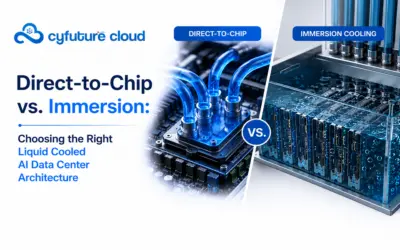

Introduction
As AI infrastructure continues to scale, data center operators are facing a critical challenge: how to efficiently cool increasingly dense GPU environments.
Modern AI workloads, including large language model (LLM) training, generative AI, autonomous systems, and high-performance computing (HPC), are pushing rack densities beyond 50kW, 100kW, and even 150kW per rack. At these power levels, traditional air cooling becomes increasingly inefficient, making liquid cooling a necessity rather than an option.
Today, two liquid cooling approaches are emerging as leading contenders for next-generation AI infrastructure:
- Direct-to-Chip (D2C) Cooling
- Immersion Cooling
Both technologies offer significant advantages over conventional cooling methods, but they differ in design, deployment complexity, operational requirements, and long-term scalability.
For organizations building AI-ready infrastructure, understanding these differences is essential for making the right investment decision.
Why AI Data Centers Are Moving Toward Liquid Cooling
The rise of GPU-powered AI clusters has fundamentally changed data center design.
Modern AI environments require:
- High-density GPU infrastructure
- Continuous compute-intensive workloads
- Improved energy efficiency
- Lower Power Usage Effectiveness (PUE)
- Future-ready thermal management
As GPU power consumption continues to rise with newer architectures, liquid cooling has become the most effective method for removing heat while maintaining performance and reliability.
What is Direct-to-Chip Cooling?
Direct-to-Chip cooling uses liquid-cooled cold plates mounted directly onto heat-generating components such as:
- GPUs
- CPUs
- Memory modules
Coolant circulates through these plates and absorbs heat directly from the hardware before it spreads throughout the server.
The heated liquid is then transported to a cooling loop where the heat is removed efficiently.
How Direct-to-Chip Cooling Works
Step 1: Heat Generation
AI workloads generate heat within GPUs and processors.
Step 2: Heat Transfer
Cold plates absorb heat directly from the components.
Step 3: Coolant Circulation
Liquid coolant carries thermal energy away from the server.
Step 4: Heat Rejection
The cooling system transfers heat to facility-level heat exchangers.
This process significantly reduces the dependence on traditional airflow.
Benefits of Direct-to-Chip Cooling
Easier Integration with Existing Infrastructure
Direct-to-chip systems can often be deployed within existing data center environments with minimal facility redesign.
Support for High-Density AI Workloads
D2C cooling effectively supports:
- 30kW-100kW+ racks
- AI training clusters
- GPU-intensive workloads
Familiar Server Architecture
Servers remain relatively similar to traditional hardware designs, simplifying maintenance and operations.
Lower Deployment Complexity
Compared to immersion cooling, D2C often requires less infrastructure modification.
Challenges of Direct-to-Chip Cooling
Residual Air Cooling Requirements
Not all server components are liquid-cooled.
Some components may still require airflow for thermal management.
Cooling Capacity Limits
As rack densities continue to rise, future deployments may eventually push beyond the practical limits of D2C systems.
More Complex Server Plumbing
Coolant distribution systems introduce additional infrastructure considerations.
What is Immersion Cooling?
Immersion cooling takes a radically different approach.
Instead of cooling individual components, entire servers are submerged in a thermally conductive dielectric fluid.
The fluid absorbs heat directly from all components simultaneously.
This creates one of the most thermally efficient cooling environments available today.
How Immersion Cooling Works
Step 1: Server Immersion
Servers are placed inside tanks filled with dielectric liquid.
Step 2: Heat Absorption
The fluid absorbs heat from GPUs, CPUs, memory, storage, and networking components.
Step 3: Heat Transfer
The heated liquid transfers thermal energy through heat exchangers.
Step 4: Cooling Cycle
The fluid is cooled and recirculated continuously.
This process eliminates the need for traditional airflow-based cooling systems.
Benefits of Immersion Cooling
Exceptional Thermal Efficiency
Immersion cooling provides superior heat transfer capabilities compared to both air cooling and D2C cooling.
Ultra-High Rack Density
Immersion environments can support:
- 100kW+
- 150kW+
- 200kW+ future deployments
making them highly attractive for AI factories and GPU superclusters.
Lower Cooling Energy Consumption
By eliminating many airflow requirements, immersion cooling significantly reduces cooling overhead.
Better Hardware Performance Stability
Uniform cooling helps maintain optimal operating temperatures across all components.
Challenges of Immersion Cooling
Higher Infrastructure Transformation
Immersion cooling often requires significant facility redesign and operational changes.
Specialized Maintenance Procedures
Accessing and servicing immersed hardware requires specialized workflows.
Hardware Compatibility Considerations
Not all equipment is designed for immersion environments.
Organizations must ensure component compatibility.
Direct-to-Chip vs. Immersion Cooling: Key Comparison
| Feature | Direct-to-Chip Cooling | Immersion Cooling |
|---|---|---|
| Cooling Efficiency | High | Very High |
| Rack Density Support | Up to 100kW+ | 150kW-200kW+ |
| Infrastructure Changes | Moderate | Significant |
| Server Accessibility | Easier | More Complex |
| Air Cooling Dependency | Partial | Minimal |
| Energy Efficiency | High | Extremely High |
| AI Scalability | Excellent | Exceptional |
| Deployment Complexity | Lower | Higher |
Which Architecture is Best for AI Workloads?
Direct-to-Chip Cooling is Ideal For
Organizations that:
- Need faster deployment
- Want to retrofit existing facilities
- Operate AI clusters below extreme density thresholds
- Require familiar operational models
This approach is often preferred by enterprises transitioning gradually toward liquid cooling.
Immersion Cooling is Ideal For
Organizations that:
- Build AI factories from the ground up
- Operate ultra-dense GPU environments
- Prioritize maximum energy efficiency
- Plan for future AI infrastructure scaling
Immersion cooling offers the highest thermal performance available today.
The Impact of Next-Generation GPU Architectures
Future AI accelerators are increasing power density dramatically.
Architectures such as:
- NVIDIA Blackwell
- Vera Rubin-ready systems
- Advanced AI accelerators
will place even greater demands on cooling infrastructure.
Data center operators must evaluate whether their cooling strategy can support future rack densities rather than simply current requirements.
The Future of Liquid Cooled AI Data Centers
The industry is increasingly moving toward:
Hybrid Cooling Architectures
Combining direct-to-chip and liquid-assisted cooling systems.
AI-Optimized Data Center Design
Facilities purpose-built for GPU infrastructure.
High-Density AI Factories
Supporting continuous AI training and inference operations.
Sustainable AI Infrastructure
Reducing energy consumption while increasing compute capacity.
As AI workloads continue to grow, liquid cooling will become the default architecture for advanced AI environments.
Conclusion
The choice between Direct-to-Chip and Immersion Cooling is not simply a cooling decision. It is an infrastructure strategy that will influence performance, scalability, operational efficiency, and future readiness.
Direct-to-Chip cooling offers a practical path for organizations modernizing existing facilities, while immersion cooling provides unmatched thermal performance for next-generation AI factories and ultra-dense GPU clusters.
As AI infrastructure evolves, selecting the right architecture for a Liquid Cooled AI Data Center will become one of the most important decisions data center operators make in preparing for the future of accelerated computing.
data center Data Center Cooling System AI Data Centers
Disclaimer
This content is a community contribution. The views and data expressed are solely those of the author and do not reflect the official position or endorsement of nasscom.
That the contents of third-party articles/blogs published here on the website, and the interpretation of all information in the article/blogs such as data, maps, numbers, opinions etc. displayed in the article/blogs and views or the opinions expressed within the content are solely of the author's; and do not reflect the opinions and beliefs of NASSCOM or its affiliates in any manner. NASSCOM does not take any liability w.r.t. content in any manner and will not be liable in any manner whatsoever for any kind of liability arising out of any act, error or omission. The contents of third-party article/blogs published, are provided solely as convenience; and the presence of these articles/blogs should not, under any circumstances, be considered as an endorsement of the contents by NASSCOM in any manner; and if you chose to access these articles/blogs , you do so at your own risk.
CTO
Cyfuture Cloud is a cutting-edge cloud infrastructure and service platform delivering next-gen computing solutions for businesses, researchers, and developers. Specializing in Cloud Hosting, we offer highly scalable, secure, and performance-optimized environments tailored for modern workloads. Our platform empowers innovation with a comprehensive suite of services, including AI as a Service, GPU as a Service, Inferencing as a Service, and Fine-Tuning capabilities, enabling faster AI model development, training, and deployment. Whether you're building intelligent applications or running complex simulations, our robust infrastructure backed by NVIDIA-powered clusters ensures seamless scalability and performance. With our IDE Lab Service, users can access pre-configured development environments in the cloud to streamline coding, testing, and deployment, all within a collaborative, secure setup.