

Why AI is Becoming Essential for Frontline Workforce Development
Frontline employees are at the heart of every organization's operations.
Whether they are assisting customers, managing logistics, maintaining machinery, or delivering patient care, their contributions directly shape service quality and brand perception. In industries such as retail, healthcare, transportation, and manufacturing, frontline workers form a significant portion of the workforce and play a critical role in ensuring business continuity.
According to research by Boston Consulting Group (BCG), frontline workers account for over 100 million employees in the United States alone, representing more than 70% of the workforce.
As industries rapidly evolve, the expectations placed on these employees continue to grow. This shift is creating new challenges-and new opportunities-for workforce development.
The Challenges Facing Today's Frontline Workforce
Frontline employees operate in fast-paced, high-pressure environments. We see several recurring challenges that limit their ability to perform at their best:
- Increasing demand for real-time problem-solving and faster service delivery
- Continuous need to learn new tools, technologies, and processes
- Limited access to learning resources during active work hours
- High turnover rates, leading to repeated onboarding and training cycles
Traditional training models-such as classroom sessions or static eLearning modules-often fail to address these dynamic needs. They are typically not designed for real-time application or personalization.
How AI is Transforming Workforce Development
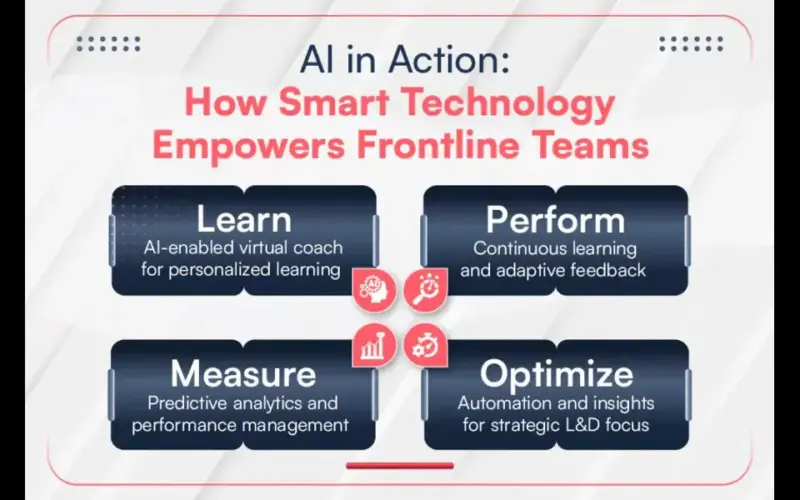
Artificial Intelligence is reshaping how organizations approach training and development for frontline employees. Instead of relying on one-size-fits-all learning, we can now enable adaptive, on-demand, and highly personalized experiences.
1. Just-in-Time Learning Support
AI-powered systems provide instant answers and guidance during workflows. Employees no longer need to memorize large volumes of information-they can access knowledge exactly when needed.
2. Personalized Skill Development
Using predictive analytics, AI identifies individual skill gaps and recommends tailored learning paths. This ensures that employees receive relevant training aligned with their roles and performance.
3. Immersive Learning Experiences
Simulations powered by AI allow workers to practice real-world scenarios in a safe environment. This is especially valuable in high-risk industries like healthcare and manufacturing.
4. Automation of Learning Operations
AI reduces the administrative burden on learning and development teams by automating tasks such as content tagging, translation, and course recommendations. This allows teams to focus on strategic initiatives.
Industry-Wide Impact of AI in Frontline Training
AI is not limited to a single sector-it is creating measurable impact across industries:
Healthcare
AI-driven training tools help medical professionals stay updated with protocols and technologies, while simulations improve decision-making in critical scenarios.
Retail and E-commerce
Chatbots and AI-driven simulations enhance customer interaction skills and align employee training with evolving consumer behavior.
Manufacturing
Predictive learning models prepare workers for new production processes, reducing downtime and improving operational efficiency.
Logistics and Transportation
AI provides real-time insights, route optimization, and scenario-based training to improve safety and decision-making.
Energy and Utilities
AI ensures compliance training and helps maintain workforce readiness by identifying gaps before audits or inspections.
Real-World Impact: AI-Powered Learning in Action
We have seen firsthand how AI-driven solutions can transform frontline workforce development. For example, an AI-enabled virtual coach (chatbot) implemented for a large food chain delivered measurable improvements:
- 92.5% success rate in query resolution
- Over 90% accuracy in responses
- Faster, voice-enabled support for employees
- Reduced training costs and improved productivity
Such outcomes highlight how AI can move beyond theory and deliver tangible business value.
Why AI Matters Now More Than Ever
Frontline workforce development is no longer just a support function-it is a strategic priority. Organizations that embrace AI are not simply improving training; they are enhancing agility, boosting employee engagement, and driving measurable performance outcomes.
The future of workforce development is not about increasing the volume of training-it is about delivering the right learning at the right time, in the right format.
Conclusion
As the workplace continues to evolve, we must rethink how we empower frontline employees. AI provides the tools to bridge skill gaps, deliver continuous learning, and enable employees to perform with confidence and efficiency.
By integrating AI into workforce development strategies, we can create a more resilient, capable, and future-ready workforce-one that is equipped to meet the demands of an ever-changing business landscape.
Author: Jyotsna KULKARNI
President and Head of Business
Jyotsna Kulkarni is the President and Head of Business at Harbinger Group. With a strong focus on enterprise transformation, she leads global delivery strategies that enable organizations to reimagine sourcing models in the age of agentic AI and automation.
Disclaimer
This content is a community contribution. The views and data expressed are solely those of the author and do not reflect the official position or endorsement of nasscom.
That the contents of third-party articles/blogs published here on the website, and the interpretation of all information in the article/blogs such as data, maps, numbers, opinions etc. displayed in the article/blogs and views or the opinions expressed within the content are solely of the author's; and do not reflect the opinions and beliefs of NASSCOM or its affiliates in any manner. NASSCOM does not take any liability w.r.t. content in any manner and will not be liable in any manner whatsoever for any kind of liability arising out of any act, error or omission. The contents of third-party article/blogs published, are provided solely as convenience; and the presence of these articles/blogs should not, under any circumstances, be considered as an endorsement of the contents by NASSCOM in any manner; and if you chose to access these articles/blogs , you do so at your own risk.