
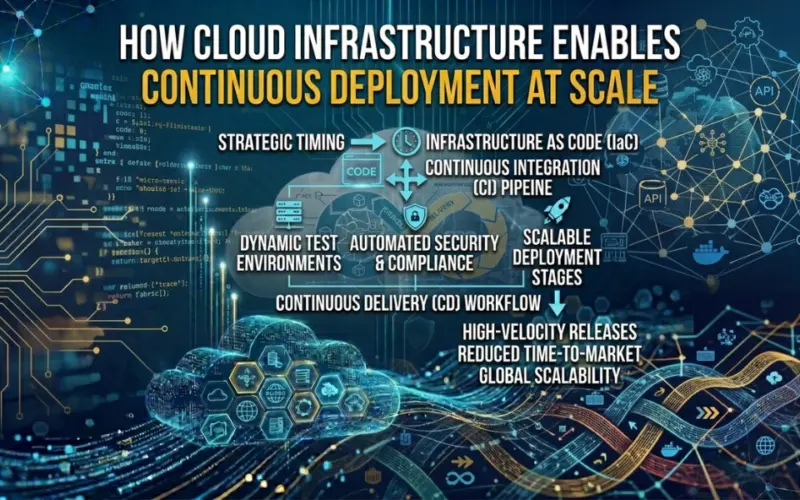

India's technology ecosystem is rapidly embracing agile development practices to stay competitive in a fast-moving digital economy.
Continuous Deployment (CD), a key component of DevOps, allows organizations to release software updates frequently and reliably. However, achieving this level of agility requires a strong and scalable infrastructure foundation.
Cloud infrastructure has become central to enabling continuous deployment, offering flexibility, automation, and on-demand resources. For Indian startups and enterprises alike, leveraging platforms such as cloud web hosting India environments is helping streamline development cycles and improve time-to-market.
Industry Evolution: From Periodic Releases to Continuous Delivery
Traditionally, software releases were infrequent and resource-intensive. Today, organizations aim to deploy updates multiple times a day. This shift is driven by:
- Increasing customer expectations for faster feature delivery
- Growth of SaaS and digital platforms in India
- Adoption of DevOps and microservices architectures
- Expansion of cloud-native technologies
According to industry estimates, organizations implementing continuous deployment can reduce deployment times by up to 80% and significantly lower failure rates.
Cloud infrastructure plays a vital role in supporting these changes by offering scalable environments where applications can be built, tested, and deployed seamlessly.
Key Challenges: Operational Barriers to Continuous Deployment
While continuous deployment offers clear benefits, implementing it effectively requires overcoming several infrastructure-related challenges.
Common challenges include:
- Environment Inconsistency
Differences between development, testing, and production environments can lead to deployment failures. - Scalability Constraints
Traditional infrastructure may not handle sudden spikes in deployment workloads. - Security Risks
Frequent releases increase the attack surface if security practices are not integrated into the pipeline. - Complex Toolchains
Managing multiple tools for CI/CD pipelines can lead to inefficiencies. - Downtime Risks
Without proper infrastructure support, deployments can disrupt application availability.
Modern Approaches: Infrastructure Best Practices for Continuous Deployment
To overcome these challenges, organizations are adopting infrastructure strategies designed to support automated and reliable deployments.
Key best practices include:
- Infrastructure as Code (IaC)
Automating infrastructure provisioning ensures consistency across environments. - Containerization and Microservices
Breaking applications into smaller services allows independent deployment and scaling. - Auto-Scaling Environments
Cloud platforms enable dynamic scaling to handle varying workloads during deployments. - Integrated Security (DevSecOps)
Embedding security checks within deployment pipelines reduces vulnerabilities. - Blue-Green and Canary Deployments
These techniques minimize downtime and reduce risks during updates. - Flexible Hosting Environments
Leveraging solutions like cloud web hosting India setups allows teams to deploy applications quickly while maintaining performance and reliability.
Impact on Innovation & Business Efficiency
Cloud-enabled continuous deployment significantly enhances an organization's ability to innovate and respond to market demands.
Key benefits include:
- Faster Innovation Cycles
Teams can experiment, test, and release features rapidly. - Reduced Operational Overhead
Automation minimizes manual intervention in deployment processes. - Improved Application Reliability
Large-scale failures are less likely with frequent, smaller updates. - Enhanced Developer Productivity
Developers spend more time building features rather than managing infrastructure. - Scalability for Growth
Cloud environments support businesses as they scale without major infrastructure changes.
For India's growing startup ecosystem, these advantages are critical in building competitive, scalable products.
Conclusion: Building the Foundation for Continuous Innovation
Continuous deployment is no longer a niche practice but a necessity in modern software development. However, its success depends heavily on the underlying infrastructure.
Cloud infrastructure provides the flexibility, scalability, and automation required to support continuous deployment models. As Indian organizations continue to adopt DevOps practices, investing in robust cloud environments will be essential for sustaining innovation and growth.
A thoughtful approach to infrastructure can help organizations move beyond traditional deployment limitations and embrace a more agile, resilient future.
Hybrid Cloud India digital transformation Cloud Computing Scalable Infrastructure
Disclaimer
This content is a community contribution. The views and data expressed are solely those of the author and do not reflect the official position or endorsement of nasscom.
That the contents of third-party articles/blogs published here on the website, and the interpretation of all information in the article/blogs such as data, maps, numbers, opinions etc. displayed in the article/blogs and views or the opinions expressed within the content are solely of the author's; and do not reflect the opinions and beliefs of NASSCOM or its affiliates in any manner. NASSCOM does not take any liability w.r.t. content in any manner and will not be liable in any manner whatsoever for any kind of liability arising out of any act, error or omission. The contents of third-party article/blogs published, are provided solely as convenience; and the presence of these articles/blogs should not, under any circumstances, be considered as an endorsement of the contents by NASSCOM in any manner; and if you chose to access these articles/blogs , you do so at your own risk.
Hi, I'm Kartik Sen, a Digital Marketer at CloudMinister the web hosting provider . I specialize in promoting web hosting, cloud VPS, dedicated servers, and Linux hosting solutions. With a strong passion for technology and server infrastructure, I focus on SEO-driven strategies that boost brand visibility, generate quality leads, and support long-term business growth.