




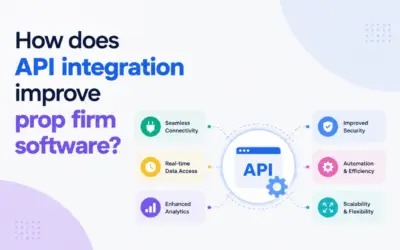

Prop trading has changed. Success now depends on automation, technology, and data.
Modern firms need strong software to manage risk, track trader performance, and execute orders properly.
The secret weapon making this possible is API integration.
APIs serve as the digital connection between trading platforms, financial tools, and data streams.
For prop firms that want to grow, automate operations, and gain a market edge, API integration is not simply an extra feature; it is an essential business strategy.
Let's get started!
What Does API Integration Mean for Prop Firm Software?
A prop firm usually depends on multiple tools to run daily operations.
You may have a trading platform for executing trades, a CRM for managing traders, a payment system for handling transactions, and risk management tools for monitoring performance.
Without proper integration, these systems work separately. This can lead to delays, repeated tasks, and mistakes.
With API integration, these systems can communicate automatically.
For example, when a trader completes a challenge, the system can instantly verify the results, update the account status, and move the trader to the next stage, without your team manually checking everything
Key Ways API Integration Improves Prop Firm Software
1. Real-Time Data Updates
In trading, timing matters.
API integration enables your prop firm software to receive and share data instantly between different platforms. This helps you track trader activity, monitor account performance, and keep profit and loss information updated.
Instead of waiting for reports or manually collecting data, your team gets a clear picture of what is happening in real time.
2. Smarter Risk Management
Risk management is one of the most important parts of running a prop firm.
APIs can connect your trading platform with risk management systems to automatically monitor rules like:
→ Daily loss limits
→ Maximum drawdown
→ Trading activity
→ Account restrictions
This helps you identify potential risks faster and ensures that trading rules are applied consistently.
3. Trading Platform Integration
Many prop firms support different trading platforms and tools. Managing all these connections manually can become difficult as your business grows.
API integration helps connect your backend systems with trading platforms, making processes like account creation, trade tracking, and performance reporting much easier.
This means your team can spend less time managing systems and more time improving the business.
4. Improved Trader Experience
Today's traders expect a smooth and transparent experience.
With connected systems, traders can easily access:
→ Account performance
→ Challenge progress
→Trading history
→ Risk statistics
→ Payment updates
A faster and better platform creates more trust and improves trader satisfaction.
5. Automated Onboarding and Account Management
The first experience a trader has with your platform matters.
API integration can automate important steps like payment confirmation, account creation, verification, and platform access.
Instead of waiting for manual approvals, traders can move through the process faster, while your team saves valuable time.
6. Advanced Analytics and Performance Tracking
Every trade creates valuable data. But collecting data is only useful when you can understand it.
API connected systems allow prop firms to analyze trader performance, identify patterns, and understand what strategies are working.
These insights can help improve your evaluation process and make better business decisions.
7. Better Scalability for Growing Prop Firms
When your prop firm grows, managing hundreds or thousands of traders manually becomes difficult.
A well-integrated software system makes it easier to add new features, connect new platforms, and handle more users without rebuilding your entire infrastructure.
API integration gives your business the flexibility needed for long-term growth.
8. Stronger Security and Control
Financial platforms handle sensitive information, so security cannot be ignored.
API integration allows businesses to control how data is shared between systems, manage access, and monitor activities more effectively.
A properly designed API structure helps maintain security while keeping operations efficient.
Why API Integration Matters When Building a Prop Firm From Scratch
When you're building a prop firm, the goal is not just to launch a platform. It is to build a business that can handle growth. In the beginning, managing a few traders manually may seem possible. But as your user base grows, disconnected systems can become a challenge.
Imagine managing hundreds or thousands of traders while keeping track of account updates, payments, trading activity, risk rules, and performance reports. Without proper integration, your team may spend hours handling tasks that could be automated.
By planning API integration from the start, you create a strong technology foundation for your prop firm. New features, platforms, and services can be added more easily without disrupting your existing operations. APIs help your software become more flexible, allowing your business to adapt as your needs change.
For founders, this means fewer operational challenges, faster decision-making, and more time to focus on growing the business instead of managing disconnected systems.
The Future of API Integration in Prop Firm Software
Automation, AI, and smarter decision-making will drive the future of prop trading.
As firms continue to adopt advanced technology, APIs will play an important role in connecting different tools and creating more intelligent trading ecosystems.
Future prop firm platforms may use API integrations for:
- AI-based trader evaluation
- Automated risk predictions
- Advanced performance analysis
- Personalized trader insights
- Real-time decision support
As competition increases in the prop trading industry, firms that invest in flexible and integrated software solutions will have a stronger advantage.
Conclusion
API integration has become an essential component of modern prop firm software. It improves operational efficiency, enables real-time data exchange, strengthens risk management, enhances trader experience, and supports business scalability.
For prop firms aiming to build better, automated, and future ready platforms, API integration is no longer an optional feature; it is a foundation for creating efficient and competitive trading ecosystems.
API Integration
Disclaimer
This content is a community contribution. The views and data expressed are solely those of the author and do not reflect the official position or endorsement of nasscom.
That the contents of third-party articles/blogs published here on the website, and the interpretation of all information in the article/blogs such as data, maps, numbers, opinions etc. displayed in the article/blogs and views or the opinions expressed within the content are solely of the author's; and do not reflect the opinions and beliefs of NASSCOM or its affiliates in any manner. NASSCOM does not take any liability w.r.t. content in any manner and will not be liable in any manner whatsoever for any kind of liability arising out of any act, error or omission. The contents of third-party article/blogs published, are provided solely as convenience; and the presence of these articles/blogs should not, under any circumstances, be considered as an endorsement of the contents by NASSCOM in any manner; and if you chose to access these articles/blogs , you do so at your own risk.