
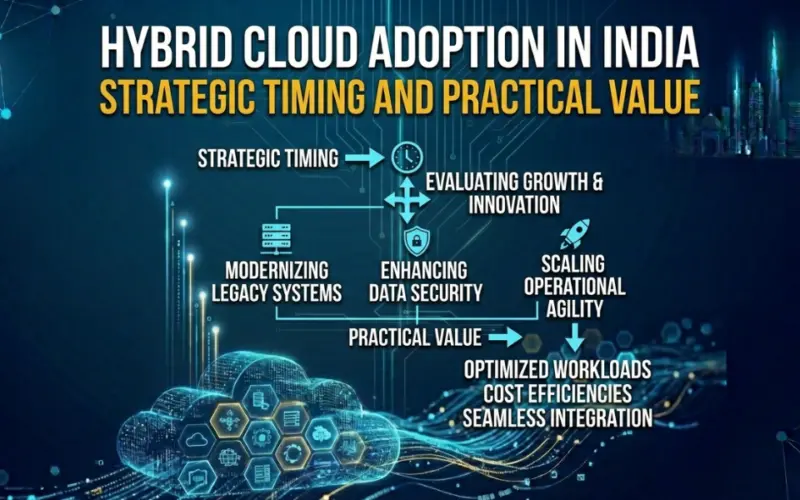

India's digital economy is evolving rapidly, driven by startups, enterprises, and government-led digital initiatives. As organizations scale, the need for flexible, secure, and cost-efficient IT infrastructure becomes increasingly important.
Hybrid cloud has emerged as a practical approach, allowing businesses to combine on-premise systems with public and private cloud environments.
For Indian organizations operating in diverse regulatory and operational conditions, hybrid cloud adoption offers a balanced pathway between control and scalability. It is particularly relevant in scenarios where data sensitivity, latency requirements, and cost considerations intersect.
Industry Landscape: Rising Demand for Flexible Infrastructure
India's cloud market is expected to grow at a CAGR of over 20% in the coming years, reflecting increased reliance on digital infrastructure. Enterprises are moving beyond single-cloud strategies to more adaptive models that align with business needs.
Key trends shaping hybrid cloud adoption include:
- Data localization requirements driving partial on-premise deployments
- Growth of AI and analytics workloads requiring scalable compute environments
- Increased focus on disaster recovery and business continuity
- Expansion of SaaS platforms across industries
In this evolving environment, hybrid cloud offers the flexibility to deploy workloads where they perform best, while maintaining compliance and control.
Key Challenges: Barriers to Effective Hybrid Cloud Implementation
Despite its advantages, hybrid cloud adoption is not without challenges. Many Indian organizations face operational and strategic hurdles while transitioning.
Common challenges include:
- Integration Complexity
Managing seamless communication between on-premise and cloud systems can be technically demanding. - Security and Compliance Risks
Ensuring consistent security policies across environments is critical, especially for regulated industries. - Skill Gaps in Cloud Management
Lack of expertise in hybrid environments often leads to inefficiencies or misconfigurations. - Cost Visibility Issues
Without proper monitoring, hybrid setups can lead to unexpected infrastructure expenses. - Latency and Performance Concerns
Improper workload distribution may impact application performance.
Emerging Approaches: Building Effective Hybrid Cloud Strategies
Organizations are adopting structured approaches to overcome these challenges and maximize the value of hybrid cloud environments.
Best practices include:
- Workload Segmentation
Identify which applications should remain on-premise and which can move to the cloud based on performance and compliance needs. - Unified Security Frameworks
Implement consistent identity and access management (IAM) policies across all environments. - Automation and Orchestration
Use automation tools to manage deployments, scaling, and monitoring efficiently. - Edge and Regional Deployment Models
Deploy infrastructure closer to users to reduce latency and improve performance. - Balanced Infrastructure Mix
Combining private infrastructure with cloud solutions likewindows vps hosting india helps maintain flexibility while ensuring control over critical workloads.
Impact on Innovation & Business Agility
Hybrid cloud plays a significant role in enabling innovation across India's technology ecosystem. By offering both control and scalability, it allows organizations to experiment, iterate, and scale without major infrastructure constraints.
Key benefits include:
- Faster Time-to-Market
Developers can deploy and test applications quickly using cloud resources while maintaining core systems on-premise. - Improved Resilience
Hybrid setups support better disaster recovery and uptime management. - Enhanced Data Control
Sensitive data can remain within local infrastructure while leveraging cloud for processing. - Support for Emerging Technologies
AI, IoT, and big data applications benefit from hybrid environments that offer both performance and scalability. - Scalable Growth for Startups
Startups can begin with minimal infrastructure and expand seamlessly as demand increases.
Conclusion: A Pragmatic Path Forward
Hybrid cloud is not just a transitional model but a long-term strategy for organizations navigating complex digital requirements. For Indian enterprises and startups, it offers a practical balance between innovation, compliance, and operational efficiency.
As infrastructure demands continue to evolve, businesses that adopt well-planned hybrid strategies will be better positioned to scale sustainably, manage risks effectively, and drive continuous innovation.
Hybrid Cloud India Cloud Computing IT infrastructure enterprise technology Scalable Infrastructure
Disclaimer
This content is a community contribution. The views and data expressed are solely those of the author and do not reflect the official position or endorsement of nasscom.
That the contents of third-party articles/blogs published here on the website, and the interpretation of all information in the article/blogs such as data, maps, numbers, opinions etc. displayed in the article/blogs and views or the opinions expressed within the content are solely of the author's; and do not reflect the opinions and beliefs of NASSCOM or its affiliates in any manner. NASSCOM does not take any liability w.r.t. content in any manner and will not be liable in any manner whatsoever for any kind of liability arising out of any act, error or omission. The contents of third-party article/blogs published, are provided solely as convenience; and the presence of these articles/blogs should not, under any circumstances, be considered as an endorsement of the contents by NASSCOM in any manner; and if you chose to access these articles/blogs , you do so at your own risk.
Senior Digital Marketing Executive
I'm a Senior Digital Marketing Executive at CloudMinister Technologies, working closely with cloud and technology-driven businesses to improve their online presence and digital growth. My experience includes SEO, content strategy, campaign planning, and performance optimization, with a strong focus on measurable results. I enjoy staying updated with the latest digital marketing trends and tech innovations, and I'm always keen to learn, share insights, and connect with professionals across the startup and technology ecosystem.