





Introduction
Modern businesses require infrastructure that balances performance, flexibility, security, and cost efficiency. Relying entirely on either public cloud or on-premise infrastructure often creates limitations.
This is why organizations are increasingly adopting hybrid cloud infrastructure.
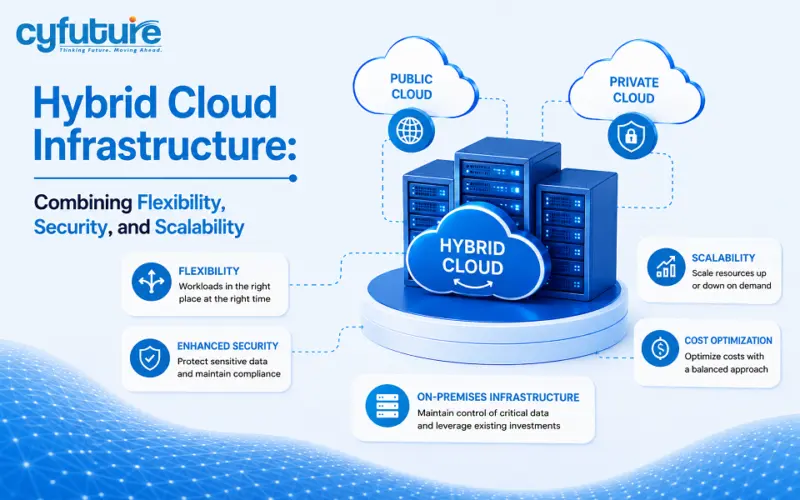
Hybrid cloud combines private infrastructure with public cloud environments, enabling businesses to optimize workloads while maintaining greater operational control.
What is Hybrid Cloud Infrastructure?
Hybrid cloud infrastructure is an IT architecture that integrates:
- Private cloud environments
- Public cloud platforms
- On-premise infrastructure
into a unified ecosystem.
This allows workloads and data to move seamlessly between environments based on business requirements.
Why Businesses are Moving to Hybrid Cloud
Greater Flexibility
Organizations can choose where workloads should run based on:
- Performance requirements
- Security policies
- Cost optimization goals
Improved Security and Compliance
Sensitive workloads can remain in private environments while less critical applications run on public cloud infrastructure.
Better Scalability
Public cloud resources can handle sudden traffic spikes without requiring permanent infrastructure expansion.
Cost Optimization
Hybrid cloud enables businesses to optimize infrastructure spending by balancing private and public resources.
Key Components of Hybrid Cloud Infrastructure
Private Cloud Environment
Used for:
- Sensitive workloads
- Regulated applications
- Internal systems
Public Cloud Services
Used for:
- Scalable applications
- Development environments
- Temporary workloads
Orchestration and Management Layer
This layer enables:
- Workload management
- Automation
- Monitoring
- Resource optimization
Networking and Connectivity
Secure networking ensures seamless communication across cloud environments.
Common Hybrid Cloud Use Cases
Disaster Recovery
Backup environments can run in public cloud infrastructure while primary systems remain private.
Application Modernization
Organizations can modernize legacy systems gradually without complete migration.
AI and Data Analytics
Hybrid cloud allows AI workloads to scale dynamically using public cloud GPU resources.
DevOps and CI/CD
Development teams can leverage public cloud resources while maintaining secure production environments.
Benefits of Hybrid Cloud Infrastructure
Operational Flexibility
Run workloads in the most suitable environment.
Business Continuity
Hybrid cloud improves resilience and disaster recovery capabilities.
Faster Innovation
Public cloud services accelerate development and deployment cycles.
Optimized Performance
Critical workloads remain close to internal systems while scalable workloads use cloud elasticity.
Challenges in Hybrid Cloud Adoption
Infrastructure Complexity
Managing multiple environments requires advanced orchestration and monitoring.
Security Management
Consistent security policies must be enforced across environments.
Data Synchronization
Ensuring seamless data flow between systems can be challenging.
Best Practices for Hybrid Cloud Deployment
Define Workload Placement Strategy
Determine which workloads belong in private or public environments.
Implement Unified Monitoring
Use centralized monitoring and management tools.
Strengthen Security Policies
Apply consistent access controls and encryption standards.
Automate Infrastructure Management
Automation reduces operational complexity and improves efficiency.
Future of Hybrid Cloud Infrastructure
Hybrid cloud is evolving with:
- AI-driven infrastructure optimization
- Edge cloud integration
- Multi-cloud orchestration
- Containerized application environments
These advancements are making hybrid cloud more scalable and intelligent.
Conclusion
Hybrid cloud infrastructure provides the balance businesses need between control, scalability, and flexibility.
By combining private and public cloud environments, organizations can build resilient, future-ready infrastructure that supports modern digital workloads efficiently.
Cloud Cloud & Compute Cloud Infrastructure Cloud Infrastructure India
Disclaimer
This content is a community contribution. The views and data expressed are solely those of the author and do not reflect the official position or endorsement of nasscom.
That the contents of third-party articles/blogs published here on the website, and the interpretation of all information in the article/blogs such as data, maps, numbers, opinions etc. displayed in the article/blogs and views or the opinions expressed within the content are solely of the author's; and do not reflect the opinions and beliefs of NASSCOM or its affiliates in any manner. NASSCOM does not take any liability w.r.t. content in any manner and will not be liable in any manner whatsoever for any kind of liability arising out of any act, error or omission. The contents of third-party article/blogs published, are provided solely as convenience; and the presence of these articles/blogs should not, under any circumstances, be considered as an endorsement of the contents by NASSCOM in any manner; and if you chose to access these articles/blogs , you do so at your own risk.
Founder & CEO
Since 2001, Cyfuture has empowered organizations of all sizes with innovative business solutions, ensuring high performance and an enhanced brand image. Renowned for exceptional service standards and competent IT infrastructure management, our team of over 2,000 experts caters to diverse sectors such as e-commerce, retail, IT, education, banking, and government bodies. With a client-centric approach, we integrate technical expertise with business needs to achieve desired results efficiently. Our vision is to provide an exceptional customer experience, maintaining high standards and embracing state-of-the-art systems. Our services include cloud and infrastructure, big data and analytics, enterprise applications, AI, IoT, and consulting, delivered through modern tier III data centers in India. For more details, visit: https://cyfuture.com/