
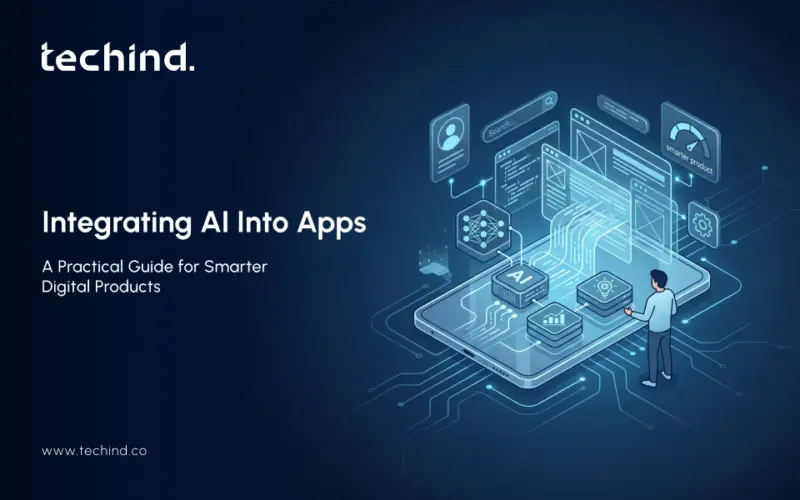

Artificial intelligence is no longer a future concept. It has become a real business tool that helps mobile and web applications deliver faster service, better personalization, and smarter automation.
From shopping apps suggesting products to banking apps detecting fraud, AI is changing how users interact with technology.
Today, businesses across industries are looking to integrate AI into apps to improve customer experience, reduce manual work, and stay ahead of competitors. But successful AI integration is not just about adding a chatbot or recommendation engine. It requires clear goals, the right data, smart planning, and a strong product strategy.
This blog explains how AI can be integrated into apps, the benefits it offers, common use cases, and how businesses can approach implementation the right way.
Why Businesses Are Integrating AI Into Apps
Users now expect apps to be quick, personalized, and intelligent. Standard app experiences often fail to meet rising expectations. AI helps solve this by enabling apps to learn from user behavior and make better decisions over time.
Businesses are adopting AI because it helps:
- Improve user engagement through personalization
- Automate repetitive tasks
- Offer 24/7 customer support
- Increase sales conversions
- Reduce operational costs
- Strengthen security and fraud prevention
- Generate useful business insights
According to market reports, the global AI software market is growing rapidly, with companies investing heavily in intelligent digital products.
Popular AI Features in Modern Apps
AI can be added in many ways depending on the app's purpose and target audience.
1. Personalized Recommendations
AI studies user behavior, preferences, search history, and buying patterns to recommend relevant products, content, or services.
Examples:
- E-commerce apps suggesting products
- OTT apps recommending shows
- Learning apps suggesting courses
2. AI Chatbots and Virtual Assistants
Smart chatbots answer customer questions, guide users, resolve issues, and reduce support workload.
Examples:
- Banking support bots
- Travel booking assistants
- Retail customer service chatbots
3. Voice Recognition
Voice-enabled AI lets users interact through speech commands.
Examples:
- Smart home apps
- Healthcare assistant apps
- Navigation apps
4. Predictive Analytics
AI can predict future behavior using past data.
Examples:
- Predicting customer churn
- Forecasting sales demand
- Suggesting next best offers
5. Image and Video Recognition
Computer vision allows apps to identify images, faces, products, and documents.
Examples:
- Face unlock systems
- Medical image analysis
- Visual product search
6. Fraud Detection
AI identifies suspicious behavior and flags unusual transactions instantly.
Examples:
- Banking apps
- Insurance claim systems
- Payment platforms
Industries Using AI-Powered Apps
Almost every sector can benefit from AI.
Healthcare
- Symptom checkers
- Appointment assistants
- Medical report analysis
- Personalized treatment insights
Retail and Ecommerce
- Product recommendations
- Smart search
- Inventory forecasting
- Customer support bots
Finance
- Risk scoring
- Fraud monitoring
- Loan eligibility analysis
- Personal finance assistants
Education
- Adaptive learning systems
- AI tutors
- Student performance tracking
- Automated assessments
Logistics
- Route optimization
- Demand forecasting
- Delivery tracking
- Warehouse automation
How to Integrate AI Into Apps Successfully
AI integration should be done with business goals in mind.
Step 1: Identify the Right Use Case
Do not add AI just because it is trending. Choose a clear problem AI can solve.
Examples:
- Slow customer support response
- Low user retention
- Poor recommendation quality
- Manual data processing delays
Step 2: Collect and Prepare Data
AI depends on quality data. Businesses need clean, relevant, and structured data to train accurate models.
Step 3: Choose the Right AI Model
Depending on the requirement, businesses can use:
- Machine learning models
- Natural language processing
- Computer vision systems
- Generative AI models
- Predictive analytics engines
Step 4: Integrate With Existing App Architecture
AI should connect smoothly with backend systems, APIs, databases, and frontend interfaces.
Step 5: Test and Improve Continuously
AI models should be monitored regularly to maintain performance and accuracy.
Challenges in AI App Integration
While AI creates value, implementation also comes with challenges.
Data Privacy
Apps handling customer data must comply with privacy laws and security standards.
High Initial Investment
Custom AI development can require skilled talent, infrastructure, and testing.
Model Accuracy
Poor training data leads to weak outcomes.
User Trust
AI should remain transparent and helpful, not confusing or intrusive.
Build vs Buy: What Should Businesses Choose?
Some companies build custom AI systems, while others use ready-made APIs or third-party AI tools.
Build Custom AI If You Need:
- Unique workflows
- Competitive advantage
- Full control over data
- Industry-specific intelligence
Buy Ready Solutions If You Need:
- Faster launch
- Lower upfront cost
- Standard AI features
- Quick experimentation
Many businesses use a hybrid model.
Future of AI in Apps
AI-powered apps will continue to become more natural, predictive, and personalized. Future trends include:
- Generative AI inside apps
- AI voice agents
- Real-time translation
- Emotion-aware interfaces
- Hyper-personalized experiences
- Autonomous workflows
Apps that fail to evolve may struggle to meet user expectations.
Final Thoughts
Integrating AI into apps is no longer optional for many businesses. It is becoming a core part of digital growth strategies. Whether the goal is improving customer experience, increasing efficiency, or creating new revenue streams, AI offers strong opportunities when implemented correctly.
The best results come from starting with a real business problem, using quality data, and building AI features that create clear value for users.
Businesses that invest early in practical AI integration will be better positioned to lead in the next generation of digital products.
AI integration into apps AI app development artificial intelligence in mobile apps AI chatbot apps machine learning apps AI business solutions smart mobile applications AI product development generative AI apps enterprise AI solutions
Disclaimer
This content is a community contribution. The views and data expressed are solely those of the author and do not reflect the official position or endorsement of nasscom.
That the contents of third-party articles/blogs published here on the website, and the interpretation of all information in the article/blogs such as data, maps, numbers, opinions etc. displayed in the article/blogs and views or the opinions expressed within the content are solely of the author's; and do not reflect the opinions and beliefs of NASSCOM or its affiliates in any manner. NASSCOM does not take any liability w.r.t. content in any manner and will not be liable in any manner whatsoever for any kind of liability arising out of any act, error or omission. The contents of third-party article/blogs published, are provided solely as convenience; and the presence of these articles/blogs should not, under any circumstances, be considered as an endorsement of the contents by NASSCOM in any manner; and if you chose to access these articles/blogs , you do so at your own risk.