
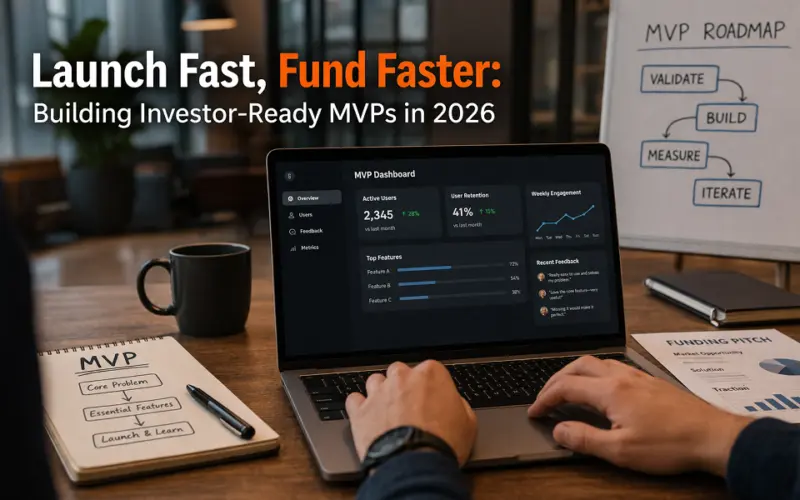

Every successful startup journey begins with a focused first step. Scalable global products are not built in a single phase. They evolve through continuous learning, iteration, and market validation.
Many of today's most widely adopted digital platforms started as simple concepts with limited functionality.
A well-known example is Instagram. When it launched in 2010, it was limited to iOS users and offered only a few core features such as photo sharing and basic filters. Its early simplicity allowed the team to observe user behavior closely, refine the experience, and expand features in a way that aligned with user expectations and market demand.
This approach reflects the core principle behind a Minimum Viable Product, or MVP. Rather than building a fully featured product upfront, startups focus on developing a version that delivers essential value with minimal complexity. The objective is to test assumptions in real market conditions and gather actionable insights before scaling further.
Industry data reinforces the importance of this approach. Studies indicate that over 74 percent of companies report improved product outcomes when they adopt MVP strategies. In addition, nearly 87 percent of businesses state that MVPs help them better understand customer needs and validate market demand more effectively.
For founders and product teams planning to launch in 2026, an MVP-led approach offers a practical path to reduce risk and improve decision-making. It enables early validation, supports faster feedback loops, and strengthens the foundation for future growth. It also plays a critical role in building investor confidence by demonstrating traction and clarity of direction.
Understanding how to design and execute an effective MVP is therefore becoming a key capability for modern startups. Let us explore how this approach works in practice.
What Is MVP Development?
A Minimum Viable Product, or MVP, is the earliest functional version of a product that includes only the core features required to address a specific user problem. Instead of investing time and resources into building a fully featured solution from the outset, organizations launch a focused version to test assumptions in real market conditions.
The objective of MVP development is to enable rapid learning. By putting a simplified product in the hands of users, teams can gather real feedback, assess product relevance, and make informed decisions about future development. This approach reduces uncertainty and helps ensure that further investments are guided by validated insights rather than assumptions.
At its core, an MVP helps organizations
• Validate whether the product idea addresses a real need
• Gather actionable feedback from early users
• Identify gaps and areas for improvement
• Reduce technical and market risks before scaling
Rather than committing significant resources upfront, teams release a basic but usable version of the product. This feedback-driven cycle allows them to refine features, improve usability, and prioritize what truly matters to users.
Organizations typically adopt MVP development to
• Test concepts with real users in live environments
• Understand customer behavior and preferences
• Accelerate time to market
• Minimize financial exposure and development risk
For startups and emerging businesses, this approach is particularly valuable. It provides a structured and efficient path to validate ideas, build early traction, and evolve the product based on real-world usage, all while maintaining control over costs and resources.
Why MVP Is Crucial for Raising Funding in 2026?
In 2026, the funding landscape has become significantly more evidence-driven. Investors are no longer influenced by ideas alone. They expect clear validation that a product can solve a real problem and scale in a competitive market. Metrics such as user adoption, engagement, and early traction have become central to investment decisions.
This is where a Minimum Viable Product plays a critical role.
An MVP enables founders to move beyond assumptions and present tangible proof of market demand. Instead of relying solely on projections or vision statements, startups can demonstrate how their product performs in real-world conditions.
With an MVP, startups can
• Demonstrate clear market demand through actual usage
• Showcase user engagement and retention trends
• Present early indicators of revenue or growth
• Validate that the product addresses a meaningful problem
A working product, even in its simplest form, provides investors with something far more compelling than a pitch deck. It reflects execution capability, speed of delivery, and the ability to learn from users. These are key signals investors look for when assessing both the idea and the founding team.
In addition, an MVP helps establish a feedback loop that strengthens the product over time. Startups can iterate quickly, refine their offering, and align more closely with customer expectations before scaling. This reduces uncertainty and increases the likelihood of long-term success.
As a result, startups that approach investors with a validated MVP are often in a stronger position to secure funding. They are able to present evidence instead of assumptions, making their case more credible and investment-ready in a highly competitive environment.
Key Steps to Build an MVP
Building a successful Minimum Viable Product requires a structured and disciplined approach. The goal is to move quickly without compromising on clarity, usability, or future scalability. The following steps outline a practical framework for developing an MVP that is both efficient and market-ready.
1. Analyze Your Business Niche
Before initiating development, it is essential to understand the market context in which your product will operate. This includes identifying your target audience, studying competitors, and uncovering gaps in existing solutions. Engaging directly with potential users through surveys, interviews, and research helps validate real problems and ensures that the product direction is grounded in actual demand.
2. Define Core Features
An MVP should focus strictly on solving the primary user problem. Begin by listing all potential features, then prioritize them based on impact and necessity. Eliminate non-essential elements that do not contribute to the core value proposition. This focused approach helps reduce development time, optimize resources, and accelerate market entry.
3. Plan a Scalable Architecture
Although an MVP is a simplified version of the product, its technical foundation should support future expansion. Designing a scalable architecture ensures that new features and functionalities can be added without significant rework. Leveraging modular design principles and cloud-based infrastructure can provide the flexibility needed for growth.
4. Choose the Right Technology Stack
The selection of technologies has a direct impact on performance, security, and long-term maintainability. It is important to evaluate frontend and backend frameworks, databases, hosting environments, and third-party integrations carefully. The chosen stack should align with the product's objectives and expected scale, enabling efficient development and easier upgrades.
5. Design a User-Friendly UX and UI
User experience plays a critical role in the success of an MVP. Even with limited features, the interface should be intuitive, clean, and easy to navigate. Creating wireframes and prototypes before development helps map the user journey and identify usability improvements early. A well-designed interface enhances engagement and encourages continued usage.
6. Develop the Backend Infrastructure
The backend forms the core of the product's functionality. It manages data processing, authentication, and communication between systems. Building secure APIs and well-structured databases is essential for reliability. Attention to performance and security at this stage ensures the system can handle growth and maintain user trust.
7. Build the Frontend
The frontend is the user-facing layer of the product. It should be responsive, interactive, and consistent across devices and browsers. The focus should be on delivering a smooth and seamless experience that aligns with user expectations. Iterative refinement based on usability testing can significantly improve the overall quality.
8. Test and Validate
Comprehensive testing is necessary to ensure the MVP performs as intended. This includes functional testing, performance checks, and security validation. Involving early users or beta testers provides valuable insights into usability and potential improvements. Addressing issues at this stage helps build a more reliable product.
9. Launch and Measure Performance
After launch, continuous monitoring becomes critical. Tracking metrics such as user engagement, retention, conversions, and feedback provides a clear understanding of product performance. These insights guide future iterations and feature enhancements. Ongoing improvement is key to achieving product-market fit and preparing the product for scale.
By following these steps, organizations can build MVPs that are not only faster to launch but also better aligned with user needs and long-term growth objectives.
MVP vs Prototype vs Proof of Concept
These three terms are often confused, but each plays a different role in product development.
Prototype
A prototype is a visual or interactive model of a product used to refine design, user flow, and experience. It may look like the final product but is usually not fully functional.
Proof of Concept (POC)
A POC is used to test whether a specific idea or technology is technically feasible. It is typically built for internal validation and is not intended for real users.
Minimum Viable Product (MVP)
An MVP is a functional product with core features, launched to real users. It helps validate demand, gather feedback, and guide future development.
While all three are important, the MVP is the stage that directly impacts market validation, user traction, and investor interest.
Benefits of Developing an MVP
1. Cost-Effective Development
An MVP focuses only on essential features, helping reduce initial development costs. Businesses avoid spending on complex functionalities that may not deliver immediate value, allowing better allocation of budget and resources.
2. Faster Market Entry
With an MVP, companies can launch much sooner instead of waiting to build a fully featured product. Early entry helps validate demand, build visibility, and attract initial users.
3. Reduced Risk
Testing the product with real users helps identify gaps, usability issues, and improvement areas early. This reduces the risk of investing heavily in a product that may not meet market needs.
4. Better Product-Market Fit
Continuous feedback from users allows businesses to refine features and improve the overall experience. This iterative approach helps align the product more closely with customer expectations over time.
5. Faster Return on Investment
Launching early enables businesses to start generating revenue sooner. Early traction also strengthens investor confidence, supporting faster funding and long-term growth.
Conclusion
Developing an MVP in 2026 is not just about launching a simplified version of a product. It is a strategic approach to validate ideas early, reduce risk, and build with clear market direction. In a landscape where investors prioritize evidence over assumptions, an MVP provides the data and insights needed to support stronger decisions.
By focusing on core features, gathering real user feedback, and continuously iterating, startups can create products that are better aligned with market needs. This approach not only improves efficiency but also strengthens the foundation for sustainable growth and scalability.
For founders and product teams, adopting an MVP-first mindset can significantly improve the chances of building a successful and investment-ready digital product.
mvp MVP Development ai app app development MVP Software Development
Disclaimer
This content is a community contribution. The views and data expressed are solely those of the author and do not reflect the official position or endorsement of nasscom.
That the contents of third-party articles/blogs published here on the website, and the interpretation of all information in the article/blogs such as data, maps, numbers, opinions etc. displayed in the article/blogs and views or the opinions expressed within the content are solely of the author's; and do not reflect the opinions and beliefs of NASSCOM or its affiliates in any manner. NASSCOM does not take any liability w.r.t. content in any manner and will not be liable in any manner whatsoever for any kind of liability arising out of any act, error or omission. The contents of third-party article/blogs published, are provided solely as convenience; and the presence of these articles/blogs should not, under any circumstances, be considered as an endorsement of the contents by NASSCOM in any manner; and if you chose to access these articles/blogs , you do so at your own risk.
Co-Founder & Digital Strategist at PixelBrainy
Sagar Sahay Bhatnagar is the Co-founder and CTO at PixelBrainy, bringing over a decade of experience in the IT industry. A visionary tech leader, Sagar excels in innovative software development and strategic technology management. His expertise drives PixelBrainy's mission to deliver cutting-edge digital solutions. Passionate about leveraging technology for transformative impact, Sagar's leadership and technical acumen continue to propel the company's growth and success.