
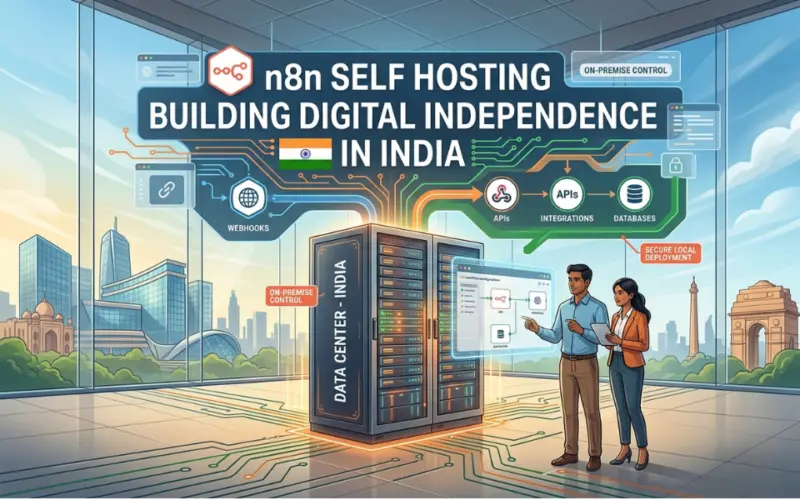

Automation in 2026 is no longer limited to simple workflows-it now powers AI pipelines, API orchestration, and real-time business processes.
As a result, many developers and companies are shifting toward self-hosted environments to gain control over cost, customization, and data privacy.
This shift has significantly increased interest in n8n self hosting in India, especially among teams dealing with execution limits, compliance requirements, and AI-driven automation. A structured understanding of deployment and infrastructure strategies can be explored through this reference on n8n self hosting in India.
However, self-hosting is not as simple as deploying a Docker container-it introduces serious engineering challenges that most users discover only after failures.
What 2026 Search Behavior Clearly Shows
Search intent today is highly problem-driven:
- "Why is n8n slow on VPS?"
- "How to scale n8n workflows in production?"
- "Is self-hosted n8n secure for AI automation?"
- "Why does my n8n instance crash randomly?"
These queries reflect a shift toward performance, reliability, and security engineering, not basic setup.
The Core Problems in Self-Hosted n8n (2026 Reality)
1. Performance Bottlenecks Under Real Load
n8n works well at a small scale-but struggles as workflows grow.
- performance depends heavily on hardware and configuration
- small VPS setups (1-2 GB RAM) often lag or crash under load
- large workflows increase memory and CPU usage significantly
Even though a single instance can handle hundreds of executions per second in ideal conditions, real-world workloads often degrade performance due to poor configuration and resource limits .
2. Frequent Downtime and Stability Issues
Downtime is one of the most common complaints in self-hosted setups.
- memory exhaustion can silently kill processes
- servers may reboot without restarting n8n
- disk space fills up due to execution logs
In many cases, workflows fail unpredictably because of infrastructure-not automation logic .
3. Critical Security Risks (Major 2026 Concern)
Security has become the biggest risk factor.
- Several flaws let code run remotely (CVSS up to 10).
- attackers can extract API keys, tokens, and credentials
- tens of thousands of exposed instances remain vulnerable globally
Because n8n connects multiple services (APIs, databases, AI models), a single breach can compromise entire systems.
4. Database and Storage Overload
One of the most ignored problems:
- execution logs grow rapidly
- databases become overloaded
- disk usage causes system crashes
In real deployments, workflows may run fine initially but fail after weeks due to storage exhaustion.
5. Infrastructure Misconfiguration
Most failures are caused by setup mistakes:
- incorrect SSL or reverse proxy configuration
- broken webhook URLs
- missing environment variables
In fact, surveys show over 60% of users face failures within the first month of self-hosting .
6. Scaling Is Not Linear (Big Misconception)
Many assume scaling is simple-just add more workers.
Reality:
- workflows compete for shared resources
- database becomes a bottleneck
- adding workers can sometimes reduce performance
Proper scaling requires queue-based architecture and distributed systems design, not just bigger servers.
Hosting Architecture Comparison (What Actually Works)
1. Basic VPS Setup
Pros
- low cost
- full control
Cons
- crashes under load
- no fault tolerance
- manual maintenance
Best only for testing or small workflows.
2. Docker-Based Deployment
Pros
- easier setup
- better environment isolation
Cons
- still limited scalability
- requires DevOps knowledge
3. Distributed Queue-Based Architecture (Recommended)
Components
- main instance
- Redis queue
- worker nodes
- PostgreSQL database
Advantages
- horizontal scaling
- better reliability
- improved performance
This is the only viable approach for production-grade automation systems.
Cost vs Reality: What People Get Wrong
Search intent: "Is self-hosting cheaper?"
Reality:
- lower upfront cost
- hidden costs (downtime, maintenance, scaling)
- engineering time becomes expensive
Many teams switch to self-hosting for cost savings but later struggle with operational complexity.
Practical Implementation Strategy (2026 Standard)
To build a stable system:
- use PostgreSQL instead of SQLite
- enable queue mode with Redis
- deploy multiple worker instances
- implement log pruning and monitoring
- secure access with authentication + firewall
At this stage, many teams transition to structured environments like cloudminister, where infrastructure, automation, and security are aligned for production reliability.
Future Trends in Automation Hosting
- AI-integrated workflows increasing load complexity
- self-healing infrastructure systems
- serverless execution models
- stronger focus on security-first architecture
Automation is evolving into infrastructure engineering, not just workflow design.
Final Thoughts
Self-hosting n8n provides flexibility and control, but it introduces serious challenges in performance, security, and scalability. Most failures are not caused by the tool itself-but by infrastructure limitations and poor architectural decisions.
By addressing these challenges with proper system design, organizations can build n8n self hosting in India environments that are reliable, scalable, and capable of supporting modern automation workloads in 2026.
AI Automation API Integration Distributed Systems kubernetes
Disclaimer
This content is a community contribution. The views and data expressed are solely those of the author and do not reflect the official position or endorsement of nasscom.
That the contents of third-party articles/blogs published here on the website, and the interpretation of all information in the article/blogs such as data, maps, numbers, opinions etc. displayed in the article/blogs and views or the opinions expressed within the content are solely of the author's; and do not reflect the opinions and beliefs of NASSCOM or its affiliates in any manner. NASSCOM does not take any liability w.r.t. content in any manner and will not be liable in any manner whatsoever for any kind of liability arising out of any act, error or omission. The contents of third-party article/blogs published, are provided solely as convenience; and the presence of these articles/blogs should not, under any circumstances, be considered as an endorsement of the contents by NASSCOM in any manner; and if you chose to access these articles/blogs , you do so at your own risk.
Jaipur, Rajasthan, India
I'm Devansh Mankani, an SEO Executive at CloudMinister, an IT-based company providing reliable cloud and hosting solutions. I specialize in improving organic visibility, keyword rankings, and traffic through data-driven SEO strategies. CloudMinister offers services like cloud hosting, VPS, dedicated servers, managed hosting, and advanced infrastructure solutions. I work on promoting innovative services such as N8N Hosting for workflow automation and GPU server for AI workloads. My role focuses on aligning technical SEO with business goals to drive growth. I'm passionate about making complex IT services easily discoverable online. I continuously optimize content and performance to strengthen CloudMinister's digital presence.