
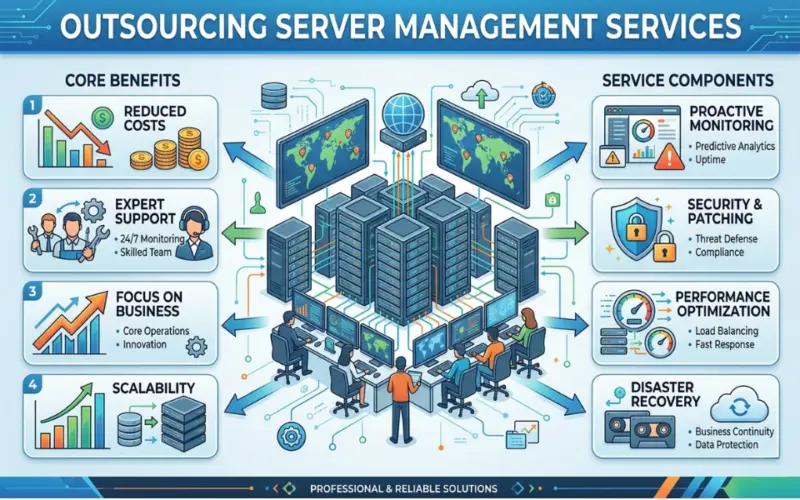

As businesses scale their digital operations, maintaining server reliability becomes increasingly complex. From handling traffic spikes to ensuring security updates and minimizing downtime, server management requires continuous monitoring and technical expertise.
This is where many organizations start evaluating Outsourcing Server Management Services as an alternative to in-house operations. A structured overview of how managed environments function can be explored through this reference on Outsourcing Server Management Services.
However, outsourcing is not always the right choice. The real challenge lies in understanding when it adds value and how it compares to managing infrastructure internally.
What People Actually Search Before Outsourcing
Modern search queries around this topic are highly practical:
- "Is outsourcing server management worth it?"
- "In-house vs managed server support cost comparison"
- "How to reduce downtime without hiring more engineers?"
- "Best way to manage servers 24/7?"
These queries show that decision-making is driven by cost, uptime, and operational efficiency, not just convenience.
In-House vs Outsourced Server Management: A Practical Comparison
1. In-House Server Management
This model relies on internal IT or DevOps teams to manage infrastructure.
Strengths
- full control over configurations
- direct access to systems
- no dependency on third-party providers
Limitations
- requires 24/7 team availability
- high staffing costs
- slower response during incidents
Search intent example: "Why does my server go down at night?"
This often happens because internal teams cannot monitor systems continuously.
2. Fully Outsourced Server Management
In this model, external teams handle monitoring, maintenance, and optimization.
Organizations considering Outsourcing Server Management Services typically move to this model when downtime starts affecting business operations.
Strengths
- 24/7 monitoring and support
- faster incident response
- proactive issue detection
Limitations
- reduced direct control
- dependency on service provider
- communication delays in some cases
This model is widely used for production environments where uptime is critical.
3. Hybrid Approach (Co-Managed Model)
This approach combines internal teams with external support.
Strengths
- balance between control and expertise
- internal teams focus on development
- external teams handle operations
Limitations
- requires clear responsibility division
- coordination challenges
This model is increasingly preferred by growing organizations.
Key Decision Factors (Based on Real Search Behavior)
🔹 Cost vs Value
Search intent: "the cost of managing servers vs. hiring engineers"
- in-house → high salary and infrastructure cost
- outsourced → predictable monthly expense
- hybrid → balanced cost
Important insight: cost should be evaluated against downtime risk, not just monthly expenses.
🔹 Uptime and Reliability
Search intent: "how to achieve 99.99% uptime"
- in-house → depends on team availability
- outsourced → proactive monitoring
- hybrid → shared responsibility
Even small downtime incidents can impact revenue and user trust.
🔹 Security and Compliance
Search intent: "how to secure production servers"
- in-house → depends on expertise
- outsourced → structured security processes
- hybrid → combined responsibility
Security failures are often caused by delayed updates or misconfigurations.
🔹 Scalability
Search intent: "how to scale servers without downtime"
- in-house → requires manual planning
- outsourced → scalable infrastructure support
- hybrid → moderate flexibility
Scaling becomes critical for applications with unpredictable traffic.
Common Mistakes When Outsourcing Server Management
- choosing providers based only on cost
- not defining clear SLAs (Service Level Agreements)
- ignoring monitoring and reporting capabilities
- lack of communication protocols
These mistakes often lead to poor outcomes even after outsourcing.
When Outsourcing Actually Makes Sense
Choose outsourcing if:
- downtime directly impacts revenue
- internal teams are overloaded
- 24/7 monitoring is required
- infrastructure is scaling rapidly
Many organizations adopt Outsourcing Server Management Services at this stage to maintain stability without expanding internal teams.
When You Should Avoid Outsourcing
- infrastructure is small and non-critical
- you already have a strong DevOps/SRE team
- workloads do not require continuous monitoring
In such cases, outsourcing may add unnecessary complexity.
Practical Framework for Decision-Making
- Assess workload criticality
- mission-critical → outsourcing recommended
- low-impact → in-house sufficient
- Evaluate team capability
- limited expertise → outsource
- experienced team → in-house or hybrid
- Analyze long-term cost
- compare staffing vs managed services
- Define reliability goals
- uptime targets (99.9% vs 99.99%)
This structured approach ensures better decision-making.
Future Trends in Server Management
- AI-driven monitoring and anomaly detection
- predictive maintenance
- automated scaling systems
- integration with cloud-native environments
These trends indicate that server management is becoming more automated and data-driven.
Final Thoughts
Outsourcing server management is not just about reducing workload-it is about improving reliability, performance, and operational efficiency. The right approach depends on infrastructure complexity, team capability, and business priorities.
By comparing models based on real-world factors such as uptime, cost, and scalability, organizations can decide whether Outsourcing Server Management Services is the right strategy for their needs.
Cloud Computing Server Management
Disclaimer
This content is a community contribution. The views and data expressed are solely those of the author and do not reflect the official position or endorsement of nasscom.
That the contents of third-party articles/blogs published here on the website, and the interpretation of all information in the article/blogs such as data, maps, numbers, opinions etc. displayed in the article/blogs and views or the opinions expressed within the content are solely of the author's; and do not reflect the opinions and beliefs of NASSCOM or its affiliates in any manner. NASSCOM does not take any liability w.r.t. content in any manner and will not be liable in any manner whatsoever for any kind of liability arising out of any act, error or omission. The contents of third-party article/blogs published, are provided solely as convenience; and the presence of these articles/blogs should not, under any circumstances, be considered as an endorsement of the contents by NASSCOM in any manner; and if you chose to access these articles/blogs , you do so at your own risk.
Jaipur, Rajasthan, India
I'm Devansh Mankani, an SEO Executive at CloudMinister, an IT-based company providing reliable cloud and hosting solutions. I specialize in improving organic visibility, keyword rankings, and traffic through data-driven SEO strategies. CloudMinister offers services like cloud hosting, VPS, dedicated servers, managed hosting, and advanced infrastructure solutions. I work on promoting innovative services such as N8N Hosting for workflow automation and GPU server for AI workloads. My role focuses on aligning technical SEO with business goals to drive growth. I'm passionate about making complex IT services easily discoverable online. I continuously optimize content and performance to strengthen CloudMinister's digital presence.