

Prediction markets represent one of the most data-sensitive segments within the digital economy. Unlike traditional financial systems, these markets operate on probability-driven outcomes linked to real-world events such as elections, economic indicators, regulatory shifts, and geopolitical developments.
As digital participation increases, the speed and complexity of event-driven markets have grown significantly. Manual execution is no longer sufficient to maintain competitive advantage in environments where probabilities can shift within seconds.
Intelligent automation has therefore emerged as a structural necessity rather than a technological luxury. Polymarket prediction bot development reflects this transition by introducing algorithmic systems capable of monitoring, analyzing, and executing trades in real time. This evolution is not merely about automation; it represents the architectural redesign of event trading infrastructure.
Understanding the Structural Nature of Event-Driven Markets
Event-driven markets are uniquely volatile because their pricing depends on continuously evolving public information. News cycles, regulatory announcements, macroeconomic signals, and policy changes directly influence probability distributions. In such ecosystems, market efficiency depends heavily on speed, analytical depth, and disciplined execution.
Unlike conventional equity markets, prediction platforms operate on binary or multi-outcome probability structures. This framework requires participants to evaluate statistical likelihood rather than intrinsic valuation. As participation scales, behavioral volatility and information asymmetry increase. These dynamics create opportunities for structured algorithmic systems to identify inefficiencies that human traders may overlook.
The demand for consistency, rapid analysis, and uninterrupted monitoring has accelerated the adoption of automated trading frameworks specifically engineered for prediction environments.
Architectural Foundations of a Prediction Bot System
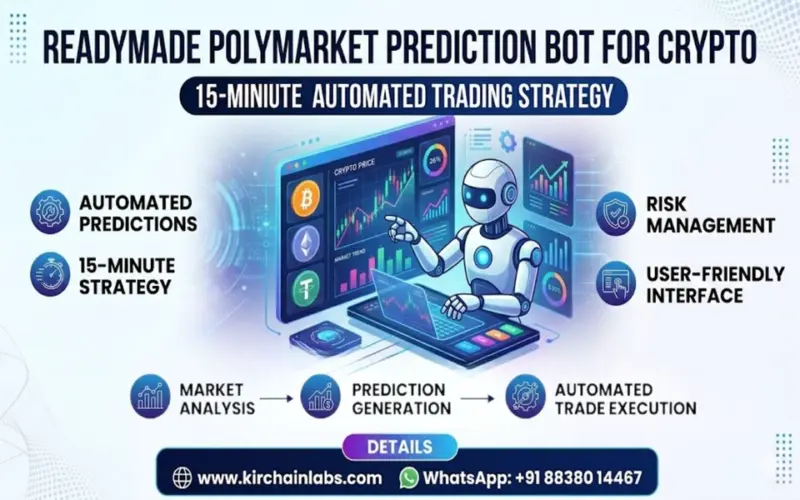
Polymarket prediction bot development is built upon a layered technological architecture designed for resilience and precision.
Real-Time Data Acquisition
The foundational layer focuses on continuous data collection. APIs retrieve order book information, liquidity depth, pricing fluctuations, and probability movements in real time. Accurate and uninterrupted data feeds form the backbone of any automated decision-making process.
Analytical and Strategy Modeling
The second layer incorporates quantitative models. Statistical frameworks analyze volatility patterns, price divergence, and liquidity variations. Strategy logic is embedded within this analytical core, defining when trades should be initiated or closed based on predefined mathematical thresholds.
Automated Execution Framework
Once trading conditions are satisfied, the execution engine places orders instantly. The system dynamically adjusts positions as new information enters the market, ensuring responsiveness without emotional hesitation.
Integrated Risk Governance
A critical architectural layer enforces capital allocation rules, exposure caps, and loss thresholds. Risk controls are embedded directly into the system logic, protecting long-term sustainability.
Together, these interconnected layers create a cohesive ecosystem capable of consistent performance in dynamic event-driven markets.
Why Intelligent Automation Matters for Enterprises
While individual traders may adopt bots for efficiency, enterprises approach prediction automation from a strategic infrastructure perspective. Businesses increasingly view automation as a scalable solution for navigating high-frequency probability shifts.
Operational Continuity and Scalability
Intelligent prediction bots enable organizations to operate continuously without dependence on manual intervention. Automated systems reduce latency, enhance accuracy, and support twenty-four-hour execution cycles.
Governance, Transparency, and Auditability
Algorithmic systems introduce measurable oversight into trading operations. Structured reporting mechanisms provide clarity on capital deployment, trade frequency, and performance outcomes. This transparency strengthens internal governance frameworks.
Strategic Portfolio Diversification
Enterprise-grade bots facilitate diversification across multiple event categories, reducing concentrated exposure. Automation also supports scenario modeling, enabling firms to simulate strategic responses before deploying capital.
In competitive digital ecosystems, automation transforms prediction trading from reactive speculation into a data-driven operational strategy aligned with long-term objectives.
Development Considerations: From Concept to Deployment
Developing a robust prediction bot requires a disciplined and multi-stage methodology.
1. Strategy Design and Quantitative Validation
The initial phase centers on strategic modeling. Developers define entry conditions, exit triggers, capital allocation logic, and risk-to-reward ratios grounded in statistical reasoning. Backtesting against historical datasets helps evaluate potential performance and uncover structural weaknesses.
2. Secure Platform Integration
Following validation, secure API integration enables seamless data retrieval and automated execution. Encryption standards, authentication protocols, and secure wallet connectivity ensure system integrity and prevent unauthorized access.
3. Testing, Simulation, and Stress Analysis
Comprehensive testing precedes deployment. Backtesting measures historical viability, while forward simulations assess behavior during volatile scenarios. Stress testing evaluates system stability under extreme probability fluctuations, ensuring operational resilience.
4. Deployment and Continuous Monitoring
After rigorous validation, deployment typically occurs on reliable cloud infrastructure to maintain uninterrupted uptime. Monitoring tools track performance metrics, detect anomalies, and enable ongoing optimization.
Each development stage demands precision, as architectural weaknesses can compromise sustainability over time.
5. Risk Governance and Ethical Responsibility
Automation in event-driven markets introduces both efficiency and responsibility. Without structured governance, algorithmic systems may amplify volatility or create unintended exposure.
Exposure limits, dynamic stop mechanisms, and diversified allocation frameworks safeguard capital. Transparency in algorithmic logic enhances accountability, particularly in enterprise environments.
Ethical deployment also requires adherence to regulatory standards, data protection norms, and platform compliance requirements. Intelligent automation should reinforce market integrity rather than disrupt stability.
As regulatory landscapes evolve, governance mechanisms must adapt in parallel with technological advancements.
The Future of Prediction Market Infrastructure
The evolution of prediction markets is closely tied to advancements in analytics and decentralized technology.
Adaptive Intelligence and Machine Learning
Future systems may incorporate machine learning models capable of recalibrating strategies based on real-time performance feedback. Pattern recognition across multiple data sources could enhance probability forecasting precision.
Cross-Market Interoperability
Blockchain interoperability may enable seamless movement across decentralized ecosystems, increasing liquidity and broadening participation. Intelligent bots could operate across multiple platforms, optimizing capital allocation dynamically.
The convergence of automation, advanced analytics, and decentralized infrastructure indicates that prediction bots will become foundational components of event-driven market architecture.
Conclusion: Automation as Strategic Infrastructure
Polymarket prediction bot development represents more than technological advancement; it signifies a structural transformation of event-driven trading systems. By combining real-time analytics, disciplined execution logic, and embedded risk governance, intelligent automation redefines how probability-based markets operate.
For enterprises and ecosystem participants, automation is evolving into strategic infrastructure rather than optional enhancement. As markets become increasingly complex and interconnected, algorithmic systems will determine speed, precision, and sustainability.
Given the architectural, security, and regulatory considerations involved, many organizations choose to collaborate with experienced crypto trading bot development companies that possess domain expertise in quantitative modeling, secure API integration, and scalable infrastructure design. Strategic partnerships of this nature can help ensure that automation frameworks are built with technical rigor, compliance awareness, and operational resilience.
polymarket prediction bot development polymarket Prediction Market platform Trading Automation Crypto Trading Bot development
Disclaimer
This content is a community contribution. The views and data expressed are solely those of the author and do not reflect the official position or endorsement of nasscom.
That the contents of third-party articles/blogs published here on the website, and the interpretation of all information in the article/blogs such as data, maps, numbers, opinions etc. displayed in the article/blogs and views or the opinions expressed within the content are solely of the author's; and do not reflect the opinions and beliefs of NASSCOM or its affiliates in any manner. NASSCOM does not take any liability w.r.t. content in any manner and will not be liable in any manner whatsoever for any kind of liability arising out of any act, error or omission. The contents of third-party article/blogs published, are provided solely as convenience; and the presence of these articles/blogs should not, under any circumstances, be considered as an endorsement of the contents by NASSCOM in any manner; and if you chose to access these articles/blogs , you do so at your own risk.
Blockchain Developer
Hi, I'm Jennifer, a passionate blockchain developer and enthusiast at KIR Chain Labs, exploring new opportunities in decentralized applications and cryptocurrency. I enjoy researching emerging technologies and their potential for disrupting traditional industries.