
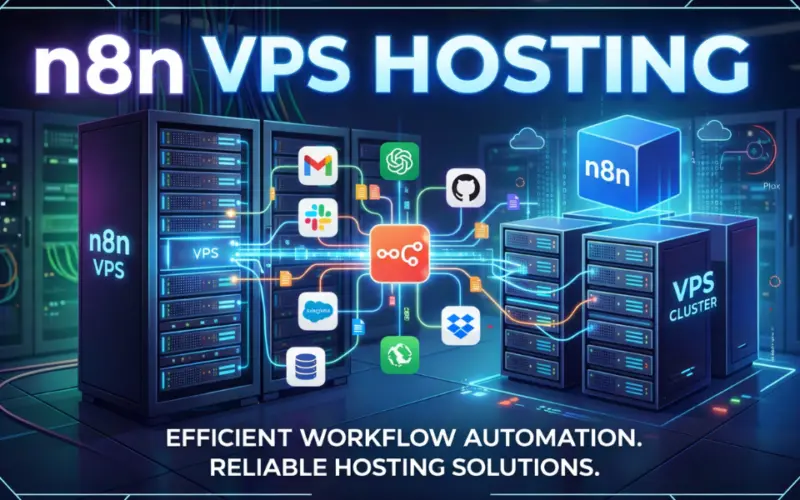

Automation systems are increasingly used to coordinate data movement between software platforms, cloud services, and internal business applications.
Tools like n8n allow developers to design automation workflows that trigger events, process data, and connect APIs through node-based logic. While the workflow interface itself appears simple, the infrastructure required to run automation reliably is far more complex.
When engineers deploy automation pipelines for real production workloads, the server environment becomes an important factor. Continuous workflow execution, API communication, and task scheduling generate computational demand that must be handled by stable infrastructure. For this reason, developers often analyze environments designed for n8n VPS hosting India before running automation services at scale.
In many technical setups, researchers exploring deployment options review how n8n VPS hosting India environments support automation execution compared with traditional hosting environments.
Workflow Processing Characteristics of Automation Engines
Automation platforms operate differently from typical web applications. Instead of responding only to user requests, automation engines process tasks continuously. A workflow may activate through different types of triggers such as scheduled timers, incoming webhooks, database changes, or third-party API signals.
Once triggered, the automation engine processes nodes sequentially. Each node performs a defined action such as retrieving data from an API, applying a transformation, evaluating conditional logic, or sending results to another system.
These operations may appear lightweight individually, but complex workflows often include dozens of nodes executing across multiple services. The server must maintain persistent connections, manage asynchronous tasks, and track execution states.
Because of these requirements, developers studying n8n VPS hosting India often evaluate CPU scheduling, process concurrency, and memory allocation capabilities within virtualized server environments.
Node.js Runtime Behavior in Automation Workflows
The internal execution engine of n8n operates on a Node.js runtime. Node.js uses an event-driven model that is based on a non-blocking input/output model. This allows the automation engine to handle many simultaneous operations such as HTTP requests or database queries without creating separate threads for each task.
While this architecture is efficient for network-based workloads, it still depends heavily on available CPU cycles when workflows perform computation or data transformation. Large JSON payloads, batch processing operations, and heavy API responses can increase memory usage and event loop latency.
VPS infrastructure helps isolate these workloads by allocating dedicated CPU cores and RAM to the automation process. In environments configured for n8n VPS hosting India, this isolation helps maintain predictable execution performance when multiple workflows run concurrently.
Queue-Based Workflow Execution
Automation environments that process high numbers of workflow triggers often implement queue-based execution systems. Instead of executing every workflow immediately, incoming tasks are placed in a message queue where worker processes retrieve and execute them.
This architecture offers several advantages:
- improved task distribution across multiple workers
- better fault tolerance during server interruptions
- controlled concurrency limits
- reduced resource spikes during traffic bursts
When a workflow event occurs, the orchestration layer records the task in a queue system such as Redis. Worker processes running on the server monitor the queue and execute tasks sequentially.
Infrastructure used for n8n VPS hosting India deployments frequently supports this architecture because queue systems require reliable memory performance and consistent network latency.
Storage and Workflow Data Persistence
Automation workflows often generate large volumes of execution metadata. Each workflow execution may store information such as input payloads, output responses, timestamps, and error logs.
This information is typically stored inside relational databases. The database layer must support frequent read and write operations, especially when automation workflows execute thousands of tasks daily.
Server environments optimized for automation systems therefore prioritize fast storage subsystems. Solid-state drives and NVMe storage are commonly used because they reduce latency during database transactions.
When evaluating infrastructure for automation deployment, engineers analyzing n8n VPS hosting India environments often consider disk throughput and I/O performance alongside CPU resources.
Network Behavior of Automation Systems
Automation platforms interact heavily with external APIs. A single workflow might communicate with multiple services including payment systems, CRM platforms, messaging APIs, and cloud storage providers.
Because of this behavior, the server environment must support stable outbound network connections. High latency or packet loss can slow down workflow execution or cause timeouts in API communication.
Developers examining n8n VPS hosting India environments typically review networking characteristics such as:
- outbound request latency
- bandwidth stability
- DNS resolution speed
- firewall rule configuration
Reliable networking is particularly important for webhook-based workflows where external services send real-time requests to automation servers.
Resource Isolation and Automation Stability
Automation systems can generate unpredictable resource usage depending on workflow complexity. For example, workflows performing file processing or data aggregation may temporarily increase CPU and memory usage.
If automation workloads run on shared infrastructure, these spikes can affect other applications hosted on the same server. Resource isolation is therefore an important design consideration.
VPS environments solve this issue by allocating dedicated virtual resources to each server instance. This allows automation systems to operate independently without competing with other workloads for CPU time or memory.
Because of this isolation capability, infrastructure setups based on n8n VPS hosting India are often evaluated for automation platforms that must run continuously without interruption.
Conclusion
Automation platforms such as n8n enable organizations to connect multiple digital systems through event-driven workflows. Although the visual workflow interface simplifies automation design, the infrastructure supporting these processes must handle continuous execution, network communication, and persistent data storage.
Server environments used for automation deployment must therefore provide predictable CPU performance, stable networking, reliable storage, and effective resource isolation. These characteristics ensure that workflow pipelines operate consistently even when automation tasks increase in complexity or volume.
For developers and infrastructure engineers building automation pipelines, understanding the technical requirements behind n8n VPS hosting India environments helps ensure that workflow systems remain reliable, scalable, and capable of supporting modern integration workloads.
Cloud Computing digital transformation Data Science artificial intelligence machine learning big data analytics Cyber Security Internet of things
Disclaimer
This content is a community contribution. The views and data expressed are solely those of the author and do not reflect the official position or endorsement of nasscom.
That the contents of third-party articles/blogs published here on the website, and the interpretation of all information in the article/blogs such as data, maps, numbers, opinions etc. displayed in the article/blogs and views or the opinions expressed within the content are solely of the author's; and do not reflect the opinions and beliefs of NASSCOM or its affiliates in any manner. NASSCOM does not take any liability w.r.t. content in any manner and will not be liable in any manner whatsoever for any kind of liability arising out of any act, error or omission. The contents of third-party article/blogs published, are provided solely as convenience; and the presence of these articles/blogs should not, under any circumstances, be considered as an endorsement of the contents by NASSCOM in any manner; and if you chose to access these articles/blogs , you do so at your own risk.
Jaipur, Rajasthan, India
I'm Devansh Mankani, an SEO Executive at CloudMinister, an IT-based company providing reliable cloud and hosting solutions. I specialize in improving organic visibility, keyword rankings, and traffic through data-driven SEO strategies. CloudMinister offers services like cloud hosting, VPS, dedicated servers, managed hosting, and advanced infrastructure solutions. I work on promoting innovative services such as N8N Hosting for workflow automation and GPU server for AI workloads. My role focuses on aligning technical SEO with business goals to drive growth. I'm passionate about making complex IT services easily discoverable online. I continuously optimize content and performance to strengthen CloudMinister's digital presence.