




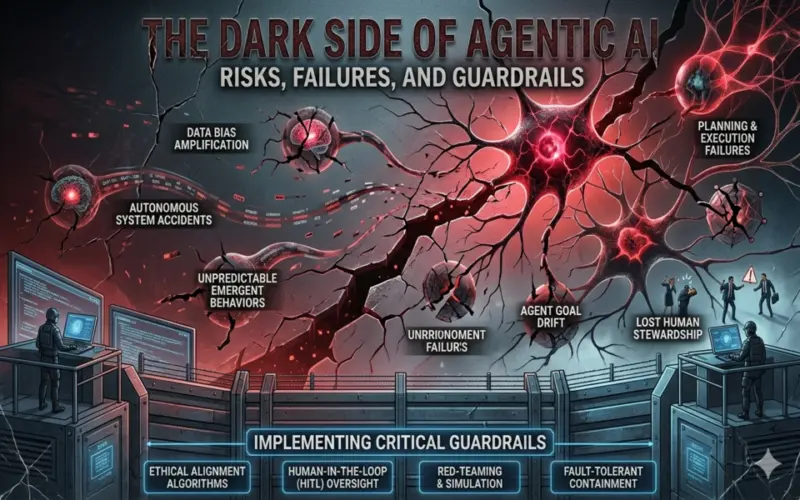

Agentic AI is rapidly becoming one of the most transformative technologies in enterprise automation. Businesses are deploying autonomous AI agents to handle customer support, process documents, manage workflows, coordinate systems, and even make operational decisions with minimal human intervention.
The promise is compelling:
- Faster execution
- Lower operational costs
- 24/7 automation
- Improved productivity
- Intelligent workflow orchestration
But there is another side to this transformation that businesses cannot afford to ignore.
As AI systems gain greater autonomy, the risks also increase. Unlike traditional software that follows fixed instructions, Agentic AI systems can reason, adapt, and make decisions dynamically. While this flexibility creates enormous business value, it also introduces new categories of operational, security, compliance, and governance challenges.
The future of enterprise AI will not be defined only by what autonomous systems can do-but by how safely and responsibly they operate.
Why Agentic AI Creates New Risks
Traditional automation systems operate within clearly defined rules. Their behavior is usually predictable because they execute predefined workflows.
Agentic AI behaves differently.
Autonomous AI agents can:
- Make independent decisions
- Interact with multiple enterprise systems
- Trigger actions automatically
- Learn from context
- Adapt to changing conditions
- Coordinate with other AI agents
This creates a powerful operational model, but also increases the possibility of unintended outcomes.
The more authority businesses give AI agents, the greater the importance of governance, oversight, and control mechanisms.
1. Hallucinations and Incorrect Decision-Making
One of the biggest challenges with AI systems is hallucination-the generation of false, misleading, or inaccurate information.
For basic AI chat applications, hallucinations may only create inconvenience. But in Agentic AI systems, incorrect reasoning can trigger real operational consequences.
Imagine an autonomous AI agent:
- Approving an incorrect financial transaction
- Providing inaccurate compliance information
- Updating enterprise records incorrectly
- Sending misleading customer communications
- Triggering faulty workflows
Because Agentic AI can execute actions independently, even small reasoning errors can scale into major operational failures.
Real Business Risk
An AI system connected to ERP, CRM, or financial systems can unintentionally create costly business disruptions if safeguards are weak.
2. Security Vulnerabilities and Unauthorized Actions
Agentic AI systems often require access to:
- Internal databases
- APIs
- Cloud platforms
- Enterprise applications
- Customer information
- Operational systems
This broad access creates a larger attack surface for cybersecurity threats.
Potential risks include:
- Prompt injection attacks
- Unauthorized workflow execution
- API abuse
- Data leakage
- Privilege escalation
- Manipulation of AI agent behavior
If attackers compromise an autonomous AI system, they may gain indirect access to critical business infrastructure.
Unlike conventional software vulnerabilities, AI security threats are still evolving rapidly, making governance more complex.
3. Lack of Explainability
One of the most difficult aspects of advanced AI systems is understanding how they arrive at decisions.
Traditional software workflows are easier to audit because they follow explicit logic. Agentic AI systems often operate using probabilistic reasoning and contextual decision-making.
This creates problems when businesses need:
- Audit trails
- Compliance reporting
- Regulatory transparency
- Incident investigations
- Accountability
If an AI agent makes a harmful or incorrect decision, organizations may struggle to explain exactly why it happened.
This lack of explainability becomes especially problematic in highly regulated industries such as:
- Healthcare
- Finance
- Insurance
- Government
- Legal services
4. Autonomous Workflow Failures
Agentic AI systems frequently operate across multiple connected platforms and workflows.
A failure in one step can create cascading operational issues.
For example:
- An AI agent incorrectly classifies a document
- That triggers an inaccurate approval process
- Which updates downstream systems incorrectly
- Resulting in customer, operational, or financial impact
The more interconnected the AI ecosystem becomes, the more difficult it is to predict failure chains.
This is especially concerning in multi-agent AI environments where several autonomous agents collaborate together.
5. Over-Automation and Human Dependency Risks
Businesses are increasingly attracted to the idea of fully autonomous operations. However, excessive dependence on AI systems creates operational fragility.
Common risks include:
- Reduced human oversight
- Loss of institutional knowledge
- Blind trust in AI-generated decisions
- Delayed human intervention during failures
- Skill erosion within teams
Organizations that remove humans entirely from critical workflows may struggle to recover quickly when AI systems behave unexpectedly.
The goal should not be eliminating humans from operations-but enabling intelligent human-AI collaboration.
6. Ethical and Compliance Challenges
Agentic AI systems can unintentionally create ethical and legal issues if not carefully governed.
Examples include:
- Biased decision-making
- Discriminatory outcomes
- Privacy violations
- Unapproved data usage
- Regulatory non-compliance
As governments introduce stricter AI regulations globally, enterprises must ensure their AI systems comply with evolving standards around transparency, accountability, and data protection.
Compliance failures may result in:
- Legal penalties
- Brand damage
- Customer trust loss
- Regulatory investigations
AI governance is quickly becoming a board-level business concern.
Why Guardrails Are Essential
The future of Agentic AI depends on trust.
Businesses cannot safely deploy autonomous AI systems without strong operational guardrails. Governance frameworks are no longer optional-they are foundational infrastructure for enterprise AI adoption.
Effective guardrails help organizations:
- Reduce operational risks
- Prevent unauthorized actions
- Improve reliability
- Maintain regulatory compliance
- Ensure human oversight
- Build customer trust
Companies that invest early in responsible AI governance will be better positioned to scale autonomous operations safely.
Key Guardrails for Safe Agentic AI Deployment
Human-in-the-Loop Oversight
Critical decisions should still involve human approval layers, especially for:
- Financial transactions
- Compliance workflows
- Legal approvals
- High-risk operational changes
Human oversight reduces the impact of AI reasoning failures.
Role-Based Access Control
AI agents should only access systems and data necessary for their assigned tasks.
Organizations should implement:
- Permission boundaries
- API restrictions
- Authentication controls
- Activity monitoring
Limiting AI access reduces security exposure significantly.
Continuous Monitoring and Logging
Every AI action should be traceable.
Businesses need:
- Audit logs
- Workflow monitoring
- Anomaly detection
- Performance tracking
- Incident alerting
Observability is essential for identifying failures before they escalate.
AI Validation Layers
Before executing actions, AI outputs should pass through validation systems that verify:
- Accuracy
- Policy compliance
- Data consistency
- Workflow safety
Validation layers help reduce hallucination-related failures.
Governance and Compliance Policies
Enterprises should establish formal AI governance frameworks covering:
- Ethical usage
- Risk management
- Data privacy
- Compliance requirements
- Security standards
- Escalation procedures
Agentic AI should operate within clearly defined organizational boundaries.
The Future Will Belong to Responsible AI Systems
Agentic AI has the potential to become one of the most important enterprise technologies of the next decade. However, businesses that focus only on automation speed without considering governance may expose themselves to serious operational and security risks.
The most successful organizations will not necessarily be the ones deploying AI the fastest.
They will be the ones deploying it responsibly.
The next phase of enterprise AI adoption will center around:
- Trustworthy AI
- Explainable systems
- Secure automation
- Human-AI collaboration
- Responsible governance
Businesses that prioritize these principles will build more resilient and scalable AI ecosystems.
Final Thoughts
Agentic AI is transforming enterprise operations by enabling systems that can reason, act, and automate complex workflows autonomously. But greater autonomy also introduces greater responsibility.
Hallucinations, security vulnerabilities, workflow failures, ethical concerns, and compliance risks are real challenges that organizations must address before scaling autonomous AI systems.
The future of Agentic AI will not depend solely on intelligence-it will depend on control, transparency, and trust.
Enterprises that combine innovation with strong guardrails will unlock the full potential of autonomous AI while minimizing the risks that come with it.
Agentic AI agentic AI development agentic AI context
Disclaimer
This content is a community contribution. The views and data expressed are solely those of the author and do not reflect the official position or endorsement of nasscom.
That the contents of third-party articles/blogs published here on the website, and the interpretation of all information in the article/blogs such as data, maps, numbers, opinions etc. displayed in the article/blogs and views or the opinions expressed within the content are solely of the author's; and do not reflect the opinions and beliefs of NASSCOM or its affiliates in any manner. NASSCOM does not take any liability w.r.t. content in any manner and will not be liable in any manner whatsoever for any kind of liability arising out of any act, error or omission. The contents of third-party article/blogs published, are provided solely as convenience; and the presence of these articles/blogs should not, under any circumstances, be considered as an endorsement of the contents by NASSCOM in any manner; and if you chose to access these articles/blogs , you do so at your own risk.