

In today's fast-evolving business environment, managing customer relationships effectively has become essential for sustainable growth.
Over the years, Customer Relationship Management (CRM) systems have played a crucial role in helping organizations organize customer data and streamline sales processes.
However, with changing customer expectations and increasing digital interactions, businesses are now moving towards more advanced CRM approaches that go beyond traditional functionalities.
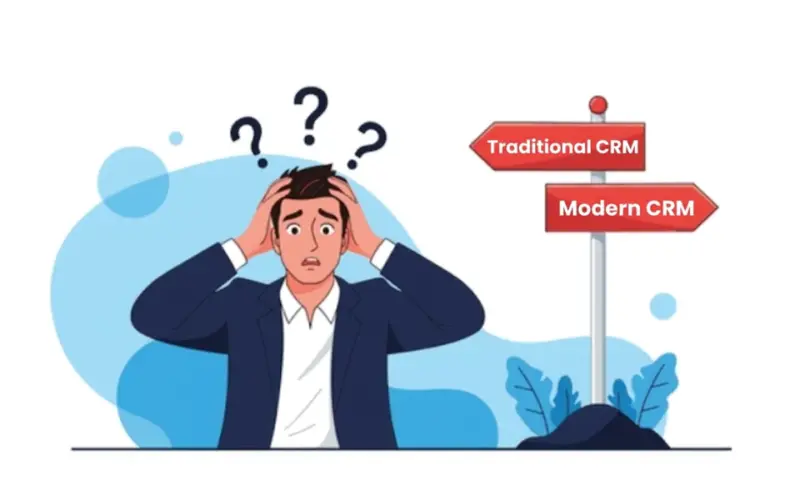
This raises an important question: What is the difference between traditional CRM and modern CRM tools, and how do they impact business operations?
What is a Traditional CRM?
A traditional CRM system is designed to help businesses store and manage customer information, track interactions, and monitor sales pipelines.
Key Features:
- Contact and lead management
- Sales pipeline tracking
- Manual follow-ups
- Basic reporting and analytics
These systems are effective in organizing data and providing a structured view of customer relationships. However, they often rely heavily on manual inputs and human intervention, which can limit efficiency as business operations scale.
What is a Modern CRM?
Modern CRM tools represent an evolution of traditional systems. They incorporate advanced technologies to improve how businesses manage, analyze, and interact with customer data.
Rather than acting solely as a data repository, modern CRM systems support automation, real-time engagement, and data-driven decision-making.
Key Features:
- Automated lead capture and management
- Instant responses to customer queries
- Smart follow-ups and reminders
- Advanced analytics and predictive insights
- Comprehensive interaction tracking
Key Differences Between Traditional and Modern CRM
1. Automation
- Traditional CRM: Relies largely on manual processes
- Modern CRM: Automates repetitive tasks such as follow-ups and data updates
2. Response Time
- Traditional CRM: Dependent on team availability
- Modern CRM: Enables faster, often real-time responses
3. Lead Management
- Traditional CRM: Focuses on storing and tracking leads
- Modern CRM: Supports lead capture, prioritization, and nurturing
4. Customer Interaction
- Traditional CRM: Primarily records past interactions
- Modern CRM: Facilitates ongoing and real-time engagement
5. Decision-Making Capabilities
- Traditional CRM: Provides basic reporting
- Modern CRM: Offers data-driven insights for informed decision-making
Why Businesses Are Transitioning to Modern CRM
Customer expectations have evolved significantly. Today's customers expect quick responses, personalized communication, and seamless interactions across channels.
Traditional CRM systems, while useful, may not fully meet these expectations due to their reliance on manual processes. Modern CRM tools address these gaps by improving efficiency, responsiveness, and customer experience.
Organizations adopting modern CRM approaches often aim to:
- Improve response times
- Enhance customer engagement
- Reduce manual workload
- Increase operational efficiency
The Role of CRM in Business Growth
CRM systems - whether traditional or modern - play a critical role in strengthening customer relationships and improving business outcomes.
While traditional CRM systems provide a solid foundation for data organization, modern CRM tools extend these capabilities by enabling businesses to operate more efficiently and respond more effectively to customer needs.
Conclusion
The transition from traditional CRM to modern CRM reflects a broader shift towards digital transformation in business operations.
Understanding the differences between these systems helps organizations make informed decisions based on their specific needs, scale, and customer engagement strategies.
As businesses continue to evolve, adopting more structured and efficient approaches to customer relationship management will remain a key factor in achieving long-term success.
CRM Benefits
Disclaimer
This content is a community contribution. The views and data expressed are solely those of the author and do not reflect the official position or endorsement of nasscom.
That the contents of third-party articles/blogs published here on the website, and the interpretation of all information in the article/blogs such as data, maps, numbers, opinions etc. displayed in the article/blogs and views or the opinions expressed within the content are solely of the author's; and do not reflect the opinions and beliefs of NASSCOM or its affiliates in any manner. NASSCOM does not take any liability w.r.t. content in any manner and will not be liable in any manner whatsoever for any kind of liability arising out of any act, error or omission. The contents of third-party article/blogs published, are provided solely as convenience; and the presence of these articles/blogs should not, under any circumstances, be considered as an endorsement of the contents by NASSCOM in any manner; and if you chose to access these articles/blogs , you do so at your own risk.
AI & CRM Solutions Provider