

Think about the last time you had to trust a middleman. A bank to cash your cheque. To validate a document a notary is needed. An agent to do a transaction.
Each and every step was time-consuming, required money and there was the risk of human error or even worse, manipulation.
Suppose you took out all that. Not by promise or a handshake, but by code that just runs automatically as the conditions are fulfilled. No middlemen. No delays. None to play around.
It is what smart contracts do and they are quietly transforming industries in the finance industry to the medical industry to supply chain management. The smart contract market has been valued at more than 1.5 billion in the world and is expected to rise exponentially in the coming decade. Working in the technology sector, finance, or any other digitally developing sector, it is no longer a luxury to be acquainted with smart contracts. It is a competitive requirement.
This guide simplifies all that you should know. Not the superficial materials on Wikipedia. The actual technical richness, the platforms, the integrations, the security issues and where this technology is actually going.
What Are Smart Contracts?
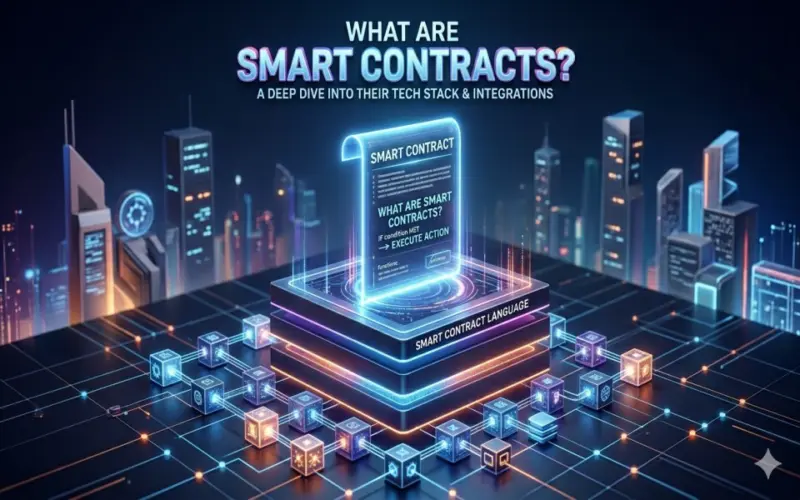
A smart contract is an automated program that is stored on a blockchain and executed automatically to enforce and implement the conditions of an agreement when specified conditions are satisfied.
It is a concept that was initially presented by cryptographer Nick Szabo in 1994, when blockchain was yet to be created. He described it as a "computerized transaction protocol that executes the terms of a contract." The concept was ground breaking at the time. It was made possible with blockchain.
How Smart Contracts Work
Smart contracts follow a simple trigger-and-perform paradigm. The following is the lifecycle decomposition:
- Parties are in agreement on terms and the terms are coded.
- The agreement is set up on a blockchain network.
- Status is observed in real-time (and using oracles to feed real-world data).
- The contract will automatically run as long as the conditions are satisfied.
- The outcome is permanently and irrevocably stored in the blockchain.
Since the contract exists on a decentralized blockchain, no one entity is in control. This renders it virtually impossible to tamper with once it is deployed.
Key Components of Smart Contracts
Understanding what makes a smart contract function requires looking at its individual building blocks.
Bytecode and ABI
The source code (usually written in Solidity or Vyper) is compiled into bytecode that the Ethereum Virtual Machine (EVM) can read. The Application Binary Interface (ABI) defines how to interact with the contract, specifying function names, inputs, and outputs.
State Variables
These store persistent data on-chain. Think of them as the contract's memory, values that remain even after a function call ends.
Functions
Functions are the executable logic. They can be:
- View functions: Read-only, no gas cost
- Pure functions: No state access at all
- State-changing functions: Require gas and create transactions
Events
Events log specific actions to the blockchain, enabling front-end applications and third-party services to listen and react to contract activity.
Modifiers
Modifiers restrict access to functions. For example, only allowing the contract owner to execute a particular action. They act as guardrails built directly into the logic.
Smart Contract Tech Stack Explained
Here is a comprehensive breakdown of the technology layers that power smart contract development:
This stack is not static. It evolves rapidly as the Web3 ecosystem matures, and understanding each layer helps you build or evaluate smart contract solutions with genuine technical confidence.
Integrations that drive Smart Contracts
An isolated smart contract is not very useful. Its real power is created by integrations which bring it to the real world and other systems.
Oracle Networks
Oracles are the interface between blockchain and external data. Chainlink is the largest oracle provider that provides price feeds, weather data, sports results, and more to smart contracts that require trusted real-world data.
Cross-Chain Bridges
The cross-blockchain communication protocols such as LayerZero, Wormhole, and Axelar enable smart contract communication between different blockchains, enabling assets and data to move across ecosystems.
DeFi Composability
The most evident implementation of smart contract integrations is in DeFi. Aave (lending), Uniswap (trading), and Yearn Finance (yield optimization) are all constructed using interconnected smart contracts, which call on each other, what developers refer to as money legos.
Identity and Compliance
Decentralized identity is incorporated in protocols such as Worldcoin and Polygon ID, and it can be used to conduct DeFi operations that are compliant with KYC and privacy-protective authentication.
IoT Integration
The industrial applications now have IoT sensors linked to smart contracts. A contract automatically releases money when a shipment was transported at the right temperature, as a temperature sensor confirms that it was kept at the right temperature during this process. No invoice needed. No disputes possible.
Popular Smart Contract Platforms
Not all blockchains support smart contracts in the same way. Here is how the major players compare:
Choosing a platform depends heavily on your use case. DeFi protocols tend to gravitate toward Ethereum and its Layer 2 networks like Arbitrum and Optimism. High-throughput gaming applications often favor Solana. Enterprise solutions increasingly lean on Polygon or Avalanche for their lower costs and compliance-friendly tooling.
Real-World Use Cases of Smart Contracts
The use cases have moved well beyond theoretical at this point.
Decentralized Finance (DeFi)
By 2025, there are more than $80 billion of assets stored in DeFi smart contracts. No banks are involved in lending, borrowing, yield farming, or decentralized exchanges.
NFT Ownership and Royalties.
The ownership of NFTs is regulated by ERC-721 smart contracts. More to the point, they are able to automatically remit royalty payments to original creators whenever an NFT is resold, which traditional licensing deals could never depend on to happen.
Supply Chain Management
Smart contracts based on blockchain are used by companies such as Walmart and Maersk to trace goods to shelf, which automatically results in payment and quality checks at every checkpoint.
Insurance
Parametric insurance products are now automatically paid out in the event of verifiable conditions such as a delay of a flight over a certain threshold without the involvement of a claims adjuster.
Real Estate
Fractional ownership of real estate is enabled by property tokenization platforms that enable smart contracts to transfer and distribute rental income, which are automatically conducted.
Healthcare
Smart contract applications in regulated healthcare contexts include patient consent management, medical record access control, and pharmaceutical supply chain verification.
Teams working with a professionalsmart contract development company can translate these use cases into production-grade, audited deployments far more efficiently than building from scratch internally.
Benefits of Smart Contracts
What is causing enterprises and startups to invest in the development of smart contracts? The benefits are tangible:
- Trustless implementation: There is no dependence on any central authority to enforce the agreement.
- Reduced cost: The removal of intermediaries will reduce transaction costs and overheads.
- Speed: Automated performance processes transactions in seconds, not days.
- Transparency: The code of the contract can be inspected by all sides before contract signing.
- Immutability: Once deployed, the rules cannot be changed unilaterally
- Globally accessible: The smart contract can be used by anyone with a wallet, not confined to any geographical location.
Challenges and Limitations
To be honest in covering smart contracts, one must note what they cannot perform, and where they are not performing at the moment.
Code is law, and cuts both ends. A bug in a smart contract is a bug that is permanent after it is deployed. In 2016, a notorious reentrancy-based hack of the DAO emptied 60 million ETH. The code did what it said it did.
Oracle risk: Smart contracts are as reliable as the information they get. A compromised or hacked oracle feed may lead to wrong executions that have actual financial implications.
Legal ambiguity: In most jurisdictions, smart contracts are not well-established as legal instruments. This poses tension as there are disagreements that are not contained within the blockchain.
Scalability expenses: Gas fees in an overloaded network such as Ethereum mainnet can render simple interactions with a contract economically impractical with small transactions.
Complexity of upgradeability: Immutability is a constraint but a feature. The need to upgrade contracts demands proxy patterns and designs, which are complicated to engineer.
Smart Contract Security Best Practices
Security is not an afterthought in smart contract development. It is the entire game. A single exploited vulnerability can drain millions in minutes.
Common Vulnerabilities to Know
Best Practice Checklist
- Use audited libraries like OpenZeppelin rather than reinventing security logic
- Always conduct multiple independent security audits before mainnet deployment
- Implement timelocks and multi-sig controls for administrative functions
- Set up bug bounty programs to incentivize responsible disclosure
- Use formal verification tools like Certora for critical financial contracts
- Deploy on testnet and stress-test under real conditions before going live
The Future of Smart Contracts
The trend is to make smart contracts the invisible infrastructure of world trade. This is being catalyzed by a number of developments:
EIP-4337 Account Abstraction (EIP-4337) is standardizing smart contract wallets and removing seed phrases and allows gas-sponsored payments. Web3 and Web2 are narrowing their user experience gap.
AI and Smart Contracts:Autonomous economic agents are currently being constructed that autonomously deploy, monitor, and communicate with smart contracts according to real-time conditions, entirely autonomous actors in the economy.
Zero-Knowledge Proofs (ZKPs) are making it possible to have private smart contracts in which computation is verifiable without exposing the underlying data. This enables friendly-to-compliance private DeFi and secret corporate contracts.
The Real-World Asset (RWA) Tokenization will be a multi-trillion dollar industry. Already live on Ethereum are tokenized government bonds, real estate, and private credit, all under smart contracts.
Interoperability across chains is coming to maturity. There is no single blockchain in the future. It is a network of thousands of chains that communicate with each other via smart contract-based bridges and messaging protocols.
Final Thoughts
Smart contracts represent far more than a technical novelty. They are a fundamental shift in how agreements are made, enforced, and settled. The layer of trust we have always outsourced to institutions is now being embedded directly into code.
For businesses, developers, and investors, the question is no longer whether smart contracts will matter. They already do. The question is how quickly you build the fluency to work with them.
Whether you are exploring DeFi protocols, tokenizing assets, building decentralized applications, or automating supply chains, partnering with experienced smart contract developers who understand both the technical depth and the business context can significantly reduce your time to market and your risk exposure.
The blockchain is not waiting. Neither should your strategy.
SmartContract smartcontractdevelopment technologies Security Best Practices
Disclaimer
This content is a community contribution. The views and data expressed are solely those of the author and do not reflect the official position or endorsement of nasscom.
That the contents of third-party articles/blogs published here on the website, and the interpretation of all information in the article/blogs such as data, maps, numbers, opinions etc. displayed in the article/blogs and views or the opinions expressed within the content are solely of the author's; and do not reflect the opinions and beliefs of NASSCOM or its affiliates in any manner. NASSCOM does not take any liability w.r.t. content in any manner and will not be liable in any manner whatsoever for any kind of liability arising out of any act, error or omission. The contents of third-party article/blogs published, are provided solely as convenience; and the presence of these articles/blogs should not, under any circumstances, be considered as an endorsement of the contents by NASSCOM in any manner; and if you chose to access these articles/blogs , you do so at your own risk.