




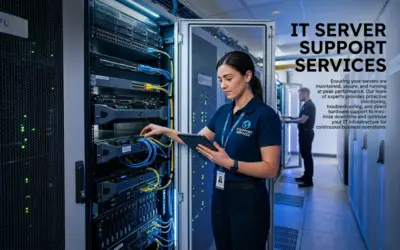

Modern businesses rely heavily on server infrastructure to deliver applications, manage data, and ensure uninterrupted user experiences.
However, maintaining consistent uptime, performance, and security has become increasingly complex due to distributed architectures, cloud environments, and continuous deployment cycles.
This complexity is why organizations actively search for IT server support services when they face challenges such as downtime, latency issues, or security vulnerabilities. A structured understanding of how managed server environments operate can be explored through this reference on IT server support service.
From a technical standpoint, server support is no longer limited to troubleshooting-it now involves proactive monitoring, performance optimization, and automated incident response.
What Real Search Queries Tell Us About Server Support Needs
Users today are not searching for definitions-they are searching for solutions:
- "How to reduce server downtime?"
- "Why is my server slow under high traffic?"
- "Best way to monitor server performance 24/7?"
- "How to prevent server crashes in production?"
These queries indicate a strong focus on availability, performance, and reliability engineering.
The Role of Monitoring in Modern Server Support
Server monitoring is a core component of infrastructure management. It involves continuously tracking system health, resource usage, and uptime to ensure operational stability.
Key Metrics Monitored
- CPU utilization
- memory consumption
- disk I/O performance
- network latency
Monitoring systems collect and analyze this data in real time, allowing teams to detect anomalies early and prevent failures.
Why Monitoring Matters
- reduces downtime through early detection
- improves performance optimization
- enables proactive issue resolution
Research shows that 90% of organizations now aim for at least 99.99% uptime, highlighting the importance of continuous monitoring.
Reactive vs Proactive Server Support: A Critical Comparison
1. Reactive Support (Traditional Approach)
This model is all about fixing problems after they happen.
Characteristics
- manual intervention
- delayed response time
- limited automation
Limitations
- higher downtime
- slower recovery
- increased operational risk
2. Proactive Support (Modern Approach)
This model emphasizes prevention rather than reaction.
Organizations adopting IT server support services increasingly rely on proactive systems to maintain stability.
Characteristics
- real-time monitoring and alerts
- automated remediation scripts
- predictive failure detection
Advantages
- reduced downtime
- faster incident response
- improved system reliability
Key Technical Components of Effective Server Support
🔹 Observability Systems
Modern observability integrates:
- metrics (system performance)
- logs (event tracking)
- traces (request flow across services)
This provides a complete view of system behavior.
🔹 Automation and Configuration Management
Automation reduces human error and improves efficiency.
Common Practices
- infrastructure as code (IaC)
- automated patch management
- configuration standardization
🔹 Performance Optimization
Performance issues often arise from inefficient resource utilization.
Optimization Techniques
- load balancing across servers
- caching mechanisms
- database query optimization
Monitoring tools help detect bottlenecks before they impact users.
🔹 Security and Compliance
Server support also includes:
- vulnerability scanning
- firewall configuration
- access control management
Security is something that needs to be done all the time, not just once.
Cost of Downtime: Why Server Support Matters
Downtime is not just a technical issue-it is a business risk.
Studies show that a single hour of downtime can cost enterprises over $100,000, and in some cases even millions.
This is why organizations prioritize IT server support services to ensure continuous availability and performance.
Common Mistakes Businesses Make
- relying only on basic monitoring tools
- ignoring performance metrics until failure occurs
- delaying security updates
- underestimating infrastructure scaling needs
These mistakes often lead to avoidable outages and performance degradation.
Practical Decision Framework
Choose basic support if:
- infrastructure is small
- workloads are non-critical
Choose advanced support if:
- uptime directly impacts revenue
- systems are distributed or cloud-based
Choose proactive managed support if:
- continuous monitoring is required
- internal teams are limited
At this point, many businesses switch to structured solutions like those used by cloudminister, where monitoring, automation, and performance optimization are all part of the same process.
Future Trends in Server Support Services
- AI-driven anomaly detection
- predictive maintenance systems
- automated incident response
- integration with cloud-native observability tools
These trends indicate a shift toward intelligent and autonomous infrastructure management.
Final Thoughts
Server support has evolved into a critical engineering function that directly impacts business performance, user experience, and operational efficiency. Organizations can no longer rely on reactive approaches in environments where downtime and latency have immediate consequences.
By adopting modern practices such as proactive monitoring, automation, and performance optimization, businesses can use to build infrastructure that is resilient, scalable, and aligned with current technological demands
Server Management IT Service
Disclaimer
This content is a community contribution. The views and data expressed are solely those of the author and do not reflect the official position or endorsement of nasscom.
That the contents of third-party articles/blogs published here on the website, and the interpretation of all information in the article/blogs such as data, maps, numbers, opinions etc. displayed in the article/blogs and views or the opinions expressed within the content are solely of the author's; and do not reflect the opinions and beliefs of NASSCOM or its affiliates in any manner. NASSCOM does not take any liability w.r.t. content in any manner and will not be liable in any manner whatsoever for any kind of liability arising out of any act, error or omission. The contents of third-party article/blogs published, are provided solely as convenience; and the presence of these articles/blogs should not, under any circumstances, be considered as an endorsement of the contents by NASSCOM in any manner; and if you chose to access these articles/blogs , you do so at your own risk.
Jaipur, Rajasthan, India
I'm Devansh Mankani, an SEO Executive at CloudMinister, an IT-based company providing reliable cloud and hosting solutions. I specialize in improving organic visibility, keyword rankings, and traffic through data-driven SEO strategies. CloudMinister offers services like cloud hosting, VPS, dedicated servers, managed hosting, and advanced infrastructure solutions. I work on promoting innovative services such as N8N Hosting for workflow automation and GPU server for AI workloads. My role focuses on aligning technical SEO with business goals to drive growth. I'm passionate about making complex IT services easily discoverable online. I continuously optimize content and performance to strengthen CloudMinister's digital presence.