
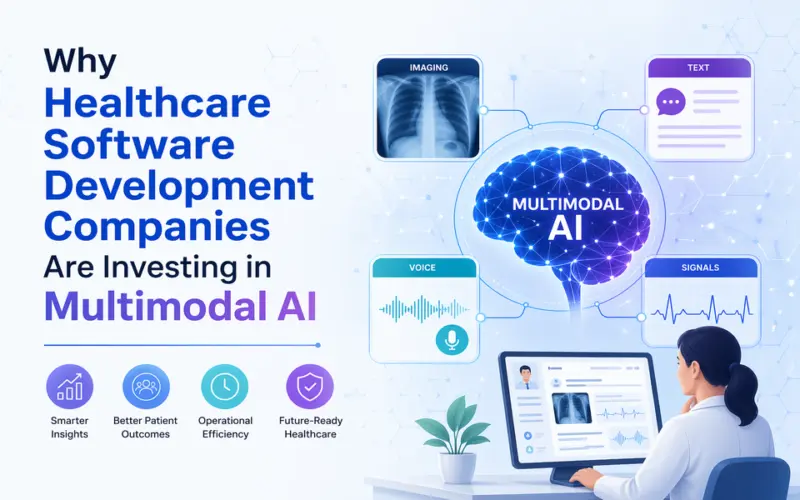

The healthcare industry is entering a new phase of digital transformation where data is no longer limited to structured Electronic Health Records (EHRs).
Today, clinical decision-making depends on diverse data sources-medical imaging, physician notes, wearable device data, genomics, and even voice inputs. This is where Multimodal AI in Healthcare is becoming a strategic priority.
Healthcare software development companies are rapidly investing in multimodal AI capabilities to help providers unlock deeper insights, improve patient outcomes, and gain a competitive edge. Unlike traditional AI systems that rely on a single data source, multimodal AI integrates multiple data streams, offering a more holistic and accurate view of patient health.
Let's explore why this shift is happening and how healthcare organizations can leverage it effectively.
Market Trends Driving Adoption
Rising Demand for Precision Medicine
Precision medicine is reshaping how healthcare is delivered. Instead of a one-size-fits-all approach, providers now aim to deliver personalized treatments based on a patient's genetic profile, lifestyle, and clinical history.
Multimodal AI in Healthcare plays a critical role here by combining genomic data with clinical records, imaging, and real-time patient data. This allows healthcare providers to:
Identify disease risks earlier
Customize treatment plans
Improve therapeutic outcomes
For healthcare software companies, this trend represents a major opportunity to build advanced platforms that support personalized care at scale.
Growth of AI in Healthcare Market
The global AI in healthcare market is expanding rapidly, driven by increasing data volumes and the need for automation. Hospitals and clinics are no longer experimenting with AI-they are actively investing in production-grade solutions.
Multimodal AI is at the center of this growth because it:
Enhances diagnostic accuracy by correlating multiple data inputs
Reduces manual workload for clinicians
Supports predictive analytics for better decision-making
Healthcare software development firms are aligning their offerings with this demand, building AI-powered solutions that go beyond basic automation to deliver measurable clinical and financial outcomes.
Need for Real-Time Clinical Insights
Modern healthcare environments require real-time decision-making, especially in critical care settings. Delays in diagnosis or treatment can significantly impact patient outcomes.
By leveraging Multimodal AI in Healthcare, providers can:
Monitor patients continuously using wearable and IoT devices
Analyze imaging and clinical data simultaneously
Generate real-time alerts for critical conditions
This capability is particularly valuable in emergency care, ICU monitoring, and chronic disease management. As a result, software development companies are focusing on building systems that can process and analyze multimodal data in real time.
How Development Companies Deliver Multimodal AI Solutions
End-to-End AI Product Engineering
Healthcare software development companies are not just building isolated AI models-they are delivering complete, end-to-end solutions.
This includes:
Data collection and preprocessing from multiple sources
Model development using advanced machine learning techniques
Deployment of AI models into clinical workflows
Continuous monitoring and optimization
In the context of Multimodal AI in Healthcare, this approach ensures that different data types-structured and unstructured-are seamlessly integrated and utilized effectively.
End-to-end engineering also helps healthcare organizations reduce time-to-market and achieve faster ROI on their AI investments.
Integration with EHR and IoT Devices
One of the biggest challenges in healthcare is data fragmentation. Patient information is often scattered across multiple systems, making it difficult to derive meaningful insights.
Healthcare software companies address this by integrating multimodal AI solutions with:
EHR systems for clinical data
IoT devices and wearables for real-time monitoring
Imaging systems for radiology and diagnostics
This integration enables a unified data ecosystem where Multimodal AI in Healthcare can function effectively. It allows clinicians to access a comprehensive patient profile, improving both diagnosis and treatment planning.
Cloud-Based AI Platforms
Scalability and performance are critical for handling large volumes of healthcare data. This is why many development companies are leveraging cloud-based platforms to deploy multimodal AI solutions.
Cloud infrastructure enables:
High-performance computing for AI model training
Secure data storage and management
Seamless integration across healthcare systems
Real-time data processing at scale
By using cloud-based architectures, healthcare organizations can implement Multimodal AI in Healthcare without heavy upfront infrastructure investments. It also ensures flexibility and scalability as data volumes grow.
Choosing the Right Development Partner
Domain Expertise in Healthcare
Not all AI solutions are suitable for healthcare. The industry has unique challenges, including complex workflows, regulatory requirements, and the need for high accuracy.
A reliable development partner must have:
Deep understanding of clinical workflows
Experience with healthcare data standards
Knowledge of interoperability requirements
Domain expertise ensures that Multimodal AI in Healthcare solutions are not only technically sound but also clinically relevant.
Compliance and Security Capabilities
Healthcare data is highly sensitive, and any AI solution must comply with strict regulations such as HIPAA and GDPR.
When selecting a development partner, organizations should evaluate:
Data encryption and security protocols
Compliance with healthcare regulations
Ability to implement privacy-preserving AI models
Multimodal AI systems deal with diverse data types, increasing the complexity of compliance. A strong focus on security is essential to protect patient data and maintain trust.
Proven AI Implementation Experience
Experience matters when it comes to deploying AI in real-world healthcare settings. A capable development partner should have:
A portfolio of successful AI projects
Expertise in handling multimodal data
Ability to scale solutions across organizations
Proven experience reduces implementation risks and ensures that the Multimodal AI in Healthcare solution delivers tangible results.
Conclusion
The shift toward Multimodal AI in Healthcare is not just a technological trend-it is a strategic necessity. As healthcare becomes more data-driven, the ability to integrate and analyze multiple data sources will define the success of digital health initiatives.
Healthcare software development companies are investing heavily in multimodal AI to help providers:
Deliver personalized care
Improve diagnostic accuracy
Enable real-time decision-making
Optimize operational efficiency
Organizations that adopt this approach early will be better positioned to lead in an increasingly competitive healthcare landscape.
AI in Healthcare multimodal AI in Healthcare
Disclaimer
This content is a community contribution. The views and data expressed are solely those of the author and do not reflect the official position or endorsement of nasscom.
That the contents of third-party articles/blogs published here on the website, and the interpretation of all information in the article/blogs such as data, maps, numbers, opinions etc. displayed in the article/blogs and views or the opinions expressed within the content are solely of the author's; and do not reflect the opinions and beliefs of NASSCOM or its affiliates in any manner. NASSCOM does not take any liability w.r.t. content in any manner and will not be liable in any manner whatsoever for any kind of liability arising out of any act, error or omission. The contents of third-party article/blogs published, are provided solely as convenience; and the presence of these articles/blogs should not, under any circumstances, be considered as an endorsement of the contents by NASSCOM in any manner; and if you chose to access these articles/blogs , you do so at your own risk.