

Automation platforms have become central to modern digital operations, especially with the integration of AI-driven workflows, API orchestration, and real-time data pipelines.
However, as automation scales, organizations increasingly face reliability, performance, and security challenges that are not visible during initial deployment.
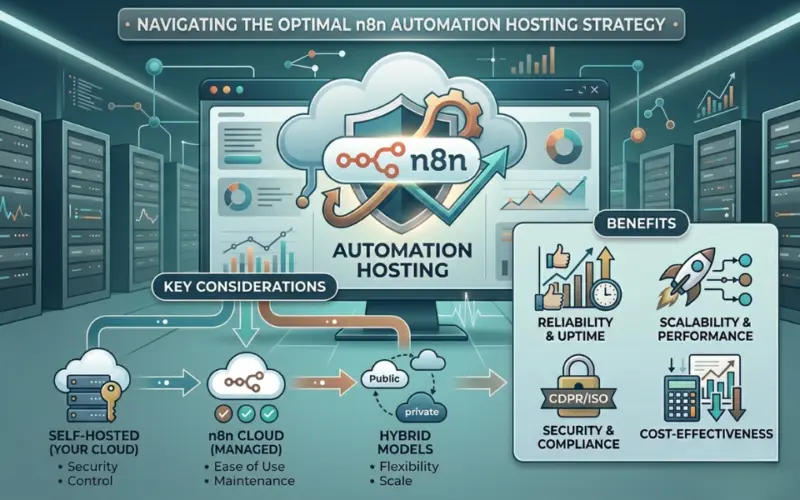
This is why businesses are actively searching for n8n automation hosting solutions that go beyond basic deployment and address production-level challenges. A structured overview of infrastructure considerations and deployment models can be explored through this reference on n8n automation hosting.
In 2026, the conversation has shifted from "how to run workflows" to "how to run them reliably at scale."
What 2026 Search Behavior Reveals About Automation Challenges
Modern queries are no longer beginner-focused. Instead, they reflect operational pain points:
- "Why do n8n workflows fail after deployment?"
- "How to scale automation to millions of executions?"
- "How to secure automation workflows handling API keys?"
- "Why is my automation slow with large datasets?"
These questions highlight a clear shift toward performance engineering, security, and scalability.
The Hidden Bottlenecks in n8n Automation Systems
1. Performance Degradation at Scale
One of the most common issues is performance drop as workflows grow.
- n8n processes items sequentially by default, leading to slow execution for large datasets
- large data payloads increase memory and CPU usage
- looping workflows create execution delays
A workflow that performs well with small data volumes can become inefficient when scaled to thousands of executions.
2. Architectural Limitations in Default Setups
Basic deployments are not designed for production environments.
- default setups struggle with high execution volumes
- lack of distributed processing creates bottlenecks
- scaling requires architectural changes, not just hardware upgrades
Modern n8n automation hosting environments must move toward distributed systems with queue-based execution.
3. Security Risks in Automation Infrastructure
Security has become one of the biggest concerns in 2026.
- critical vulnerabilities allow remote code execution in poorly secured instances
- exposed credentials can grant access to connected services (APIs, databases, cloud platforms)
- automation platforms act as centralized integration hubs, increasing risk exposure
This makes secure hosting and proper isolation essential.
4. Workflow Fragility in Real-World Environments
Automation often breaks when exposed to real-world conditions.
Common causes include:
- API response changes
- expired credentials
- inconsistent data formats
- lack of retry and error handling
These issues highlight the need for resilient system design rather than simple automation logic.
Comparative Analysis of Hosting Architectures
1. Single Instance Deployment
Characteristics
- all components on one server
- minimal setup complexity
Limitations
- poor scalability
- single point of failure
- limited fault tolerance
Suitable only for testing or low-scale workflows.
2. Containerized and Modular Deployment
Characteristics
- Docker-based isolation
- easier deployment and updates
Advantages
- improved resource utilization
- better portability
Limitations
- requires orchestration knowledge
- still limited for high-scale systems
This model is commonly used as a starting point for scalable n8n automation hosting setups.
3. Distributed Queue-Based Architecture (Recommended)
This is the most advanced model used in production systems.
Core Components
- main instance (UI + webhook handling)
- Redis queue for task distribution
- worker nodes for execution
- PostgreSQL database
Advantages
- horizontal scalability
- improved performance
- fault isolation
This architecture enables systems to handle hundreds of thousands to millions of executions per month.
Observability and Monitoring: The Missing Layer
A major reason automation fails is lack of visibility.
Modern systems require:
- real-time logging
- workflow execution tracking
- alert-based monitoring
Without observability, failures remain undetected until they impact business operations.
Cost vs Reliability Trade-Off
Search intent: "Is managed automation hosting worth it?"
- low-cost setups → higher failure risk
- optimized infrastructure → higher reliability
- distributed systems → better long-term ROI
Organizations often underestimate the cost of downtime compared to infrastructure investment.
Practical Implementation Strategy
To build a production-ready system:
- migrate from SQLite to PostgreSQL
- implement queue-based execution using Redis
- deploy multiple worker nodes
- integrate monitoring and alerting systems
- secure endpoints and credentials
At this stage, many teams adopt structured environments like those provided by cloudminister, where infrastructure and automation are aligned for performance and reliability.
Future Trends in Automation Hosting (2026 and Beyond)
- AI-assisted workflow optimization
- self-healing automation systems
- serverless execution models
- deeper integration with LLM-based workflows
Notably, a significant percentage of modern workflows now include AI components, increasing both complexity and infrastructure requirements .
Final Thoughts
Automation is no longer just about connecting APIs-it is about building resilient, scalable systems that can operate under real-world conditions. As workflows become more complex and business-critical, hosting decisions play a defining role in performance and reliability.
By addressing challenges such as scalability, security, and observability, organizations can design n8n automation hosting environments that are robust, efficient, and future-ready
Automation n8n Workflow Automation Cloud Infrastructure
Disclaimer
This content is a community contribution. The views and data expressed are solely those of the author and do not reflect the official position or endorsement of nasscom.
That the contents of third-party articles/blogs published here on the website, and the interpretation of all information in the article/blogs such as data, maps, numbers, opinions etc. displayed in the article/blogs and views or the opinions expressed within the content are solely of the author's; and do not reflect the opinions and beliefs of NASSCOM or its affiliates in any manner. NASSCOM does not take any liability w.r.t. content in any manner and will not be liable in any manner whatsoever for any kind of liability arising out of any act, error or omission. The contents of third-party article/blogs published, are provided solely as convenience; and the presence of these articles/blogs should not, under any circumstances, be considered as an endorsement of the contents by NASSCOM in any manner; and if you chose to access these articles/blogs , you do so at your own risk.
Jaipur, Rajasthan, India
I'm Devansh Mankani, an SEO Executive at CloudMinister, an IT-based company providing reliable cloud and hosting solutions. I specialize in improving organic visibility, keyword rankings, and traffic through data-driven SEO strategies. CloudMinister offers services like cloud hosting, VPS, dedicated servers, managed hosting, and advanced infrastructure solutions. I work on promoting innovative services such as N8N Hosting for workflow automation and GPU server for AI workloads. My role focuses on aligning technical SEO with business goals to drive growth. I'm passionate about making complex IT services easily discoverable online. I continuously optimize content and performance to strengthen CloudMinister's digital presence.