




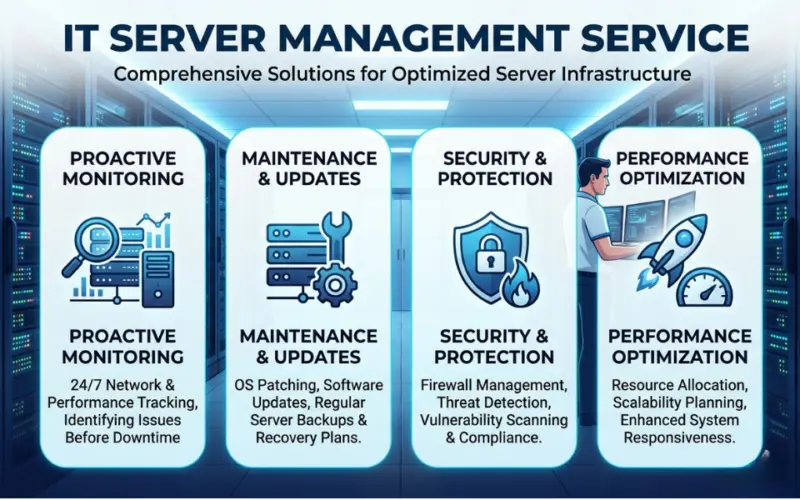

The modern digital economy depends heavily on uninterrupted infrastructure performance. Businesses today operate applications that must remain available around the clock while handling increasing traffic, cybersecurity risks, AI-driven workloads, and real-time customer expectations.
As operational complexity continues growing, organizations are investing more aggressively in IT Server Management Service solutions to maintain infrastructure reliability and long-term scalability.
In 2026, server infrastructure is no longer viewed as a backend operational requirement. It has become a core business asset directly connected to customer experience, operational continuity, digital visibility, and revenue performance.
Organizations that fail to modernize infrastructure operations often struggle with downtime, performance instability, security vulnerabilities, and rising operational costs.
The Growing Complexity of Infrastructure Environments
Modern applications are significantly more demanding than traditional software environments.
Businesses now operate:
- cloud-native applications,
- distributed databases,
- containerized systems,
- AI-driven platforms,
- hybrid cloud architectures,
- and API-intensive environments.
These systems generate continuous operational demands involving:
- scalability,
- performance optimization,
- security management,
- resource allocation,
- and workload balancing.
Traditional infrastructure management approaches are no longer sufficient for handling this level of complexity efficiently.
As businesses continue expanding digitally, infrastructure operations require more proactive and automated management strategies capable of supporting continuous scalability without compromising reliability.
This is one of the major reasons organizations are increasingly investing in IT Server Management Service solutions to improve operational stability across modern infrastructure ecosystems.
Downtime Is Now a Major Business Risk
Customer expectations have evolved rapidly over the last few years.
Modern users expect:
- uninterrupted platform access,
- fast-loading applications,
- real-time responsiveness,
- and consistent digital experiences.
Even short downtime periods can negatively impact:
- customer trust,
- transaction completion,
- application engagement,
- operational productivity,
- and search visibility.
For businesses operating:
- SaaS platforms,
- eCommerce systems,
- financial applications,
- healthcare environments,
- and AI-powered services,
infrastructure failures can create immediate operational and financial consequences.
Modern server management strategies now focus heavily on:
- predictive monitoring,
- proactive maintenance,
- infrastructure redundancy,
- automated issue detection,
- and rapid incident response.
Organizations are moving away from reactive infrastructure management toward continuous operational reliability models.
AI Workloads Are Increasing Infrastructure Demands
Artificial intelligence is embedded in the business operations today.
Organizations are deploying:
- AI automation systems,
- machine learning environments,
- predictive analytics platforms,
- intelligent monitoring systems,
- and large-scale data processing applications.
These workloads require infrastructure capable of supporting:
- high-performance computing,
- low-latency operations,
- scalable resource allocation,
- continuous uptime,
- and dynamic workload balancing.
Traditional infrastructure environments often struggle to support these operational demands efficiently.
As AI adoption accelerates across industries, businesses are increasingly relying on IT Server Management Service strategies to maintain infrastructure performance under growing computational pressure.
Infrastructure optimization is becoming especially important for organizations managing AI-driven environments where resource inefficiencies can significantly increase operational costs.
Cybersecurity Is Becoming an Infrastructure Priority
Cyber security threats are rapidly evolving across digital ecosystems.
Businesses today face increasing risks involving:
- ransomware attacks,
- unauthorized access attempts,
- infrastructure exploitation,
- malware infections,
- and API vulnerabilities.
Poorly maintained infrastructure environments create significant security exposure that can directly affect operations and customer trust.
Modern infrastructure strategies now integrate:
- security patch management,
- firewall optimization,
- access control systems,
- intrusion monitoring,
- backup automation,
- and continuous threat detection
into daily operational workflows.
Organizations can no longer afford siloed security approaches where infrastructure and cybersecurity are separate.
Security is an ongoing operational requirement for modern infrastructure environments.
Why Observability Is Becoming Essential
Modern digital systems generate enormous amounts of operational data.
Without proper infrastructure visibility, businesses struggle to:
- identify performance bottlenecks,
- monitor workload behavior,
- detect failures early,
- and optimize operational efficiency.
Traditional monitoring tools are often insufficient because they react only after incidents occur.
Modern operational environments now prioritize:
- real-time observability,
- centralized logging,
- predictive monitoring,
- intelligent alerting,
- and automated incident response.
These capabilities help organizations reduce downtime while improving infrastructure reliability and operational consistency.
Companies working with providers like cloudminister are increasingly focusing on proactive observability strategies to improve long-term infrastructure stability.
Cloud Optimization Is Becoming More Important Than Expansion
Many businesses initially adopted cloud infrastructure rapidly without fully optimizing operational efficiency.
As infrastructure environments expanded, organizations began facing:
- excessive cloud costs,
- inefficient resource utilization,
- underutilized workloads,
- and rising operational overhead.
Modern infrastructure strategies now focus heavily on optimization and performance efficiency.
This includes:
- workload balancing,
- automated scaling,
- server right-sizing,
- storage optimization,
- and performance tuning.
Organizations that optimize infrastructure effectively can significantly improve operational stability while reducing long-term infrastructure expenses.
Cloud efficiency is becoming a major competitive advantage for businesses operating at scale.
Scalability Requires Continuous Infrastructure Evolution
Digital growth places increasing pressure on infrastructure environments.
Businesses experiencing rapid expansion often struggle with:
- traffic spikes,
- unstable workloads,
- slow response times,
- and infrastructure limitations.
Without scalable operational frameworks, infrastructure environments can become unreliable under growing demand.
Modern infrastructure management strategies now focus on building environments capable of:
- supporting dynamic scalability,
- maintaining high availability,
- handling AI-driven workloads,
- and adapting continuously to changing operational requirements.
This shift is transforming infrastructure management from a technical support activity into a long-term business growth strategy.
Conclusion
Infrastructure reliability has become one of the most important foundations of digital business success in 2026.
Today's organizations require operational environments that can support:
- continuous uptime,
- cloud scalability,
- cybersecurity resilience,
- AI integration,
- performance optimization,
- and long-term operational stability.
Businesses that continue relying on outdated infrastructure management models may struggle with downtime, security vulnerabilities, operational inefficiencies, and scalability limitations.
As digital ecosystems continue evolving rapidly, IT Server Management Service strategies are becoming essential for organizations seeking sustainable growth, infrastructure resilience, and long-term operational reliability
Server Management server management
Disclaimer
This content is a community contribution. The views and data expressed are solely those of the author and do not reflect the official position or endorsement of nasscom.
That the contents of third-party articles/blogs published here on the website, and the interpretation of all information in the article/blogs such as data, maps, numbers, opinions etc. displayed in the article/blogs and views or the opinions expressed within the content are solely of the author's; and do not reflect the opinions and beliefs of NASSCOM or its affiliates in any manner. NASSCOM does not take any liability w.r.t. content in any manner and will not be liable in any manner whatsoever for any kind of liability arising out of any act, error or omission. The contents of third-party article/blogs published, are provided solely as convenience; and the presence of these articles/blogs should not, under any circumstances, be considered as an endorsement of the contents by NASSCOM in any manner; and if you chose to access these articles/blogs , you do so at your own risk.
Jaipur, Rajasthan, India
I'm Devansh Mankani, an SEO Executive at CloudMinister, an IT-based company providing reliable cloud and hosting solutions. I specialize in improving organic visibility, keyword rankings, and traffic through data-driven SEO strategies. CloudMinister offers services like cloud hosting, VPS, dedicated servers, managed hosting, and advanced infrastructure solutions. I work on promoting innovative services such as N8N Hosting for workflow automation and GPU server for AI workloads. My role focuses on aligning technical SEO with business goals to drive growth. I'm passionate about making complex IT services easily discoverable online. I continuously optimize content and performance to strengthen CloudMinister's digital presence.