
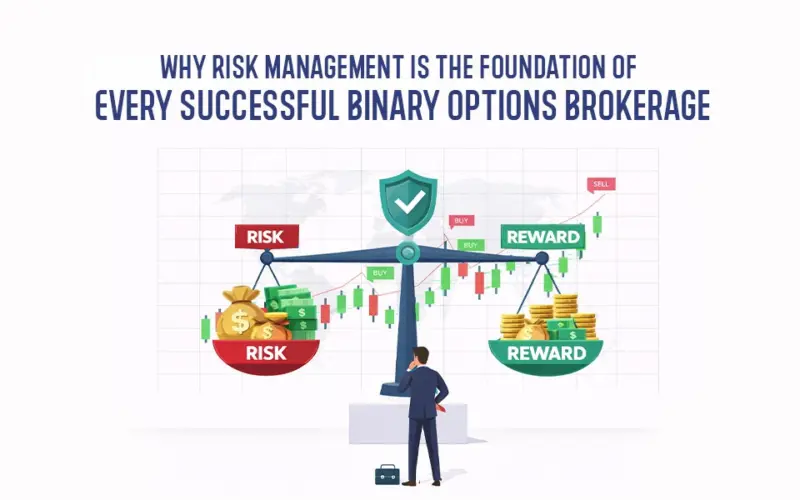

What happens when too many traders win at the same time on a binary options platform?
Every trade has real money involved, and the platform usually pays out when traders win.
If several traders win at once, the platform can face serious financial pressure, and payouts can grow faster than expected.
That is why risk management is so important.
It keeps the platform in control, protects funds, and ensures users can trust it.
In this blog, we will explain what risk really means in binary options, the problems that occur when risk is ignored, and the strategies platforms use to stay safe, stable, and profitable.
What Is Risk in Binary Options Trading Platforms?
Risk on a binary options platform is basically the chance the platform could lose money when traders win their bets.
For example, imagine 10 people all bet $10 that the price of gold will go up. If they all win at the same time, the platform has to pay them back around $18 each. That's $180 all at once. If the platform is not ready, this can create real financial stress.
It's not just money that matters. Problems can also come from technical issues, like mistakes in recording trades or delays in payouts.
Managing risk helps the platform stay safe, keep its money secure, and make sure traders trust it, even when many people win at once.
So there are more problems in running the platform if proper systems are not in place.
Common Problems Without Risk Management
When too many traders win at once, the platform can face big payouts it is not ready for. This can put a lot of pressure on the platform.
There are some common problems that come up, like financial stress, mistakes in trades, and users losing trust in the platform. Let's see in detail.
1. Big Payouts Can Put the Platform Under Pressure
When too many traders win at the same time, the platform has to pay them all. For example, if 50 people bet 10 dollars on a currency going up and they all win, the platform could owe 100 of dollars at once. If the platform is not ready, this can create serious financial stress. Large payouts like this are one of the biggest risks for any binary options platform.
2. System and Technical Issues
Trading platforms handle thousands of trades every day. Technical problems can cause delays in payouts or mistakes in recording trades. Even small errors can frustrate users and make them lose trust in the platform.
3. Losing User Trust
Traders notice mistakes, delayed payouts, or account issues. When this happens, they may stop using the platform. Trust is hard to earn and easy to lose. Platforms that do not manage risk properly can quickly develop a bad reputation.
4. Financial Pressure and Stress
Ignoring risk also creates ongoing stress for the team running the platform. Constantly worrying about unexpected losses, fixing errors, and handling complaints can drain resources and affect how the platform works.
Risk management is not just about avoiding money loss. It helps keep the platform steady, protects users, and makes traders feel confident about using it. Platforms that ignore risk face bigger problems than just money. They struggle with credibility and overall performance.
The Role of Risk Management in Building a Profitable Binary Options Platform
Managing a binary options platform can be challenging because big wins happen all at once. That's why risk management in binary options trading plays an important role. It keeps trades under control and helps traders feel their money is safe.
1. Exposure Limits and Real-Time Tracking
Exposure limits are like safety rules for the platform. They define how much money can be at risk from a single trade or a group of trades. For example, the platform might limit how much money it risks on each trade. This way, even if many traders win at the same time, it will not run out of funds.
Real-time tracking monitors all trades as they happen. When multiple traders win at the same time, the system alerts the team immediately. This allows them to take quick actions such as adjusting trade limits or preparing funds for payouts. By doing this, the platform avoids sudden losses and keeps operations steady, even during periods with high trading activity.
2. Accurate Trade Records
Every trade must be recorded correctly. Mistakes in logging trades can lead to incorrect payouts or disputes. Accurate trade systems track every transaction and provide a clear view of where money is at risk.
Precise records also make it easier to spot patterns in trading activity. This helps the team identify potential risks early and take action before problems grow. Traders notice when trades are handled properly, which builds trust and reduces errors.
3. Understanding Risk Models A Book, B Book, and Hybrid
Platforms use different models to balance risk and profits:
- A Book: Trades are sent directly to the real market. The platform earns a small fee and does not take extra risk.
- B Book: Trades are handled internally. The platform takes the opposite side of the trader's bet. If traders lose, the platform earns, and if traders win, it pays out.
- Hybrid: A combination of both. Some trades go to the market, while others stay internal. This provides flexibility depending on trading conditions.
These models help the platform manage financial exposure while still offering opportunities that attract traders. They also allow the team to plan for large payouts in advance.
4. Benefits of Risk Management
- Reduces Large Losses: Limits and models prevent payouts the platform cannot cover.
- Keeps Operations Stable: Accurate trade records and monitoring reduce mistakes and delays.
- Builds Trader Trust: Traders are more likely to continue using the platform when trades and payouts are handled correctly.
- Supports Compliance: Proper systems help the platform meet legal and regulatory rules.
Risk management allows the platform to handle changes in trading activity, protect funds, and keep operations steady. It is not just about avoiding losses but about making the platform profitable and maintaining trader trust over time.
Final Words
Risk management is the backbone of any successful binary options business. It helps control the money at risk, track trades accurately, and prevent unexpected losses that could affect both the company and its users.
By setting limits, monitoring trades in real time, and using different risk models, the team can balance profits and potential losses. This keeps funds safe and ensures traders feel their money is handled properly while using the service.
In the end, focusing on risk management builds trust, keeps operations steady, and helps the business stay profitable over time. Smart strategies are what separate successful services from those that struggle.
tr
Disclaimer
This content is a community contribution. The views and data expressed are solely those of the author and do not reflect the official position or endorsement of nasscom.
That the contents of third-party articles/blogs published here on the website, and the interpretation of all information in the article/blogs such as data, maps, numbers, opinions etc. displayed in the article/blogs and views or the opinions expressed within the content are solely of the author's; and do not reflect the opinions and beliefs of NASSCOM or its affiliates in any manner. NASSCOM does not take any liability w.r.t. content in any manner and will not be liable in any manner whatsoever for any kind of liability arising out of any act, error or omission. The contents of third-party article/blogs published, are provided solely as convenience; and the presence of these articles/blogs should not, under any circumstances, be considered as an endorsement of the contents by NASSCOM in any manner; and if you chose to access these articles/blogs , you do so at your own risk.