




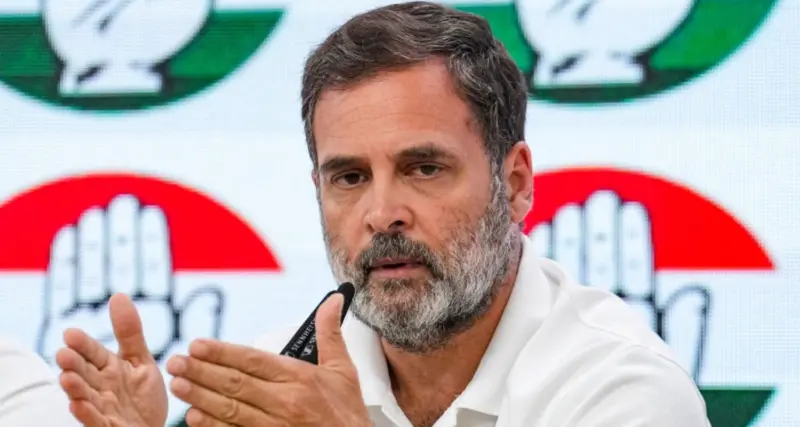

Congress leader Rahul Gandhi, as also other party leaders, have often been accusing the ruling Bharatiya Janata Party and the Rashtriya Swayamsevak Sangh (RSS) of practicing "communal politics" and trying to divide the country along communal lines.
Rahul often asserts that while the BJP, RSS divide, the Congress unites. However, his punching argument will for sure leave all the weight after the Congress formed the government in Keralam in alliance with the Indian Union Muslim League (IUML). The IUML is the reincarnation of the All India Muslim League, which propagated the idea of Pakistan and eventually got it.
The IUML originally started as Kerala Muslim Majlis in 1931. It later joined the All India Muslim League led by Mohammad Ali Jinnah. After partition, the Indian segment of the Muslim League was renamed as the Indian Union Muslim League. It remained the same in name and character, with little bit of rephrasing of the name from All India Muslim League to Indian Union Muslim League.
The Congress has adopted an aggressive posture against the BJP on the issue of secularism and has even been accusing it of undermining the Constitution. The BJP in return has been accusing the Congress of encouraging and practicing minority communalism. The alliance with the IUML will now provide additional ammunition to the BJP to target the Congress on the issue of allowing and encouraging minority communalism as part of its larger policy of "minority appeasement".
While the Congress has always targeted "majority communalism" it accuses the BJP of practicing and propagating, it has always maintained a silence on minority communalism. Keralam is the hotbed of minority communalism as much as it is that of majority communalism. Selective targeting of majority communalism has obviously helped the Congress to form the government in alliance with the IUML, at the national level, the party will find it difficult to explain the alliance.
It is not first time the Congress has aligned with the IUML. Both the Congress and the IUML have been part of the United Democratic Front (UDF) for a long time. The two parties have shared power in the past also before 2016, when the Left Democratic Front defeated the UDF. However, that time the polity was not polarised as much as it is today. Besides, there was not much political awareness among the people.
The BJP has a strong and powerful war machine that will for sure use the Congress-IUML alliance at the national level to its own advantage. Before the partition, Shyama Prasad Mukherjee-led Hindu Maha Sabha had once aligned with the All India Muslim League to form the provincial government in Bengal. The Congress has frequently been referring to this alliance to target the BJP, as Mukherjee was the founder of the Bharatiya Jana Sangh, the earlier avatar of the BJP.
The Congress may no longer retain that "secular" punch, as it will need to answer how can it align with an exclusive Muslim political party and that too the one with its roots in the All India Muslim League that divided the country.
It is also a fact that the Congress could never have formed the government in Keralam on its own. It was a formidable combination of the Congress and IUML, besides a few other local political parties, which led to the consolidation of the anti-Left vote in favour of the UDF. In the recent 2026 assembly elections, while the Congress secured about 28 per cent of the popular vote, the IUML got 11 per cent. The Congress won 63 seats and the IUML won 22.
Interestingly, the BJP, which also got 11 per cent vote share, could only translate into two assembly seats unlike the IUML, which secured 22 assembly segments with the same percentage of vote share. That was possible only because the IUML had an alliance with the Congress. The Congress in turn did benefit from the alliance, winning 63 seats.
While there can be no comparison between the BJP and IUML, for the sake of argument, in view of Rahul's accusations against the party (the BJP) that it is communal and divisive, let us put things in right and proper perspective.
The BJP may be largely supported by the Hindu community, with far less votes from the minority communities, particularly the Muslims, the party has never openly pursued any communal or sectarian agenda. It has been projecting and propagating the nationalist agenda, more along the lines that the Indian National Congress preached and pursued before the partition.
In stark contrast, the Indian Union Muslim League, the Congress is allied with, only pursues Muslim interests. It may have parted ways with the All India Muslim League for circumstantial reasons and situation, it never abandoned the core ideas of the League, of exclusively working for the welfare of the Muslims.
Here lies the problem with the Congress. It has not been able to give a convincing explanation as despite claiming itself to be a "secular party", how can it align with an exclusively religious party and that too the IUML that has its roots in the All India Muslim League of Jinnah.
The Congress will have to do a lot of explaining in the rest of the country on the matter in the coming days.