




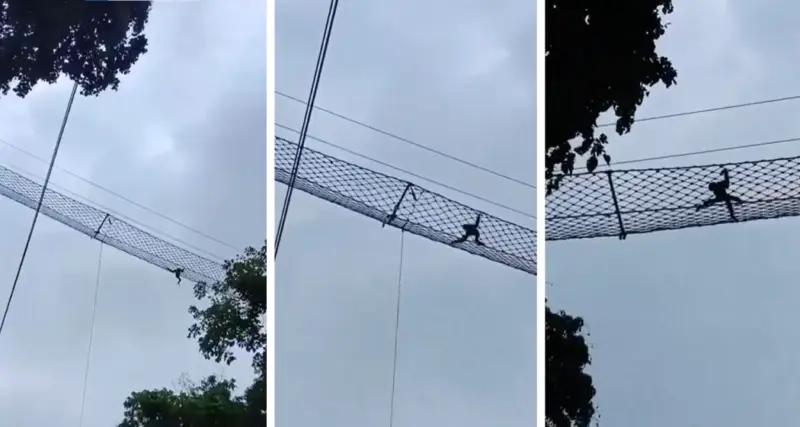

In a first-of-its-kind conservation success, a male Western Hoolock Gibbon crossed a canopy bridge installed over a railway line passing through Assam's Hollongapar Gibbon Sanctuary on Friday, marking the first documented instance of a primate using such a structure above a railway track anywhere in the world.
According to the Wildlife Institute of India (WII), this was also the first confirmed use of the canopy bridge by a gibbon inside the sanctuary.
Canopy bridges are specially designed overhead structures that connect tree canopies, enabling arboreal animals to safely cross roads, highways or railway tracks without descending to the ground. Such measures are increasingly being adopted in wildlife-sensitive areas to reduce habitat fragmentation caused by infrastructure projects.
The bridge in Hollongapar sanctuary was installed during February-March 2025 as part of mitigation measures linked to the electrification of the single-track Lumding-Dibrugarh railway line that cuts through the protected forest.
Union Environment Minister Bhupendra Yadav hailed the development as a "tech-led conservation" success.
"Good to see that mitigation measures such as this canopy bridge made over a railway passing through Assam has started being used by Hoolock Gibbon. This shows science-led small-scale efforts can also be of great help in biodiversity conservation," Yadav posted on X.
The Western Hoolock Gibbon, India's only ape species, is listed as endangered on the International Union for Conservation of Nature (IUCN) Red List. In India, the species is found across the northeastern states, mainly south of the Brahmaputra and east of the Dibang river.
Experts say the species faces serious threats from habitat fragmentation, deforestation, railway and highway expansion, tea plantation encroachment and illegal wildlife trade.
The Hollongapar Gibbon Sanctuary, a key refuge for the species, has long been affected by habitat division caused by railway tracks and roads. Conservationists believe the successful use of the canopy bridge could pave the way for similar interventions in other wildlife corridors across India.
The WII stressed that while such mitigation measures are effective, long-term conservation would require careful infrastructure planning and restoration of forest corridors to reconnect isolated gibbon populations.