




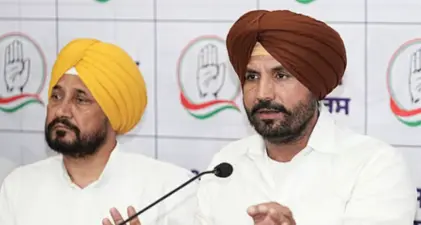

Prolonged uncertainty over settling the leadership issue in Punjab has left the entire rank and file of the Congress demoralised.
Right now, the Congress in Punjab is vertically split and in a state of full-fledged civil war.
There is no clarity as who is in real command and control of the party in the state.
Although the party high command had earlier made it categorically clear that Amarinder Singh Raja Warring will remain the PCC president till the 2027 assembly elections, there is still lack of clarity if he will be allowed to continue or not as the rebels are still holding the fort against him.
If the elections are held on time, the party has less than six months and in case these are advanced as is strongly being assumed, the party does not have any time left for any negotiations. The party must decide at the earliest, whether it has firmly decided not to change the PCC president or if it wants to change him, it must do it at the earliest without any further delay.
Former Chhattisgarh chief minister and AICC general secretary in charge Bhupesh Baghel did try his hand at forging unity and bringing in rapprochement among the two warring factions, but the situation continues to remain the same.
Baghel is seen to be siding with Warring. However, any general secretary in charge will only and always side with the PCC president as long as he enjoys the confidence of the party high command. His siding with Warring should have been a clear signal to the rebels about how the high command feels.
The Congress is losing precious time and possibly important ground as well by not being able to set its house in order. Despite being the principal opposition party and the principal challenger to the ruling AAP, it suffers from bad optics and the perception it has created among the people that the party is a house divided against itself.
The party high command appears to be biding time to wear out the rebels. But that does not seem to be happening. The rebels are holding their own events under the Congress banner, but without the PCC president and the general secretary in charge. This has created a vertical split in the party, which if not bridged at the earliest, can have damaging consequences.
The party must accept two things. First, there is a lot of opposition against the incumbent president. He does have his supporters, but the rebels outnumber him in terms of the support of the leaders. Second, Baghel as the general secretary in charge has not been able to handle the factionalism and instead, has willingly or unwittingly, ended up being seen as supporting Warring. Even if he was in Warring's favour, he should not have been seen doing that. Neutrality is basic approach a general secretary should exhibit.
The only person who can handle and control the situation is Rahul Gandhi himself. If he decides to spend some time personally in Punjab, the entire rank and file will come together. Once Warring emerges as the face of the party, other state leaders will fall in line. Their only problem right now is that Warring should not be projected as leading the campaign as the PCC president.
The PCC president does not play any extra or special role in the elections, unless it is someone like former chief minister Capt Amarinder Singh. The PCC president, however, does have a decisive say in the distribution of tickets. Although the party has a well-organised and foolproof mechanism to shortlist, screen and select the candidates, still the PCC president's role remains crucial. That is the reason most of the leaders are opposing Warring as they do not want him to have any decisive say in ticket distribution.
The party high command, particularly, Rahul Gandhi should be specific and clear that no individual leader will have any exclusive say in ticket distribution. In any case, the Congress is holding multiple surveys via different agencies to shortlist and screen the candidates where individual leaders' preferences and prejudices will not hold much value; yet a categorical assurance from Gandhi can ease the tension.
The most important thing is about the chief ministerial candidate. It will be difficult for the party to suggest and hint at anyone ahead of the elections. Gandhi can make them sit together with an assurance that the chief ministerial position can even be circulated between more than one aspirant like the party did in Karnataka.
The sooner Gandhi takes remedial measures, the better it will be for the Congress in Punjab. And if the Congress does well in Punjab, it can set the tone for other states as well.