
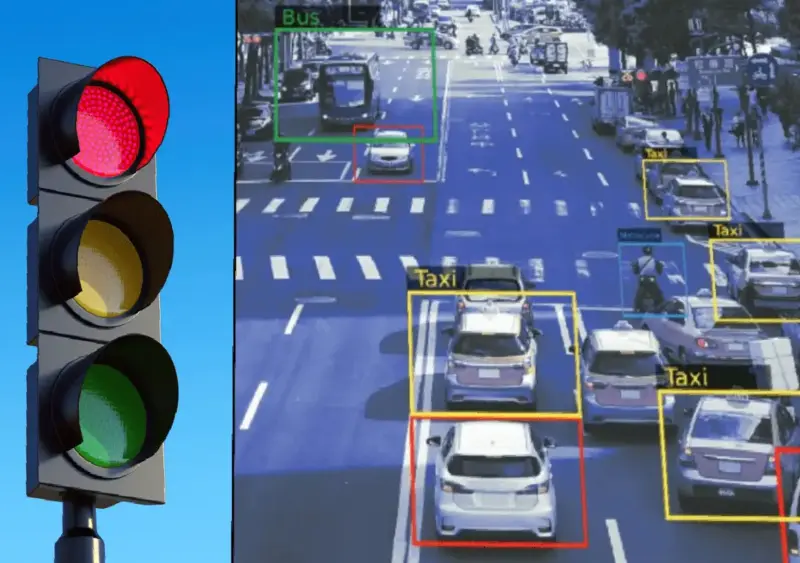

The Bengaluru Traffic Police is leveraging advanced technology to tackle the city's chronic congestion through the Bengaluru Adaptive Traffic Control System (B-ATCS), marking a major shift in urban mobility management.
With over 14 million residents and more than 12 million vehicles, Bengaluru faces severe traffic congestion. Commuters spend an average of 71 minutes daily in traffic, with key stretches like Silk Board to Electronic City often crawling below 10 kmph.
This has significant economic and environmental impact, including reduced productivity, delayed emergency response and rising air pollution levels.
Launched in March 2024, B-ATCS uses artificial intelligence and real-time data analytics to dynamically manage traffic signals. By April 2025, it had been deployed at 169 junctions across the city.
At its core is the CoSiCoSt platform developed by Centre for Development of Advanced Computing, designed specifically for India's complex, non-lane-based traffic conditions.
The system enables adaptive signal control that adjusts timings based on real-time traffic flow. It also introduces corridor synchronisation or 'green waves,' allowing smoother movement across multiple intersections.
A centralised command centre monitors traffic conditions and enables quick responses to incidents. Additionally, an Emergency Vehicle Priority System ensures ambulances and fire services receive signal clearance, reducing response times.
Authorities report up to a 25 per cent reduction in travel time across implemented corridors. The system also reduces fuel consumption, lowers emissions and enhances road safety by minimising signal violations.
For daily commuters, this translates into more predictable and less stressful journeys.
The project is backed by strong collaboration between multiple agencies, including BTP, C-DAC, Arcadis IBI Group and Infra Support Engineering Consultants, along with support from the Karnataka government.
This integrated approach has ensured both technological efficiency and on-ground adaptability.
Designed for expansion, B-ATCS can scale to over 500 intersections and integrate with public transport systems, IoT-based tracking and predictive traffic modelling.
The initiative positions Bengaluru as a leader in smart traffic management, offering a model that other cities can adopt to address growing urban mobility challenges.