




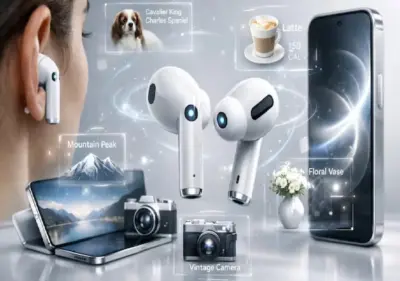

Cupertino:Apple is reportedly developing a new generation of AirPods equipped with built-in cameras, marking a significant step in the company's push towards artificial intelligence-powered wearable technology.
According to reports, the innovative earbuds could debut in late 2027 as part of a broader lineup of next-generation Apple products.
The camera-equipped AirPods are expected to differ substantially from traditional wireless earbuds. Rather than being used for photography or video recording, the cameras are reportedly being designed to help Apple’s AI systems better understand the user’s surroundings and provide more context-aware assistance.
If launched, the product could represent one of Apple’s most ambitious attempts yet to integrate AI directly into everyday wearable devices.
Cameras designed for AI, not photography
Reports indicate that the cameras embedded within the AirPods will not function like conventional smartphone cameras.
Instead, the sensors are expected to gather visual information about the environment and relay contextual data to Apple’s AI systems and voice assistant, Siri.
This would allow the earbuds to understand what a user is looking at and potentially answer questions related to nearby objects, landmarks or surroundings.
The technology is expected to form part of Apple’s broader effort to create more intelligent and personalised user experiences through artificial intelligence.
Industry analysts view the project as a move towards wearable devices that can continuously interact with the real world rather than relying solely on user commands.
Siri could become more context-aware
One of the primary goals of the project is reportedly to enhance Siri’s understanding of real-world environments.
By analysing visual cues captured through the AirPods, Siri may be able to provide more relevant responses and assistance.
For example, users could potentially ask questions about objects in front of them, receive detailed navigation guidance while walking, or obtain reminders linked to specific locations and situations.
The concept builds upon Apple’s existing Visual Intelligence technology, which can analyse images and provide contextual information.
However, the proposed AirPods would take the experience further by enabling real-time environmental awareness without requiring users to manually capture images.
Privacy measures under consideration
Given the privacy concerns associated with wearable cameras, Apple is reportedly exploring safeguards to increase transparency.
Among the measures under consideration is a visible indicator light that would activate whenever visual data is being processed or transmitted.
Privacy has long been a central component of Apple’s product strategy, and experts expect the company to implement strict controls over how visual information is collected, stored and processed.
The challenge for Apple will be balancing advanced AI functionality with user expectations regarding privacy and data protection.
Industry observers note that consumer acceptance of camera-equipped wearables may depend heavily on how effectively these concerns are addressed.
Launch delayed by AI development challenges
Earlier reports suggested that Apple could introduce camera-enabled AirPods as early as 2026.
However, the latest information indicates that the company has encountered challenges in developing the sophisticated AI models required to accurately interpret visual information.
Sources suggest Apple needs additional time to refine its visual intelligence systems and improve object recognition capabilities before bringing the product to market.
As a result, the anticipated launch window has reportedly shifted to late 2027.
The extended timeline also aligns with Apple’s broader strategy of integrating advanced AI features across multiple hardware platforms.
Part of a larger 2027 product lineup
The camera-equipped AirPods are expected to be only one component of Apple’s ambitious 2027 roadmap.
Reports indicate the company is simultaneously developing a second-generation foldable iPhone and a special 20th anniversary iPhone expected to feature a dramatically redesigned display.
The anniversary model is reportedly being designed with a nearly edge-to-edge screen and curved glass extending around the sides of the device.
Together, these products could represent one of Apple’s most significant hardware refresh cycles in recent years.
Industry analysts believe the company is aiming to redefine user interaction across smartphones, wearables and AI-driven devices.
Smart glasses also under development
Apple’s AI ambitions reportedly extend beyond AirPods.
The company is also believed to be working on smart glasses that could reach the market before the camera-equipped earbuds.
If both products are successfully launched, they could form part of an interconnected ecosystem of AI-powered wearable devices.
Experts suggest future Apple wearables may work together to provide continuous environmental awareness, navigation assistance, contextual information and hands-free interactions.
Such a strategy would place Apple in direct competition with other technology firms investing heavily in AI-enhanced wearable computing.
Growing focus on AI wearables
The reported AirPods project highlights a broader industry trend towards integrating artificial intelligence into consumer hardware.
Technology companies worldwide are increasingly exploring ways to make AI more accessible through devices that users wear throughout the day.
Wearables equipped with cameras, sensors and contextual AI capabilities are viewed by many industry leaders as the next major frontier in personal computing.
For Apple, the success of such products could play a crucial role in strengthening its position in the rapidly evolving AI landscape.
Conclusion
While Apple has not officially confirmed the development of camera-equipped AirPods, reports suggest the company is investing heavily in AI-powered wearable technology. If launched in 2027, the innovative earbuds could transform how users interact with Siri and their surroundings, offering a glimpse into Apple’s vision for the future of intelligent personal devices.