
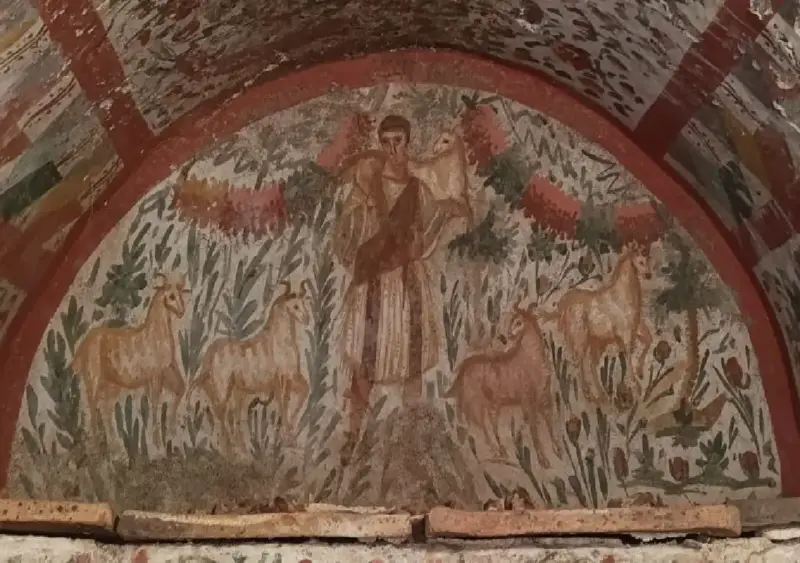

Archaeologists in northwestern Turkey have unearthed a rare and exceptionally well-preserved early Christian fresco depicting Jesus Christ as the 'Good Shepherd', offering valuable insight into the beliefs and artistic expressions of persecuted Christian communities during the Roman era.
The discovery was made in August inside an underground tomb near Iznik, a historic town of immense significance to Christian history.
The tomb was found in Hisardere village, near Iznik in Bursa province, and has been dated to the 3rd century A.D., a period when Christianity was still illegal in the Roman Empire and its followers faced widespread persecution. Experts say the fresco is among the most important early Christian artworks ever discovered in Anatolia.
Iznik, known as Nicaea in antiquity, occupies a central place in Christian history as the site of the First Council of Nicaea in A.D. 325, where the Nicene Creed — still recited by millions of Christians worldwide — was formulated. The region was part of the Roman Empire at the time the tomb was constructed.
The fresco was discovered during an archaeological excavation of a rock-cut tomb, believed to have belonged to a wealthy family. The Associated Press was the first international media organisation granted access to the site, underscoring the global significance of the find.
Lead archaeologist Gulsen Kutbay described the artwork as possibly the 'only example of its kind in Anatolia,' given both its subject and its remarkable state of preservation.
The fresco portrays Jesus as the 'Good Shepherd', a powerful and symbolic image used by early Christians before the cross became the dominant symbol of the faith. In the painting, Jesus appears youthful and clean-shaven, dressed in a Roman toga and carrying a goat across his shoulders.
Researchers say the depiction reflects strong Roman artistic influences, making it one of the rare instances in Anatolia where Jesus is shown with distinctly Roman attributes. This visual language allowed early Christians to express their faith subtly, at a time when overt Christian symbols could invite persecution.
Before the cross was widely adopted, the Good Shepherd motif symbolised protection, salvation, compassion and divine guidance. The image reassured believers of spiritual care and hope for the afterlife.
The walls and ceiling of the tomb are richly decorated with frescoes beyond the image of the Good Shepherd. Bird and plant motifs adorn the surfaces, alongside portraits of noble men and women accompanied by slave attendants. These elements reflect a blend of Roman funerary traditions and emerging Christian beliefs.
Eren Erten Ertem, an archaeologist from the Iznik Museum, said the artwork illustrates 'a transition from late paganism to early Christianity'. According to him, the frescoes depict the deceased being sent off to the afterlife 'in a positive and fitting manner', combining classical imagery with new religious meanings.
The excavation also uncovered the skeletal remains of five individuals. Anthropologist Ruken Zeynep Kose said the remains included two young adults and a six-month-old infant. Due to poor preservation, the ages of two skeletons could not be determined. The presence of an infant further highlights the personal and familial nature of the tomb.
While the Good Shepherd was a central image in early Christianity across the Roman world, very few examples have been found in Anatolia. Archaeologists say the Hisardere fresco stands out not only for its rarity but also for its clarity and condition after nearly 1,800 years.
Scholars note that Anatolia witnessed several pivotal moments in Christian history. St Paul was born in Tarsus, St John spent his final years in Ephesus, and tradition holds that the Virgin Mary may have lived her last days near the same city. The newly discovered fresco adds another layer to the region's deep Christian heritage.
The discovery has gained additional prominence following the recent visit of Pope Leo XIV to Iznik, marking his first overseas trip. The Pope visited the town last month to commemorate the 1,700th anniversary of the Council of Nicaea.
Joined by patriarchs and priests from both Eastern and Western Christian traditions, Pope Leo XIV prayed for unity among Christians worldwide. During the visit, Turkish President Recep Tayyip Erdogan presented the Pope with a tile painting inspired by the newly discovered Good Shepherd fresco.
Archaeologists say the find offers a rare and intimate glimpse into the spiritual lives of early Christians who practised their faith under threat. The fresco not only enriches understanding of early Christian art but also highlights how belief systems evolved within the cultural framework of the Roman world.
As conservation and further study continue, experts believe the Hisardere tomb will become a key reference point for understanding the transition from pagan traditions to early Christianity in Anatolia, reaffirming the region's enduring importance in global religious history.