
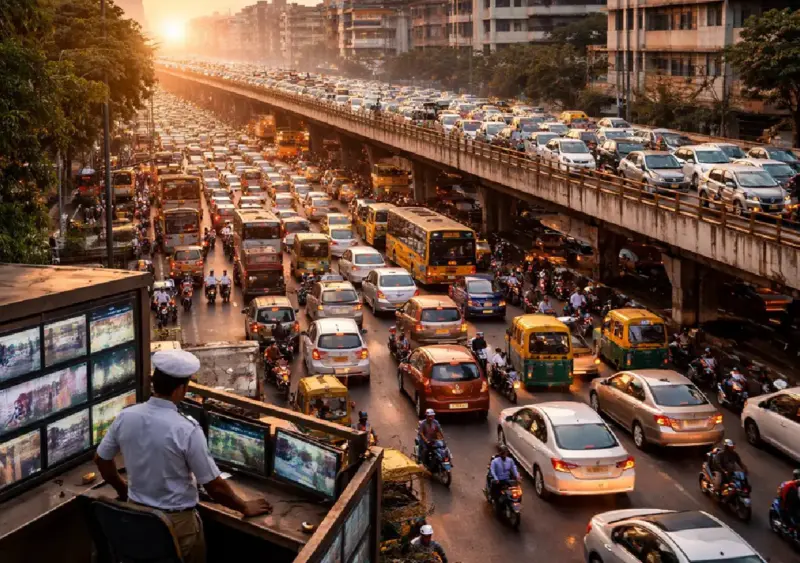

Ask most people in Bengaluru about the city's biggest problem, and many answer instantly — traffic.
Not rent. Not weather. Not rising costs.
Traffic.
Every day, nearly 2,866 new vehicles are added to Bengaluru's roads, according to recent figures. That includes around 1,910 two-wheelers and over 560 cars daily. In the last seven months alone, more than five lakh vehicles reportedly joined the city's roads.
Across Karnataka, about 3.4 crore vehicles are registered, with nearly 1.22 crore based in Bengaluru alone. With incoming vehicles from nearby districts and commercial transport, the number on roads daily rises sharply.
Yet road infrastructure has not expanded at the same pace.
Areas such as Silk Board Junction, Hebbal, Whitefield, Electronic City and Marathahalli have become symbols of everyday gridlock.
A commute that should take 30 minutes often stretches to 90 minutes or more.
For many residents, two to four hours daily are spent inside slow-moving traffic. That means up to 20 hours a week lost to commuting alone.
Experts say the hidden cost includes stress, fatigue, reduced productivity and less family time.
Many suggest using public transport, but commuters say practical issues remain.
Namma Metro is expanding, and BMTC runs a large bus network, but overcrowding, delays and poor last-mile connectivity continue to discourage users.
For many, a two-wheeler remains the fastest realistic option.
Urban planners have long warned that simply building more roads and flyovers offers only temporary relief. New capacity often attracts more vehicles, bringing congestion back quickly.
Experts instead call for better public transport integration, parking reforms, carpool incentives, cycling infrastructure and smarter housing planning.
Bengaluru remains India's innovation capital, but its infrastructure now faces its toughest test.
For residents, traffic is no longer an inconvenience. It has become part of daily life