





Bengaluru: India's most ambitious lunar mission, Chandrayaan-4, has encountered fresh technical and timeline challenges after the Indian Space Research Organisation decided to alter its launch vehicle configuration mid-development.
The mission, targeted for launch in October 2027, aims to achieve a historic first by collecting lunar samples from the Moon's south polar region and returning them safely to Earth—something no country has accomplished so far.
Chandrayaan-4 is significantly more complex than previous Indian lunar missions. It involves landing on the Moon, drilling and collecting up to 3 kg of soil, launching from the lunar surface, docking in orbit and bringing the samples back to Earth.
The mission comprises five modules—Ascender, Descender, Propulsion, Transfer and Re-entry—together weighing approximately 9,200 kg.
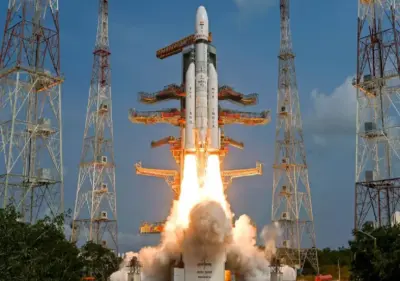
This weight exceeds the capacity of India's current heavy-lift rocket, the LVM3, prompting ISRO to split the mission into two separate launches.
To overcome payload limitations, ISRO plans to launch the modules aboard two separate LVM3 rockets. One will carry the landing modules, while the other will transport the remaining components.
Once in Earth orbit, the two parts will dock and operate as a single spacecraft before heading towards the Moon.
This dual-launch strategy, though innovative, adds layers of complexity, including precise orbital coordination and docking operations.
In a significant development, ISRO has decided to upgrade the rocket by incorporating a semi-cryogenic engine known as SE2000.
Unlike the existing liquid stage that uses hypergolic fuels, the new engine will use kerosene and liquid oxygen, offering higher thrust and better efficiency.
This upgrade is expected to increase payload capacity and provide the additional performance needed for the mission's heavy components.
The decision to modify the rocket configuration has had immediate financial implications. Of the ₹150 crore allocated for Chandrayaan-4 in 2025-26, only ₹34.6 crore had been utilised by January 2026.
A parliamentary standing committee noted that procurement of materials was deferred due to uncertainties around the final launch vehicle configuration.
This slowdown reflects the challenges of integrating a new propulsion system into an already complex mission.
While the semi-cryogenic engine offers long-term advantages, its development timeline raises concerns.
The SE2000 has undergone initial testing, with a full integrated engine test expected by the end of 2026. However, the upgraded version of the LVM3 is not expected to be flight-ready until 2028-29.
This creates a potential mismatch with the mission's target launch date of October 2027.
Experts suggest that unless development timelines are accelerated, the mission may face delays or require further adjustments.
Despite the challenges, Chandrayaan-4 represents a major leap in India's space capabilities. Successfully executing a sample return mission from the Moon's south pole would place India among a select group of spacefaring nations.
The mission also builds on the success of earlier lunar efforts, strengthening India's position in global space exploration.
The decision to switch rocket technology mid-development underscores ISRO's ambition to push technological boundaries, but it also introduces risks related to timelines and execution. As Chandrayaan-4 progresses, its success will depend heavily on the timely readiness of the new engine and launch systems.
Whether the mission meets its 2027 deadline or undergoes rescheduling, it remains a landmark project that could redefine India's role in deep space exploration.