




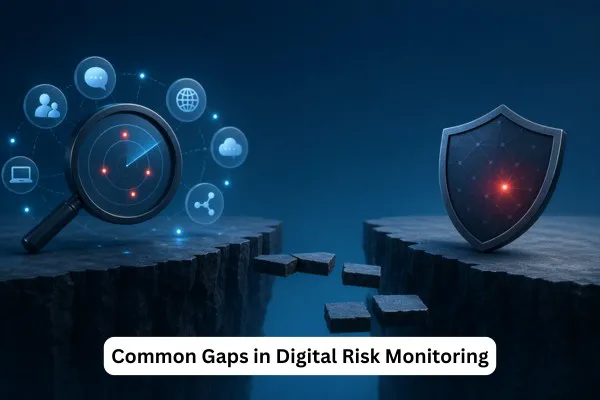

Digital risk monitoring is often described as a continuous activity. In practice, many organisations run something closer to periodic checking stitched together with a few automated alerts.
The difference matters. Modern digital exposure moves quickly. A leaked credential, a misconfigured cloud bucket or a spoofed brand domain can appear and spread long before a quarterly review notices it.
Security teams don't really lack tools. They lack coverage that reflects how digital risk actually forms and evolves outside the organisation's perimeter.
Many monitoring programmes were designed around older threat models. Those models assumed most risk lived inside corporate infrastructure. That assumption no longer holds. Employees, vendors, shadow IT, cloud platforms, developer tools and social media all create a wide external attack surface.
When monitoring programmes do not evolve at the same pace, predictable gaps start appearing. These blind spots rarely look dramatic. They look like minor oversights until an incident reveals how much was missed.
Below are several recurring gaps observed across digital risk monitoring efforts.
Digital risk monitoring often begins with domain monitoring and dark web scanning. Those are useful controls, but they represent only a small portion of the exposure landscape.
Threat actors rarely limit themselves to obvious channels. Attack preparation often begins in places that security teams do not consistently observe.
Consider a few examples.
None of these events appear on traditional monitoring dashboards. Yet each one quietly increases exposure. Without broader asset discovery and continuous tracking of external infrastructure, monitoring programmes struggle to maintain an accurate picture of risk. The problem is not the absence of alerts. It is the absence of awareness.
Many digital risk monitoring systems operate on static rule sets. Alerts trigger when predefined conditions appear. Suspicious domains containing a brand name. Mentions of company data on known forums. Credentials linked to corporate email addresses. These rules work well for known patterns. Threat actors rarely stay within those patterns.
Attack methods shift constantly. New forums appear. Domain impersonation techniques evolve. Criminal groups move between platforms as soon as monitoring becomes effective. Static monitoring logic struggles to adapt quickly enough. Alerts then become predictable rather than insightful.
Security teams begin filtering out noise. Eventually genuine indicators get buried inside alert fatigue. Effective monitoring programmes require ongoing refinement of detection logic, context-aware analysis and threat intelligence integration. Otherwise monitoring becomes little more than an automated keyword search.
Digital risk rarely belongs to a single department. Brand teams monitor social media impersonation. Fraud teams track payment abuse. Security teams handle data leaks. Legal teams respond to domain disputes. Marketing departments manage campaign websites and partner platforms.
Each group sees a small piece of the same problem.
Without coordination, these signals remain scattered across multiple tools and reporting channels. Important patterns remain invisible because no single team sees the full picture.
A fraudulent domain detected by marketing might connect directly to credentials found in a breach dataset flagged by security. When those insights stay separated, response becomes slow and incomplete.
Digital risk monitoring programmes need centralised visibility even when operational ownership is distributed. Otherwise, companies unknowingly investigate parts of the same attack from different directions.
Monitoring without response is more of an observation rather than defence. Many programmes successfully detect suspicious activity but lack defined escalation paths. Alerts arrive in dashboards, but the next step is unclear.
Without defined workflows, response becomes dependent on individual initiative. Incidents then linger while teams decide who should act.
Speed matters. Brand impersonation campaigns, phishing infrastructure, and exposed data repositories often remain active only for short periods. A delay of even a few hours can allow attackers to reach victims before containment begins.
Digital risk monitoring must connect directly to response mechanisms. Otherwise, detection has little practical value.
Another common gap lies in prioritisation. Monitoring tools can generate hundreds of alerts across different categories. But not all of them carry equal risk. A domain containing a company name may be harmless. A credential leak involving privileged accounts carries far greater impact.
When alerts appear without meaningful risk scoring or context, analysts spend time investigating low-impact events while critical signals compete for attention.
Prioritisation requires contextual enrichment. Information like credential validity, domain hosting infrastructure, threat actor activity or exposure of sensitive data changes how an alert should be treated.
Without this context, monitoring programmes become reactive rather than focused.
Several stages of the monitoring process repeatedly show structural weaknesses across organisations. Before reviewing the points below, try to view them as a chain. Weakness at any stage reduces the effectiveness of everything that follows.
Monitoring begins with identifying what exists outside the organisation. Domains, cloud assets, exposed services, developer repositories, and brand presence across platforms. If discovery is incomplete, monitoring automatically inherits that blind spot.
Once assets are known, relevant signals must be gathered. This includes domain registrations, credential exposures, dark web mentions, code leaks, impersonation attempts and data exposures.
Programmes that rely on a narrow set of sources miss large segments of attacker activity.
Raw alerts rarely provide enough information for decision making. Context must explain why the signal matters. Without enrichment, analysts waste time determining whether a threat is real.
Signals must be ranked according to impact and urgency. Otherwise the monitoring feed becomes a flat stream of events with no clear priority. High-risk exposures then compete with low-risk noise.
The final stage connects monitoring to action. Takedowns, credential resets, investigation, or escalation to incident response. When response mechanisms are unclear, the monitoring process stops before producing meaningful outcomes.
These five stages represent a simplified structure, yet many monitoring programmes struggle in at least two or three of them.
Digital risk monitoring cannot remain static for long. New SaaS platforms appear constantly. Developer workflows evolve. Threat actors change tactics with surprising speed.
Monitoring programmes often start strong during deployment. Coverage is mapped, alerts are tuned, and workflows are defined. Then momentum slows.
Six months later the environment looks very different. New assets exist. Old services remain exposed. Monitoring rules still reflect last year's threat landscape.
Without periodic reassessment, monitoring gradually drifts away from the real environment it is supposed to observe.
Continuous improvement does not require dramatic restructuring. Small adjustments, regular asset reviews and updated detection logic maintain alignment between monitoring and reality.
Tools excel at collecting signals. Interpreting those signals still requires human judgement.
A leaked credential may appear severe until investigation reveals it belongs to a decommissioned test account. A suspicious domain may initially seem malicious until brand teams confirm it is linked to an ongoing campaign.
Monitoring programmes that rely purely on automated classification struggle with these nuances.
Human analysis introduces context that automated systems cannot easily capture. Understanding business operations, employee behaviour, and organisational priorities helps separate genuine threats from harmless anomalies. The strongest programmes combine automation with analyst insight rather than replacing one with the other.
Digital risk monitoring programmes rarely fail because of a lack of technology. The underlying issue is usually structural. Incomplete visibility, fragmented ownership, slow response processes and weak prioritisation quietly erode effectiveness over time.
Attackers do not rely on a single channel. They exploit whatever gap appears first. Monitoring must therefore extend across the full digital footprint and connect directly to response mechanisms that act quickly.
Many organisations identify these gaps only after an incident exposes them. Addressing them earlier requires structured monitoring that continuously adapts to new assets, new platforms, and new threat behaviour.
This is where specialised support becomes valuable. CyberNX can help you strengthen and operationalise your digital risk monitoring checklist in a way that reflects your real environment. They use cutting-edge tools and a team of experts who can give you a full picture of your security, including any vulnerabilities, dark web behaviours and the risks that come with them.
The goal is to address the common gaps in digital risk monitoring programs, and it can be done by understanding which signals matter and responding before they become incidents.